Table of contents
14
By Salman Khan, OSCP+, Founder of XHack, SRT (Synack Red Team member)
Read this in 30 seconds: AI for bug bounty stopped being a chatbot you paste burp output into and became an agent that runs the whole recon-to-report loop on its own, but the category still has a real, unsolved false-positive problem, and this guide doesn’t hide that.
- The shift that matters isn’t “AI got smarter,” it’s “AI got autonomous.” Most 2024-era tools were chat copilots you fed one step at a time. The 2026 generation runs recon, vulnerability discovery, exploit validation and report drafting as one continuous agent loop, with a human checking the output, not steering every step.
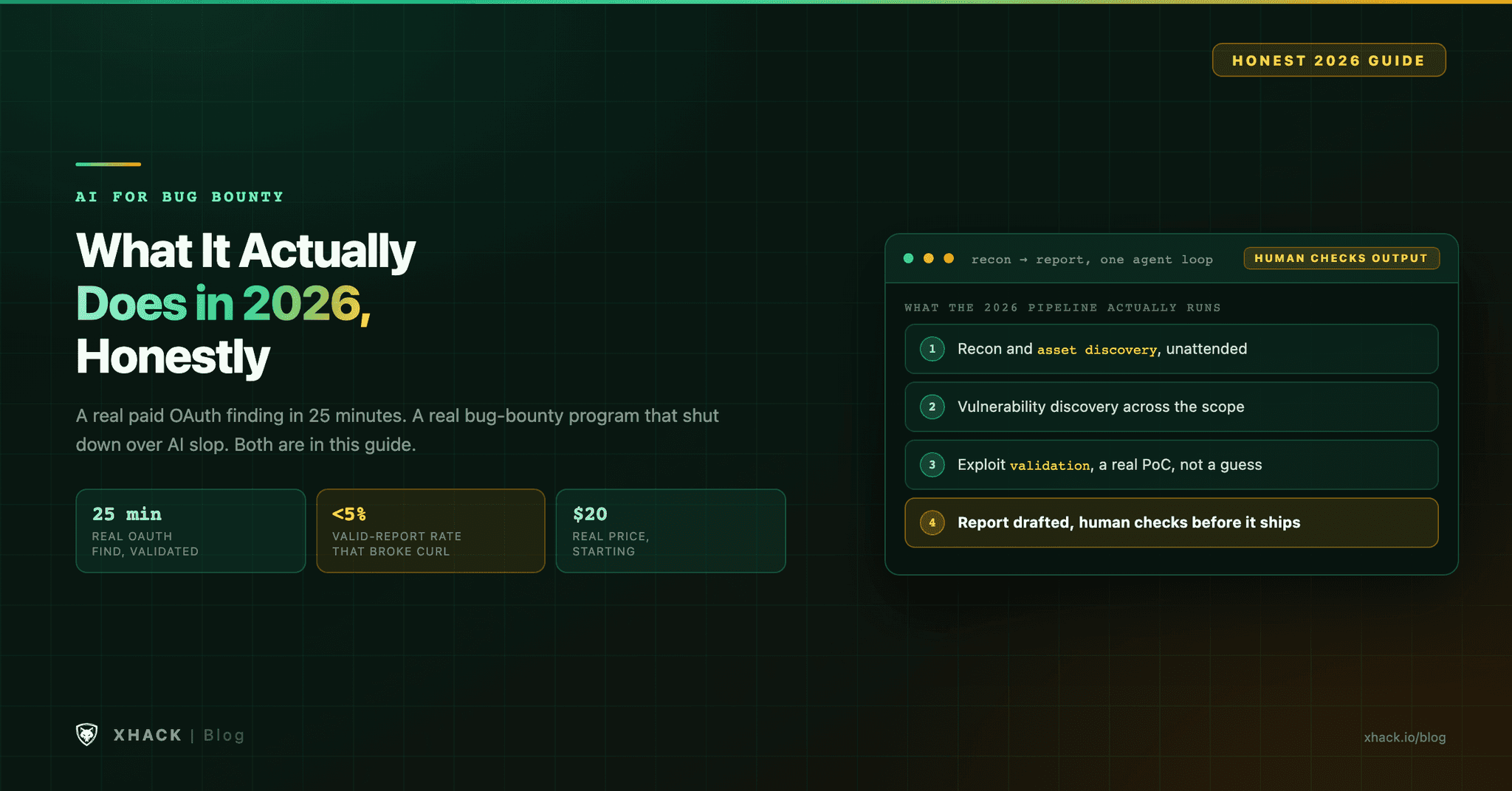
- An AI agent has already found a real, paid bug bounty finding, not a demo. Pointed at a public fintech program with one instruction, “recon, pick your own target, go,” an XHack agent independently found, validated, and packaged a working OAuth credential exposure in 25 minutes for about $5 in compute.
- The same category has a documented failure mode you should know before you trust any tool’s output. curl’s bug bounty program shut down its HackerOne intake in January 2026 after its confirmed-valid report rate collapsed from over 15% to under 5%, flooded by AI-generated submissions that looked plausible and weren’t.
- Pricing in this category ranges from free to enterprise-only, and most of it hides the number until you talk to sales. Real self-serve prices exist (XHack’s $20 Starter plan, Strix’s free open-source CLI, Shannon AI’s free tier); most of the rest, including the tools that top the “best AI pentesting agent” roundups, don’t publish one at all.
- The honest answer to “does AI help bug bounty” is: at recon and breadth, clearly yes; at judgment about what’s actually exploitable, not yet, which is exactly why validation before you submit still has to be a human decision.
Every “AI for bug bounty” article you’ll find is written by a tool trying to sell you the tool. This one names what the tools are actually good at, what they’re not, and what one of them costs.
That matters because the category changed shape in the last year. Chat-based copilots, paste your Burp output in, get a suggestion back, gave way to autonomous agents that run their own recon, chase their own leads, and only stop to hand a human a finding worth checking. That’s a genuinely different thing to evaluate, and most of what’s written about it either oversells the autonomy or undersells what’s actually working.
This guide is the vendor-neutral version: what AI for bug bounty actually does today, a real documented case of an agent finding a paid bug on its own, the honest failure mode the whole category is dealing with right now, what it costs across a few real options, and a checklist for evaluating any tool in this space, XHack included.
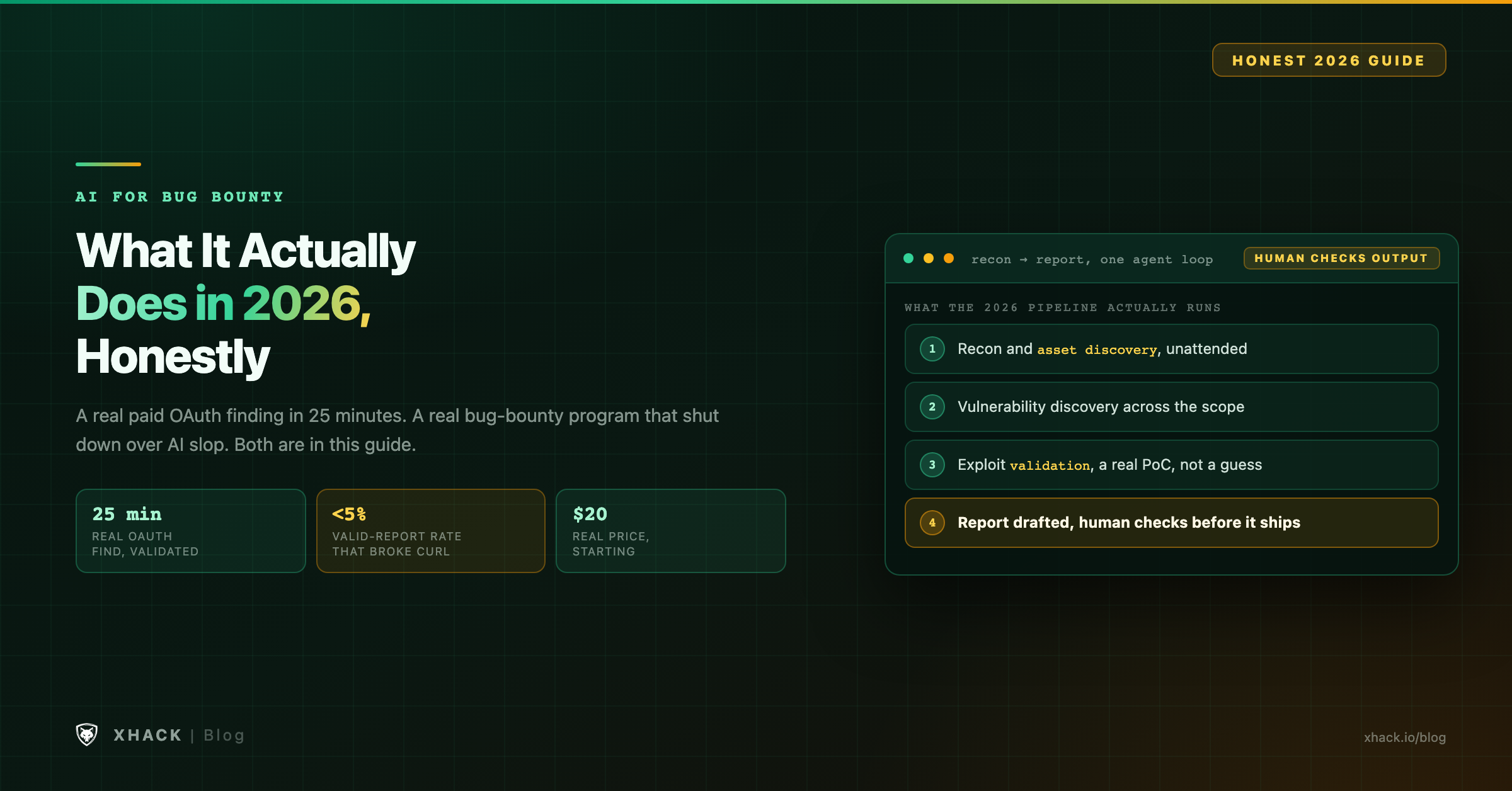
For most of 2024 and 2025, “AI for bug bounty” mostly meant a chat interface: you’d paste a request, an error message, a snippet of JavaScript, and get back a suggestion. Useful, but you were still doing the recon, still deciding what to look at next, still running every tool by hand. The AI was a smarter search bar sitting next to your actual workflow.
The 2026 generation of tools, XHack’s agent included, works differently: point it at a scope and it runs recon, chases findings across that scope on its own, attempts to validate what it finds, and drafts a report, as one continuous loop rather than a series of prompts you drive. In the AI for bug bounty context specifically, the human’s job shifts from “direct every step” to “check the output before it goes anywhere.” That’s the actual shift worth understanding before you evaluate any AI for bug bounty tool, because it changes what you should be asking: not “can it answer my question” but “what does it do when I stop giving it instructions.”
Strip away the marketing and the honest version of an AI for bug bounty pipeline looks like four stages, and the useful question for any tool is how much of each stage it actually runs unattended.
Recon and asset discovery. Subdomain enumeration, endpoint mapping, technology fingerprinting, the breadth work that takes a human hours and doesn’t require much judgment. This is where AI agents are least controversial, because the cost of a false lead here is a few wasted seconds, not a bad report.
Vulnerability discovery. The agent works across whatever it found in recon, looking for the patterns that turn into real findings, exposed credentials, misconfigured auth, injectable parameters. This is where breadth genuinely pays off: an agent can check far more of a large scope than a human working the same hours.
Exploit validation. The stage that actually separates a real finding from noise. A good agent doesn’t just flag “this looks interesting,” it attempts to prove the finding works, a working proof of concept, not a guess. This is also the stage where the category’s honesty problem lives, covered below.
Report drafting. Turning a validated finding into something a triage analyst can act on fast, since a bug bounty report is only as valuable as how quickly and clearly it gets understood.
Here’s what that looks like as an actual result, not a description. Pointed at a public fintech bug bounty program with a single instruction, “recon, pick your own target, go,” an XHack agent independently found, validated, and packaged a working OAuth credential exposure in 25 minutes, for about $5 in compute. That’s a real case, documented in our AI VAPT services guide.
On a live YesWeHack CTF called “Deadbolt,” the same kind of agent solved it fully autonomously in about three minutes, detailed in our full walkthrough of running an AI agent through a bug bounty workflow. If CTF-style practice is more where you’re starting, our guide to AI for CTF covers that separately. Neither of those cases is a demo built to look good. One is a paid finding on a real program, the other is a timed, judged competition.
Here’s the part most “AI for bug bounty” content skips, because most of it is written by someone selling a tool that benefits from you not thinking about this: the validation stage is still the hard part, and the industry has a real, recent, public example of what happens when it’s skipped.
In January 2026, curl’s maintainers shut down new bug-bounty intake through HackerOne entirely. The reason, in their own numbers: the share of submissions that turned out to be real, confirmed vulnerabilities, which had run north of 15% for years, collapsed to under 5%, buried under a flood of AI-generated reports that read convincingly but described bugs that didn’t exist. At the worst point, curl logged runs of 20-plus reports in a single stretch with not one describing a real vulnerability (as reported by Hackaday). curl moved its reporting process to GitHub directly starting February 2026.
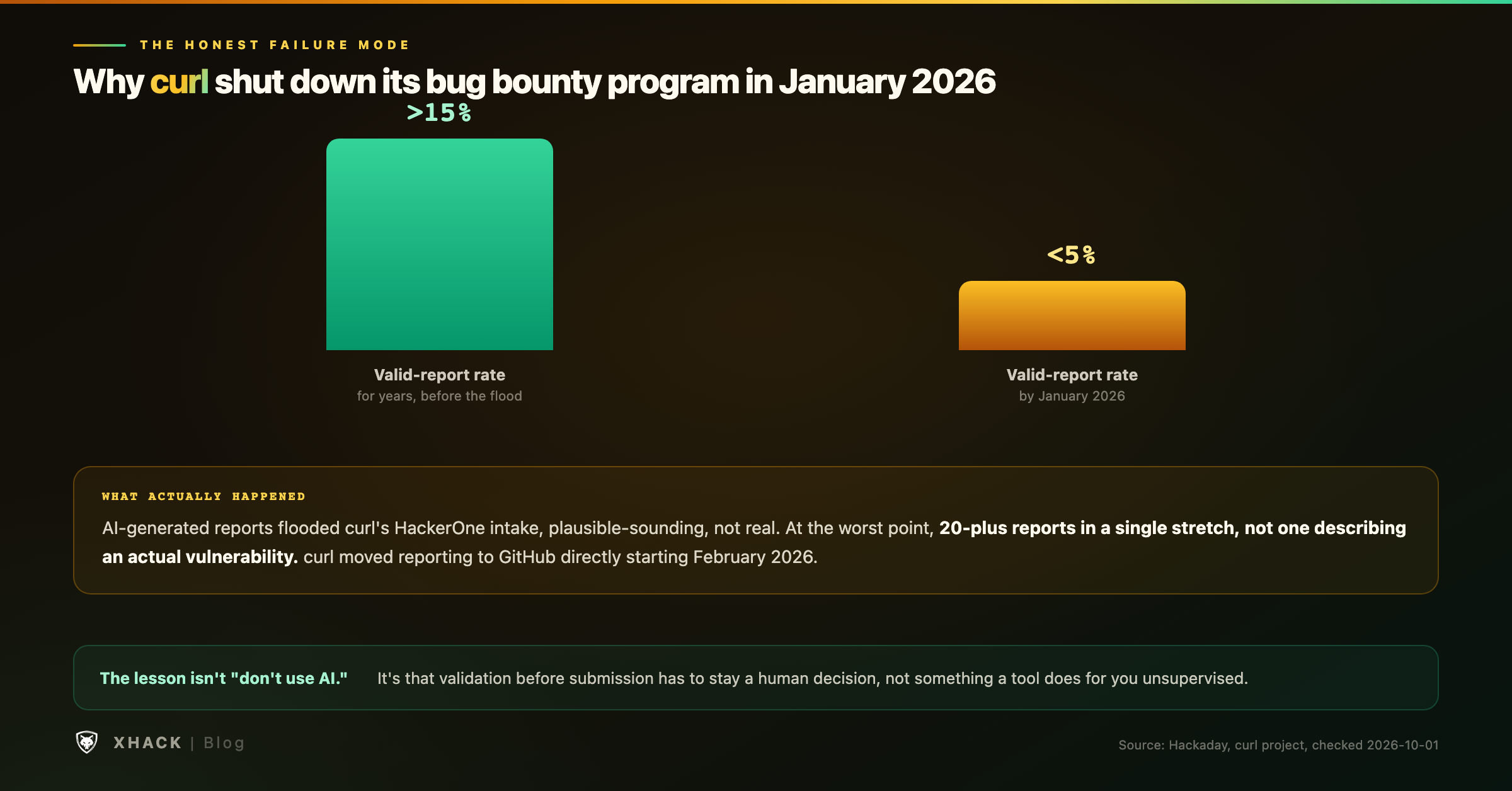
That’s not an argument against using AI for bug bounty. It’s an argument against trusting an AI tool’s claim that it found something without your own check of whether the proof of concept actually holds. The agents worth using are the ones built around that distinction, validation before a human ever sees a “submit” button, not autonomous submission. If a tool’s pitch is “it finds and submits bugs for you,” that’s the part to be skeptical of, not the part to buy.
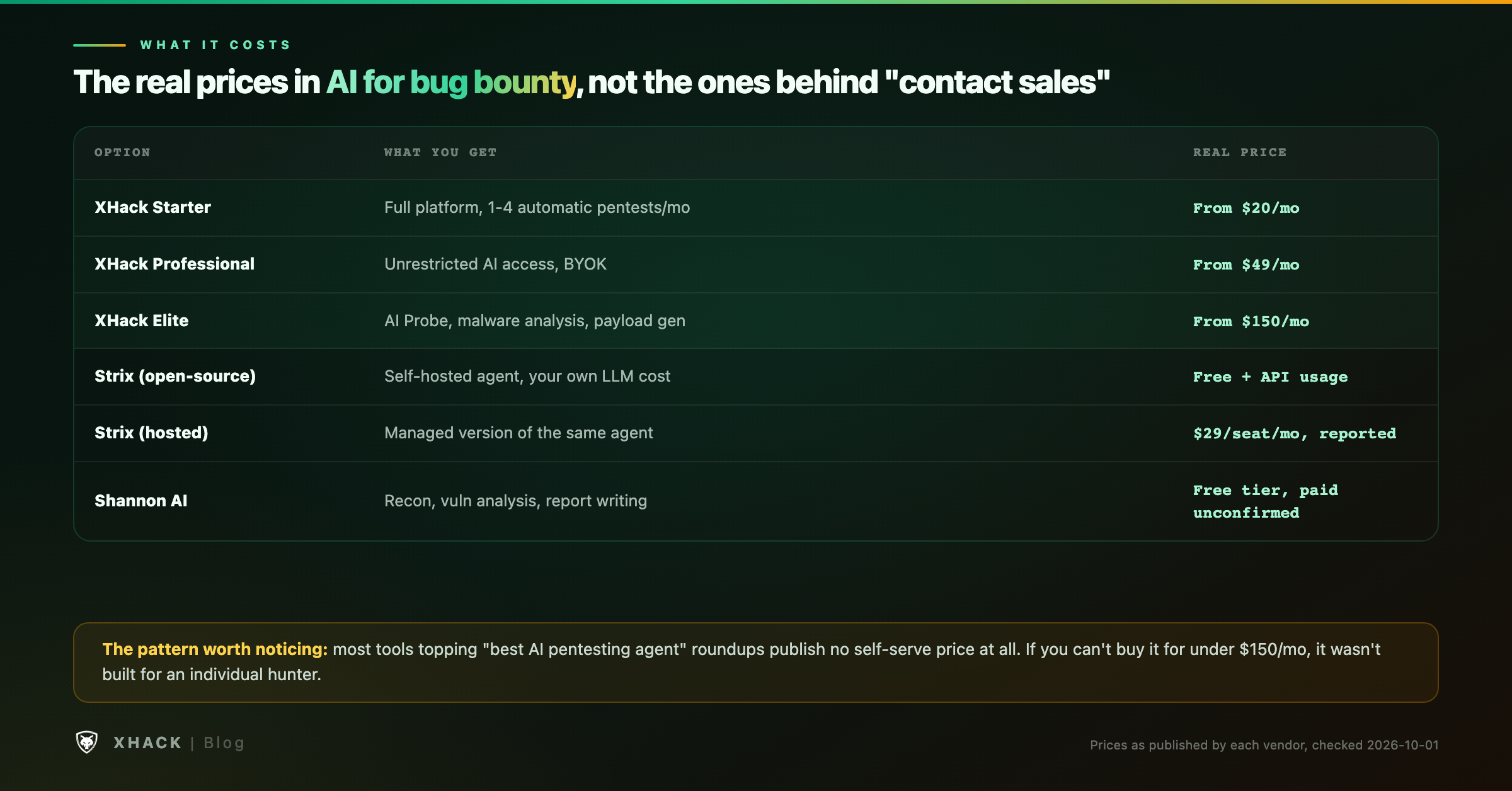
Real, self-serve, published prices for AI for bug bounty are rarer than you’d expect for a category this commercially active. A few worth naming honestly:
| Option | What you get | Real price |
|---|---|---|
| XHack Starter | Full platform, enough for 1-4 automatic pentests a month | $20/month, 7-day free trial, no card required |
| XHack Professional | Same platform, more runway, unrestricted AI access, BYOK | $49/month |
| XHack Elite | Full capability including AI Probe (OWASP LLM Top 10 testing), malware analysis, custom payload generation | $150/month |
| Strix (open-source CLI) | Self-hosted agent, you pay only your own LLM usage | Free, plus whatever your model API costs |
| Strix (hosted) | Managed version of the same agent | $29/seat/month, reported |
| Shannon AI | AI copilot for bug hunters, recon plus vuln analysis plus report writing | Free tier, paid tier price not independently confirmed |
The pattern worth noticing: most of the tools that top “best AI pentesting agent” roundups (the enterprise-facing autonomous platforms, not the ones above) publish no price at all, because they’re not selling to an individual with a credit card. If a comparison piece ranks a tool you can’t actually buy for under $150 a month, it’s not really answering the question an individual bug hunter is asking.
A short, honest AI for bug bounty checklist, the kind of thing most vendor content skips because the answers aren’t always flattering to the vendor writing it:
We’re one AI for bug bounty option in this category, and we’re not the only reasonable one, which is exactly why the table above names real alternatives at real prices instead of pretending they don’t exist.
What we’d say for ourselves: the agent runs the full recon-to-report loop described above, autonomously, with human review sitting between “the agent found something” and “this goes in a report,” not after. The two cases cited in this guide, the OAuth finding and the Deadbolt CTF, aren’t cherry-picked demos, they’re the same agent architecture every plan runs on. Pricing is the table above, starting at $20 a month with a 7-day free trial and no card required to start it. Session data stays local to you; XHack doesn’t retain it.
If you want the deeper, step-by-step walkthrough of what a real engagement looks like with this specific agent, our dedicated guide goes further than this overview has room for. If exploit development specifically, rather than the full bounty workflow, is what you’re evaluating, our guide to AI exploit development covers that stage in depth.
Yes, at recon and breadth, where an agent can cover far more of a scope than a human working the same hours. It’s weaker at the judgment call of what’s actually exploitable, which is why validation before submission should stay a human-checked step, not something you hand off entirely.
Submitting unvalidated findings. curl’s January 2026 decision to shut down HackerOne intake, after its confirmed-valid report rate fell from over 15% to under 5% under a flood of AI-generated submissions, is the clearest public example of what happens when that step gets skipped at scale.
It ranges from free (Strix’s open-source CLI, Shannon AI’s free tier) to $150 a month for a full-capability individual plan (XHack Elite), with most enterprise-facing autonomous platforms publishing no self-serve price at all.
A chatbot answers questions you ask it one at a time. An agent, given a scope, runs recon, chases findings, attempts to validate them, and drafts a report as one continuous process, with a human checking the result rather than steering every step.
Yes. Pointed at a public fintech program with the instruction “recon, pick your own target, go,” an XHack agent independently found, validated, and packaged a working OAuth credential exposure in 25 minutes, documented in our AI VAPT services guide.
No, and this guide names real alternatives at real prices: Strix’s free open-source CLI or $29/seat/month hosted tier, and Shannon AI’s free tier, among others. Evaluate against the checklist in this guide, not against marketing copy, XHack’s included.
AI for bug bounty in 2026 isn’t the chat-assistant novelty it was two years ago, and it isn’t the fully autonomous bug-finding machine some of the marketing implies either. It’s genuinely good at breadth, recon and coverage a human can’t match hour for hour, and still needs a human decision at the one step that actually matters: whether a finding is real before it goes anywhere.
The AI for bug bounty tools worth using are the ones built around that distinction, not against it. Check any AI for bug bounty tool, XHack included, against the five questions above before you pay for one, and treat every “the agent found X” claim the way curl’s maintainers wish more submitters had treated theirs: verified, not just plausible.
Categories
Related articles