Table of contents
13
By Salman Khan, OSCP+, Founder of XHack, SRT (Synack Red Team member)
Read this in 30 seconds: Every “how to become a bug bounty hunter” guide online was written before AI tooling became part of how most researchers actually work, and it shows. This one builds AI into the roadmap from week one instead of pretending it doesn’t exist.
- Most researchers already work this way, even if most guides don’t say so. Per HackerOne’s own 2025 Hacker-Powered Security Report, a majority of its researcher base now uses AI or automation to speed up recon and testing, a pattern HackerOne itself calls the rise of the “bionic hacker.”
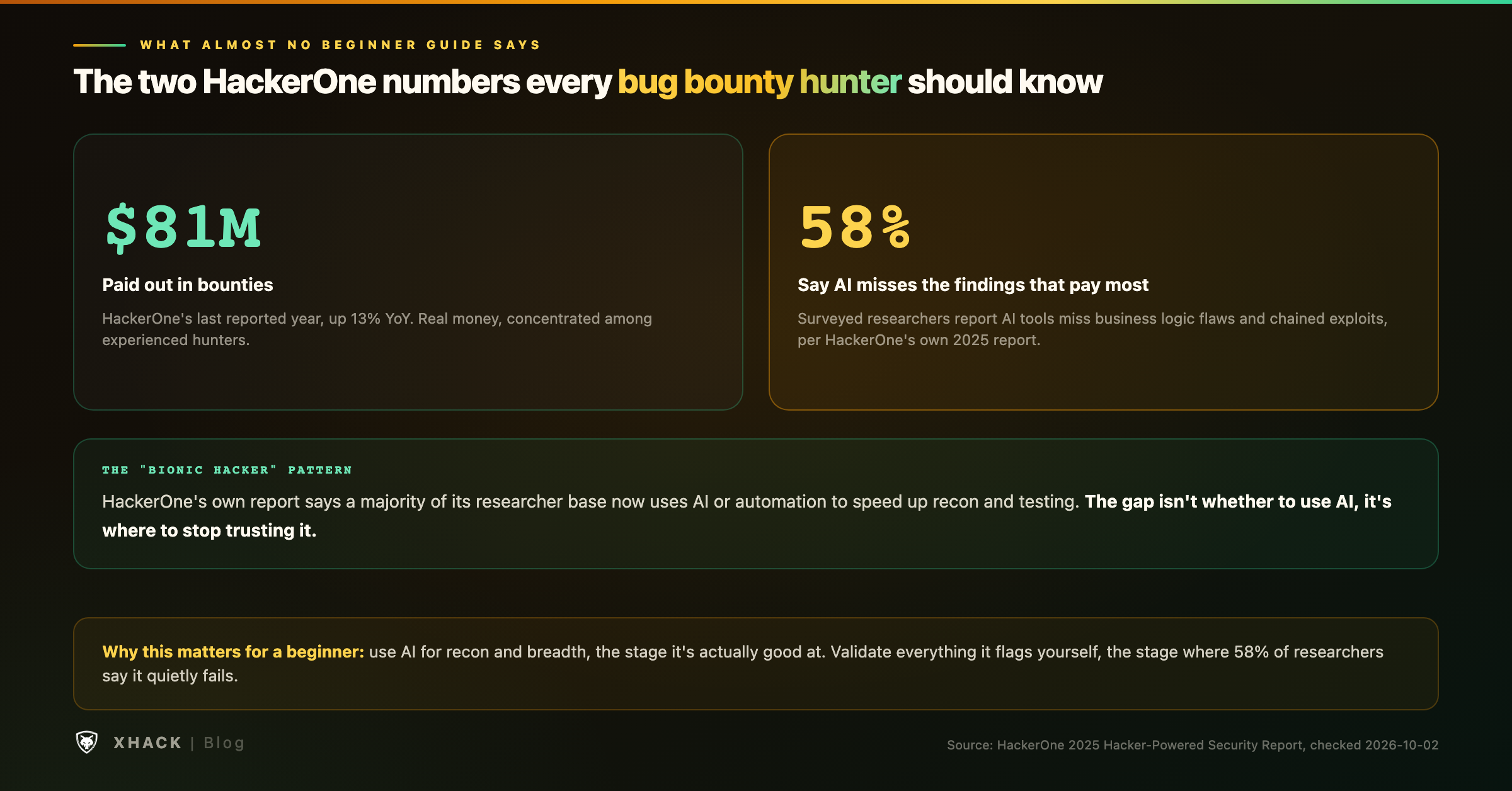
- The same report is honest about where that help stops. 58% of the researchers HackerOne surveyed said AI tools miss business logic flaws and chained exploits, the findings that pay the most. That’s the one number every beginner roadmap should lead with and almost none do.
- The money is real but concentrated. HackerOne paid out $81 million in bounties in its last reported year. Google’s Vulnerability Reward Program paid over $17 million in 2025, a 40% jump from 2024, with a $250,000 top single award. None of that is what a beginner should expect in month one.
- Every competing roadmap teaches the same 2023 playbook. Burp Suite, manual recon, HackerOne or Bugcrowd, grind. Useful, but none of them mention AI tooling at all, not once, which is a strange gap for 2026.
- This roadmap doesn’t skip the fundamentals, it adds a step most guides miss: where an AI agent actually saves you real time at each stage, and where it would cost you a report if you trusted it blindly.
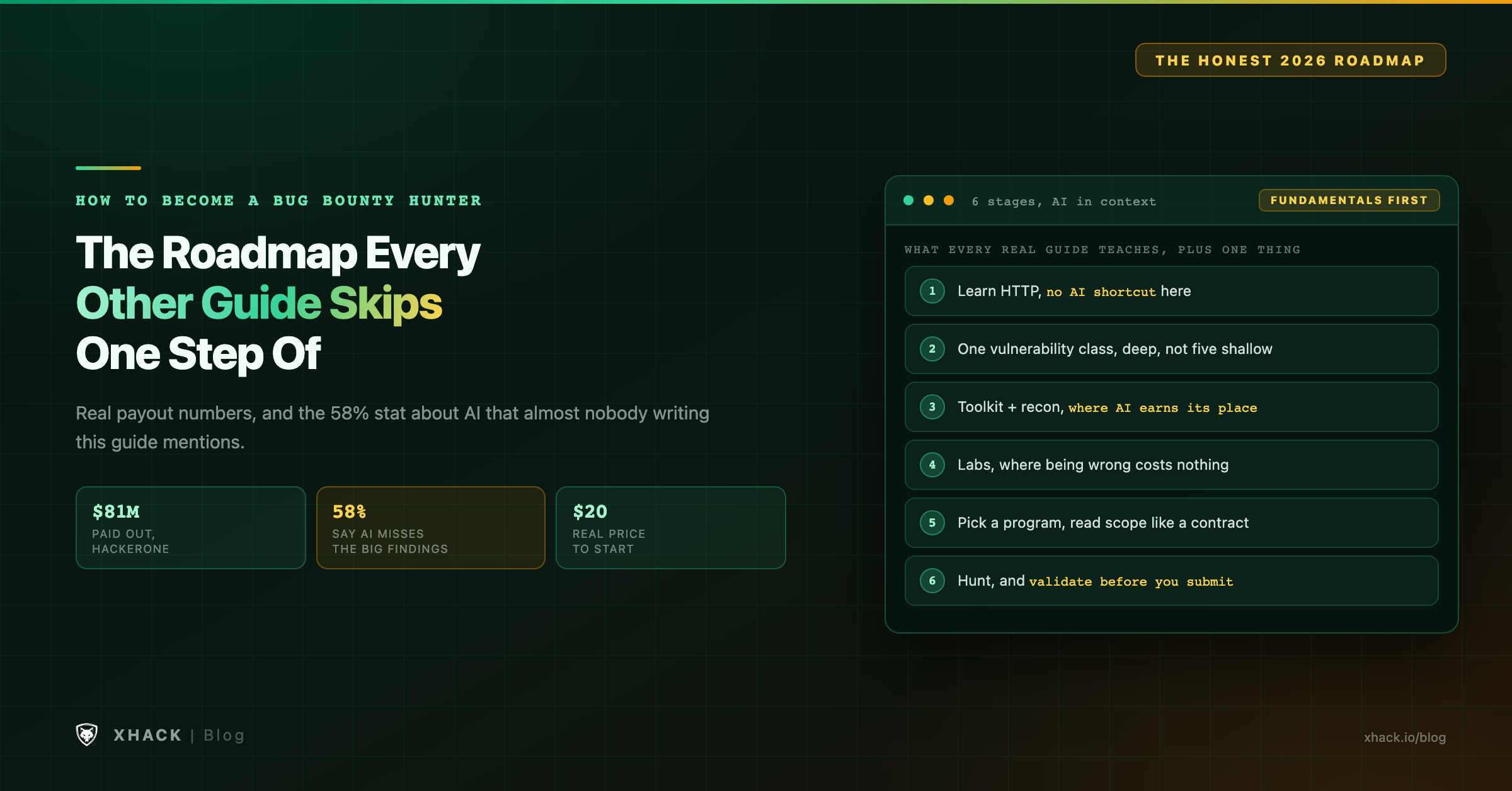
Open any “how to become a bug bounty hunter” guide published this year and you’ll find the exact same six steps someone would have written in 2023: learn HTTP, learn Burp Suite, pick a vulnerability class, practice on labs, pick a platform, grind.
That’s not wrong. It’s just incomplete for 2026, the year HackerOne’s own data says most of its researcher base is already using AI tools to work faster, and the year the same data says those tools still miss the findings that actually pay. A roadmap that doesn’t mention either fact is teaching you to compete with one hand behind your back, or to trust a tool further than its own vendor’s data says you should.
This is the roadmap with both pieces in it: the fundamentals that haven’t changed, and where AI tooling actually fits at each stage, honestly.
Every bug bounty hunter guide eventually gets to money. Here’s the honest version, sourced rather than guessed at.
HackerOne’s 2025 Hacker-Powered Security Report states the platform paid $81 million in bounties in the twelve months it covers, up 13% year over year. Google’s own Vulnerability Reward Program 2025 year in review reports it “awarded over $17 million, an all-time high and more than 40% increase compared to 2024,” to over 700 researchers, with a single top award of $250,000.
Those numbers are real, and they’re also not what a new bug bounty hunter should budget around. They describe a platform-wide total and a handful of top researchers, not a typical first year. Treat bug bounty hunting the way the better guides already frame it: paid skill-building that can turn into real income once you’re good, not a guaranteed replacement for a job from month one.
The number worth sitting with longer is this one, because almost nothing else written about starting bug bounty hunting in 2026 mentions it: per HackerOne’s same report, a majority of its researcher base now uses AI or automation tools to speed up reconnaissance and testing, part of what the report calls the rise of the “bionic hacker.” And in the same survey, 58% of researchers said AI tools miss business logic flaws and chained exploits, the exact category of finding that tends to pay the most. Both of those facts should shape how you use AI tooling from day one, not whether you use it at all.
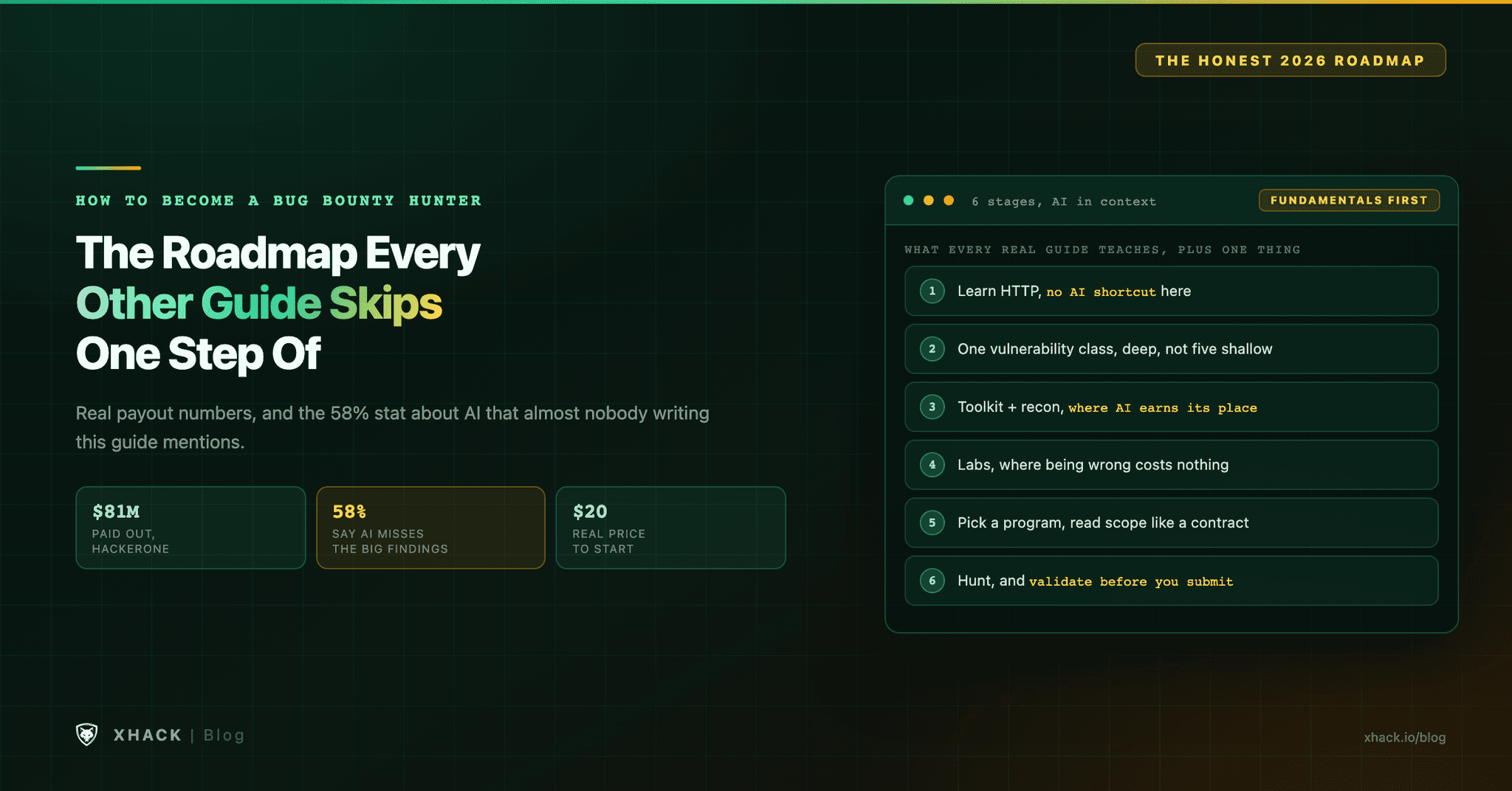
The stages below match what every serious bug bounty hunter roadmap teaches, because the fundamentals haven’t changed. What’s different is naming where AI tooling genuinely helps at each one, and where the 58% blind spot means you still have to do the thinking yourself.
Stage 1: Learn HTTP, not tools. Requests, responses, status codes, cookies, headers, how a browser and a server actually talk to each other. This is the one stage where AI tooling doesn’t help much, because you’re building the mental model everything else depends on. The Web Security Academy’s free labs are still the standard starting point, and no AI agent should be doing this learning for you.
Stage 2: Pick one vulnerability class and go deep. Every bug bounty hunter who makes it past the first few months did this. Not five, one. Broken access control and IDOR is the standard first choice across every competing guide we checked, for a good reason: it’s conceptually simple, extremely common, and doesn’t require deep technical exploitation skill to find, only a careful eye for “whose data is this, and why can I see someone else’s.”
Stage 3: Build your toolkit, and decide where AI fits now. Burp Suite is still non-negotiable, every real guide agrees on this, free or paid. This is also the stage where an AI agent starts earning its place: recon and asset discovery, the breadth work of mapping a large scope, finding subdomains, fingerprinting technology, is exactly where autonomous tooling saves real hours, because the cost of a wrong lead here is seconds, not a bad report. Our pillar guide to what AI actually does well in this category goes deeper into that distinction if you want it before you commit to any specific tool.
Stage 4: Practice where being wrong costs nothing. Intentional lab targets, not live programs, until you can reliably find and explain your chosen vulnerability class without help. This is also a legitimate place to point an AI agent at a lab target and compare its findings against your own, a low-stakes way to learn exactly where it’s strong and where it misses something you’d have caught.
Stage 5: Pick a program, and read the scope like it’s a contract, because it is. Covered in detail below. Scope documentation is the single most common thing beginners skip reading closely, and it’s the fastest way to turn a real finding into a rejected, or worse, legally risky, report.
Stage 6: Hunt one program, systematically, and validate everything before you submit. This is where the 58% number matters most. If an AI agent flags something, that’s a lead, not a finding. Confirm it works, understand why it works, and write the report in your own words. The researchers whose reports get accepted fastest are the ones who can explain the business impact clearly, something a tool that misses chained exploits and business logic by its own vendor’s admission isn’t reliably going to do for you.
The real platforms a new bug bounty hunter actually chooses between, with what distinguishes them rather than a generic “they’re all fine” summary:
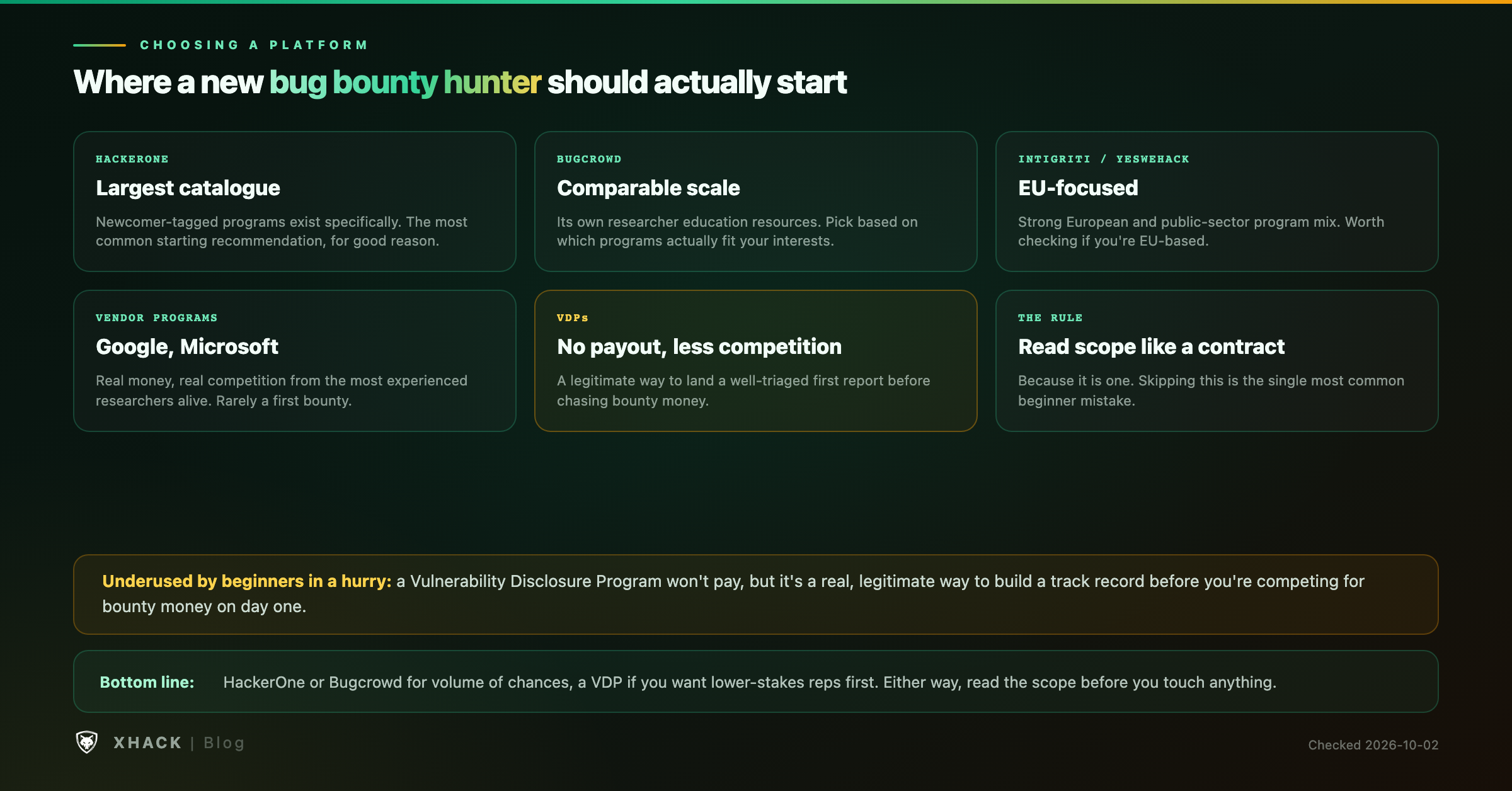
The ones that show up across every program’s own triage feedback and every bug bounty hunter guide we checked, worth naming directly:
Yes, as paid skill-building with a real income ceiling once a bug bounty hunter is good, which is a different claim than “quit your job and do this instead.” The $81 million and $17 million figures above are real money moving through this field every year, and plenty of individual researchers earn real, meaningful income from it. They’re also platform-wide totals concentrated among experienced hunters, not a beginner’s month-one expectation. If you want the fuller, numbers-first answer to what realistic income actually looks like at each experience level, that’s a dedicated piece on its own, this guide is about the path, not the paycheck.
We’re not a bug bounty platform, we don’t run programs, and nothing here is about selling a bug bounty hunter on anything. What we are is a tool a bug bounty hunter following this exact roadmap can use at the stages where it actually helps: recon and asset discovery at Stage 3, and lab comparison at Stage 4, with the validation discipline from Stage 6 built into how the agent works rather than fought against.
Starter plans begin at $20 a month with a 7-day free trial and no card required to start one. Our full walkthrough of an AI agent running a real bug bounty workflow shows what that actually looks like end to end. Our pillar guide on AI for bug bounty covers what the tool actually does and doesn’t do, honestly, including the same validation problem this roadmap keeps coming back to.
No guide, including this one, has a reliable, sourced number for time-to-first-bounty, and treat any guide that gives you a specific one with suspicion. It depends heavily on your existing technical background and how much time you put in. Months of focused practice before a first accepted report is a realistic expectation for most new bug bounty hunters starting from general technical knowledge, not web security specifically.
Not to start. You need to be able to read code well enough to understand what a request or response is doing, and to understand HTTP deeply. Writing your own exploit scripts becomes more useful as you advance, but it isn’t a prerequisite for finding and reporting your first valid vulnerability.
For recon and breadth, yes, it’s one of the places AI tooling genuinely saves time. For deciding whether something is a real, reportable finding, no, not unsupervised. HackerOne’s own 2025 data found that 58% of surveyed researchers say AI tools miss business logic flaws and chained exploits, exactly the findings that pay the most, so validation has to stay a step you do yourself.
Broken access control, including IDOR, is the standard recommendation across essentially every serious guide in this space, this one included. It’s common, conceptually straightforward to understand, and doesn’t require advanced exploitation skill to find reliably.
HackerOne or Bugcrowd, for the sheer volume of programs and newcomer-tagged options, are the most common starting recommendations. Vulnerability Disclosure Programs are a legitimate, lower-competition alternative worth more consideration than most beginners give them.
The fundamentals of becoming a bug bounty hunter haven’t changed: learn HTTP, master one vulnerability class, practice where mistakes are free, pick a program, read the scope like a contract, hunt systematically. What’s changed is that most of your future competition, per HackerOne’s own numbers, is already using AI tooling to move faster through the recon and breadth work, and the same data says that tooling reliably misses the findings worth the most.
Learn the fundamentals the way every real bug bounty hunter guide teaches them. Use AI tooling where it actually saves you time, recon and breadth, not judgment. And validate everything yourself before it goes in a report, because a tool’s vendor telling you it misses 58% of the hard findings is not a number you want to find out about the hard way, with a rejected report and a program that remembers your name for the wrong reason.
Categories
Related articles