Table of contents
13
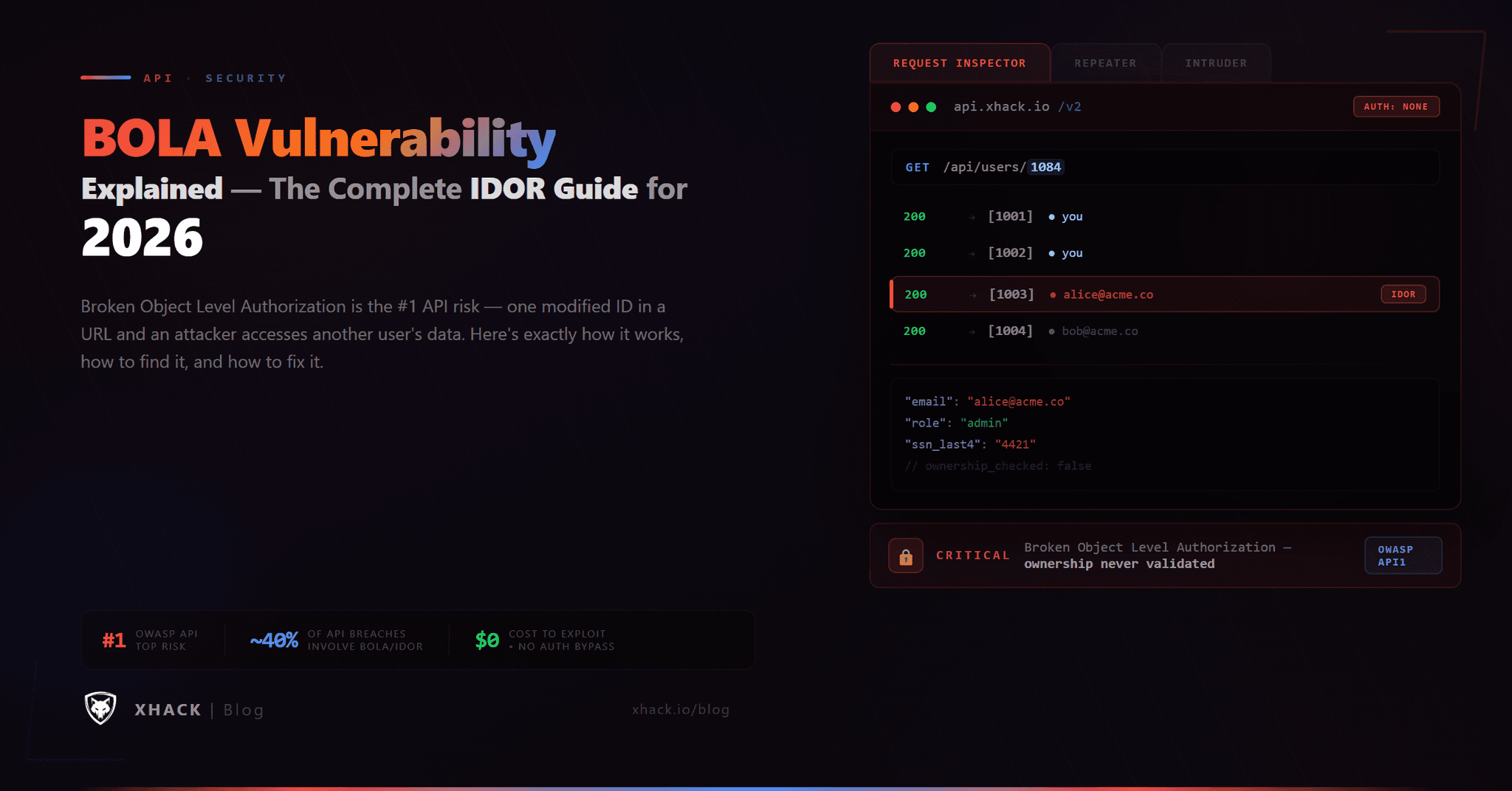
Read this in 30 seconds: A BOLA vulnerability (Broken Object Level Authorization) happens when an API checks that you’re logged in but never checks that the data you’re asking for actually belongs to you. Change the ID in a request, get someone else’s data. It’s the number one risk on the OWASP API Security Top 10 and shows up in roughly 40% of all API attacks. IDOR (Insecure Direct Object Reference) is the older, broader name for the same idea, and BOLA is its API-specific form. This guide explains how a BOLA vulnerability works, why scanners miss it, how to test for it step by step, and how to fix it for good.
The most dangerous API vulnerability in the world is also the most boring. It’s just changing a number in a request.
No exotic exploit. No buffer overflow. No clever payload. An attacker changes /api/users/1001 to /api/users/1002 and reads someone else’s account. That’s it. That’s the whole attack.
This is a BOLA vulnerability, and it sits at number one on the OWASP API Security Top 10 because it’s everywhere, it’s trivial to exploit, and it’s responsible for some of the largest data breaches of the past few years. Roughly 40% of all API attacks involve this single class of flaw. If you only learn about one API vulnerability, make it this one.
The frustrating part is that a BOLA vulnerability is conceptually simple to understand and simple to fix, yet it remains the most common API security problem in 2026. The reason it persists isn’t that it’s hard to prevent. It’s that preventing it requires a check on every single endpoint, and in fast-moving development, that one check gets forgotten over and over.
This guide explains exactly how a BOLA vulnerability works, how it relates to the older term IDOR, why automated scanners miss it, how to test for it yourself, and how to fix it permanently.
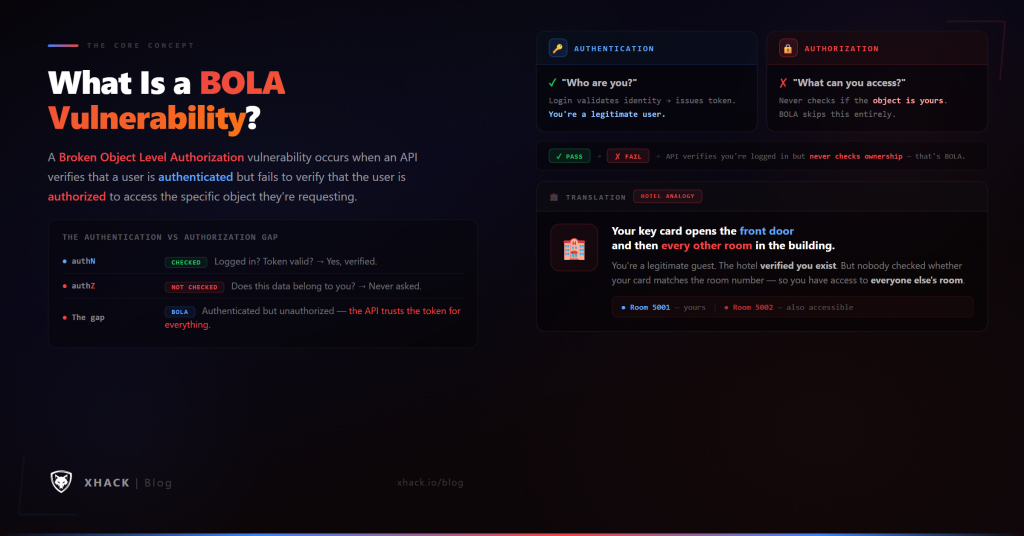
A BOLA vulnerability, short for Broken Object Level Authorization, occurs when an API verifies that a user is authenticated but fails to verify that the user is authorized to access the specific object they’re requesting.
Let’s break that down, because the distinction between authentication and authorization is the entire heart of the problem.
Authentication answers “who are you?” When you log in, the API confirms your identity and gives you a token. From that point on, the API knows you’re a legitimate, logged-in user.
Authorization answers “what are you allowed to access?” This is the check that a BOLA vulnerability skips. The API confirms you’re logged in, but when you request a specific piece of data, it never checks whether that data actually belongs to you.
Here’s the practical version. You log into an app and view your order at /api/orders/5001. The app authenticated you, so it returns the order. But what happens if you change the request to /api/orders/5002? If the API returns that order too, even though it belongs to a different customer, you’ve just found a BOLA vulnerability. The API checked that you were logged in but never checked that order 5002 was yours.
Translation: a BOLA vulnerability is like a hotel where your key card opens the front door, and then every other room in the building, because nobody bothered to check whether your card matches the room number. You’re a legitimate guest. You just have access to everyone else’s room.
If you’ve been in security for a while, you probably know this attack by a different name: IDOR, or Insecure Direct Object Reference. The relationship between BOLA and IDOR confuses a lot of people, so let’s clear it up.
IDOR is the older, broader term. It describes any situation where an application exposes a direct reference to an internal object, like a database ID, file name, or key, and an attacker manipulates that reference to access objects they shouldn’t. IDOR has been on security radars for well over a decade and applies to web applications broadly.
BOLA is the term the OWASP API Security Project chose to describe this same class of flaw specifically in the context of APIs. When OWASP built its API Security Top 10, it used “Broken Object Level Authorization” to emphasize that the root cause is a failure of authorization at the object level, not just an exposed reference.
So are they the same thing? Essentially, yes, with a subtle distinction. IDOR describes the symptom: a direct object reference that can be manipulated. BOLA describes the root cause: missing object-level authorization. A BOLA vulnerability is what causes an IDOR. In practice, the terms are used almost interchangeably, with IDOR being the classic web application term and BOLA being the modern API-focused one.
The important takeaway is that whether someone says IDOR or BOLA vulnerability, they’re pointing at the same underlying problem: the application isn’t checking that the user owns the object they’re trying to access. Don’t get hung up on the terminology. Focus on the fix, which is the same for both.
A BOLA vulnerability earns its number-one spot for several reasons that compound each other.
It’s trivial to exploit. There’s no special skill required. Anyone who can use browser developer tools or a simple proxy can change an ID in a request and see what comes back. The barrier to entry is almost nonexistent.
It’s easy to automate. This is what turns a single exposed record into a massive breach. An attacker writes a simple script that iterates through IDs, harvesting thousands or millions of records belonging to other users. A BOLA vulnerability that exposes one record exposes all of them once automated.
It exposes the most sensitive data. BOLA vulnerabilities directly expose user data: personal information, financial records, private messages, health data, whatever the API serves. Because the attacker is accessing real user objects, the impact is immediate and severe.
It’s invisible to most defenses. The requests look completely legitimate. The attacker is authenticated, the requests are well-formed, and each one looks like a normal user accessing data. Traditional security tools see authorized-looking traffic and wave it through.
It’s incredibly common. Because preventing a BOLA vulnerability requires an authorization check on every endpoint that accesses an object, and developers building dozens of endpoints inevitably miss some, these flaws are pervasive. Studies consistently find that a large share of APIs have at least one BOLA vulnerability somewhere.
Put those factors together and you get the perfect storm: a flaw that’s easy to find, easy to exploit at scale, exposes sensitive data, evades defenses, and exists almost everywhere. That’s why a BOLA vulnerability is the API risk that matters most.
Here’s the uncomfortable truth that catches many teams off guard: you can run an API vulnerability scanner, get a clean report, and still have a critical BOLA vulnerability sitting wide open.
The reason is fundamental. Detecting a BOLA vulnerability requires understanding your application’s authorization model, which objects should belong to which users, and that’s context a scanner doesn’t have. A scanner can check whether an endpoint requires authentication. It cannot easily determine whether the authenticated user should be allowed to access object 5002 specifically, because it doesn’t know who owns object 5002 or what the intended access rules are.
Automated tools that try to find BOLA vulnerabilities typically work through filtered word lists and pattern matching rather than genuine reasoning about access control. They look for ID-like parameters and try manipulating them, but they can’t reliably tell the difference between legitimate access and a real authorization violation, because that determination requires understanding intent.
This is exactly why the OWASP API Security Project and security researchers consistently recommend manual testing for BOLA vulnerabilities. A skilled human tester understands the application’s access model, sets up two test accounts, and verifies whether one account can access the other’s objects. That reasoning about what should and shouldn’t be allowed is something automated tools can’t reliably replicate.
The practical implication: if your API security strategy is “we run a scanner,” you are almost certainly not catching your BOLA vulnerabilities. The most dangerous API flaw is precisely the one automation misses.
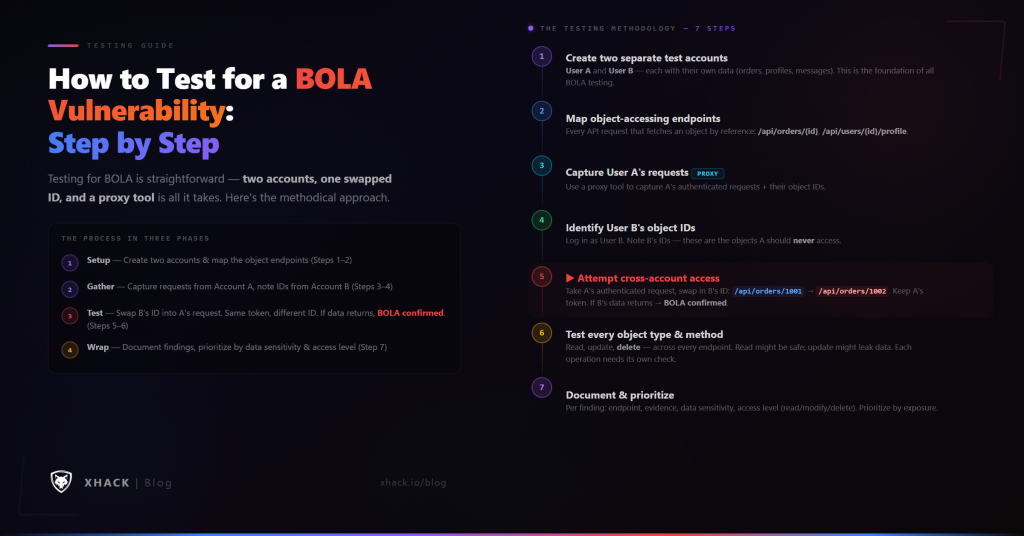
Testing for a BOLA vulnerability is straightforward in concept and something every team should do. Here’s the methodical approach a tester uses.
Step 1: Create two separate test accounts. Set up two distinct user accounts in the application, call them User A and User B. Each should have its own data: orders, profile, messages, whatever the application manages. This two-account setup is the foundation of BOLA testing.
Step 2: Map the endpoints that access objects. Using the application normally as User A, identify every API request that fetches or modifies a specific object by reference. Look for endpoints with IDs in the path or parameters, like /api/orders/{id}, /api/users/{id}/profile, or requests containing object identifiers.
Step 3: Capture User A’s requests. Use a proxy tool to capture the requests User A makes to access their own objects. Note the object IDs that belong to User A and the authentication token User A uses.
Step 4: Identify User B’s object IDs. Log in as User B and note the IDs of objects that belong to User B. These are the objects User A should never be able to access.
Step 5: Attempt cross-account access. This is the actual test. Take User A’s authenticated request and swap in User B’s object ID, keeping User A’s authentication token. Send the request. If the API returns User B’s data to User A, you’ve confirmed a BOLA vulnerability. The API authenticated User A but failed to check that the requested object belongs to them.
Step 6: Test every object type and method. Don’t stop at one endpoint. Test reading, updating, and deleting across every object type the API exposes. A BOLA vulnerability might exist on the update endpoint even if the read endpoint is properly protected. Each operation needs its own check.
Step 7: Document and prioritize. For every confirmed BOLA vulnerability, document the endpoint, the evidence, and the sensitivity of the exposed data. Prioritize based on what data is exposed and whether the access allows reading, modifying, or deleting other users’ data.
The good news is that fixing a BOLA vulnerability is conceptually simple. The challenge is doing it consistently on every endpoint. Here’s how.
Enforce object-level authorization on every endpoint. This is the core fix. Every time an API accesses an object, it must verify that the authenticated user is authorized to access that specific object. Don’t just check that the user is logged in. Check that the object they’re requesting belongs to them or that they have explicit permission to access it. This check must happen server-side, on every request, for every object.
Never rely on obscurity. Some teams think using hard-to-guess IDs like UUIDs instead of sequential numbers solves the problem. It doesn’t. Obscurity is not authorization. Attackers harvest UUIDs from other responses, referrer headers, and logs. A BOLA vulnerability protected only by unpredictable IDs is still a BOLA vulnerability. Use proper authorization checks, and treat unpredictable IDs as a minor defense-in-depth measure at best.
Use a consistent authorization mechanism. Rather than writing ad-hoc authorization logic on each endpoint, which guarantees some will be forgotten, implement a centralized, consistent authorization layer that every endpoint uses. This makes it much harder to accidentally ship an endpoint without the check.
Test continuously. Because a BOLA vulnerability can be introduced any time a developer adds a new endpoint, authorization testing should be part of your ongoing process, not a once-a-year event. Build BOLA testing into your development and review workflow so new endpoints get checked as they ship.
Bring in manual testing for critical APIs. Since automated tools miss BOLA vulnerabilities, dedicated manual API penetration testing is essential for APIs handling sensitive data. This is where specialized testing earns its value. At XHack, our API security testing focuses precisely on the authorization flaws like BOLA that scanners can’t reliably catch, combining automated coverage with the human reasoning these vulnerabilities require. Whether you test in-house or bring in a provider, make sure someone is actually verifying object-level authorization, because a scanner alone won’t.
They describe the same underlying flaw with slightly different emphasis. IDOR (Insecure Direct Object Reference) is the older, broader term describing any manipulable reference to an internal object. BOLA (Broken Object Level Authorization) is the term OWASP uses for this flaw specifically in APIs, emphasizing the root cause: missing object-level authorization. A BOLA vulnerability is essentially what causes an IDOR. In practice the terms are used almost interchangeably, with IDOR being the classic web term and BOLA being the modern API-focused one. The fix is identical for both.
A BOLA vulnerability ranks number one because it combines several dangerous traits: it’s trivial to exploit, easy to automate into a large-scale breach, exposes sensitive user data directly, looks like legitimate traffic so it evades defenses, and is extremely common because preventing it requires an authorization check on every single endpoint. Roughly 40% of all API attacks involve this class of flaw. It has held the top spot since the list’s inception because object-level authorization remains difficult to implement consistently across every endpoint in fast-moving development.
Generally no, not reliably. Detecting a BOLA vulnerability requires understanding your application’s authorization model, specifically which objects should belong to which users, and scanners don’t have that context. They can find ID-like parameters and try manipulating them, but they can’t reliably distinguish legitimate access from a real authorization violation because that requires reasoning about intent. This is why manual testing with multiple accounts is the recommended approach for finding BOLA vulnerabilities. A clean scanner report does not mean your API is free of them.
Enforce object-level authorization on every endpoint that accesses an object, verifying server-side that the authenticated user actually owns or has permission to access the specific object requested. Never rely on hard-to-guess IDs as your only protection, because obscurity is not authorization. Use a consistent, centralized authorization mechanism so endpoints can’t accidentally ship without the check, and test continuously since any new endpoint can introduce a BOLA vulnerability. For APIs handling sensitive data, add manual penetration testing because automated tools miss these flaws.
This distinction is the heart of a BOLA vulnerability. Authentication confirms who you are, like logging in and receiving a token. Authorization confirms what you’re allowed to access. A BOLA vulnerability happens when an API handles authentication correctly, confirming you’re a legitimate logged-in user, but fails at authorization, never checking whether the specific object you requested belongs to you. The attacker is genuinely authenticated, which is exactly why the attack looks legitimate and slips past defenses. The fix is adding the missing authorization check on every object access.
That’s everything you need to understand about the BOLA vulnerability, the most common and most dangerous API flaw of 2026.
The attack is almost insultingly simple: change an ID, get someone else’s data. But that simplicity is exactly what makes a BOLA vulnerability so dangerous. It’s trivial to exploit, easy to automate into a massive breach, and invisible to the scanners most teams rely on. It sits at number one on the OWASP API Security Top 10 for good reason.
The fix is equally clear, even if it takes discipline: enforce object-level authorization on every endpoint, never trust obscurity, and test continuously with real accounts because automation won’t catch what humans can. If your API handles sensitive data, make sure someone is actually testing for BOLA vulnerabilities rather than assuming a clean scan means you’re safe.
The hotel that gives every guest a key to every room eventually has a very bad day. Check the room number. Every time.
Follow Us on X: @xhackio
Related articles