Table of contents
17
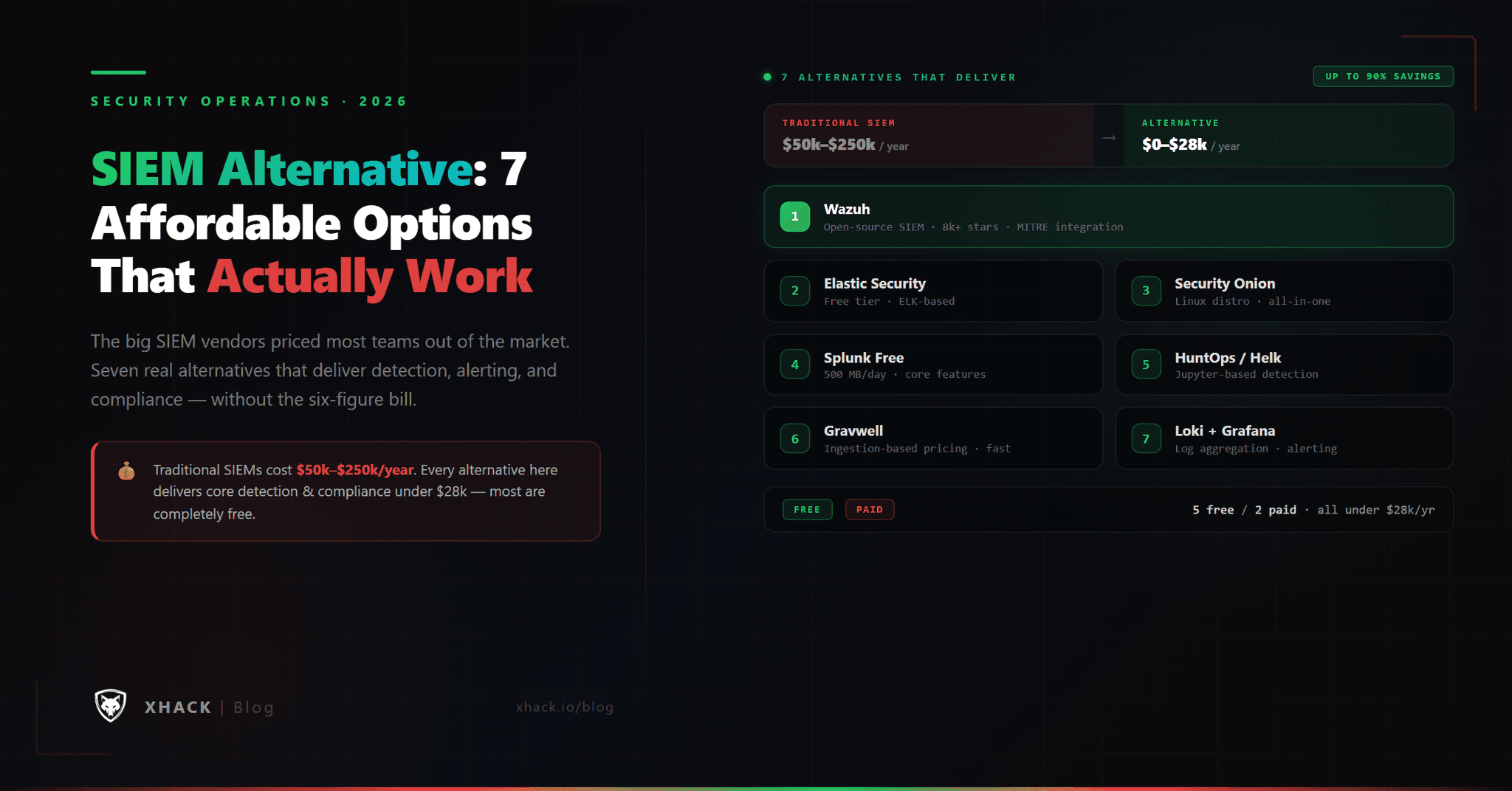
Read this in 30 seconds: The traditional enterprise SIEM priced you by data volume until your budget screamed, then required a specialist to operate. The good news for 2026 is that real SIEM alternatives exist at every budget. Open-source options like Wazuh, Graylog, Security Onion, and the ELK Stack give you power for free if you have the expertise to run them. SMB-friendly platforms like Blumira and AI-driven options like XHack SOC give you predictable pricing and easy operation without the staffing burden. This guide compares seven affordable SIEM alternatives honestly, including where each one shines and where it falls short, so you can pick the right fit for your team and budget.
The traditional enterprise SIEM is one of the most hated products in all of cybersecurity, and for good reason.
It prices you by data volume, so the more you log, the more you bleed. It takes months to deploy. And once it’s running, it generates thousands of alerts that require a specialist you can’t afford to make sense of.
For years, small and mid-sized teams had two bad options: pay enterprise SIEM prices they couldn’t afford, or go without security monitoring entirely. Neither worked. The data-volume pricing model in particular created a brutal trap, forcing teams to choose between logging everything and blowing the budget, or logging selectively and creating blind spots.
The good news is that in 2026, a genuine SIEM alternative exists for every budget and skill level. The market splintered into open-source platforms you can run for free, SMB-friendly products with predictable pricing, and AI-driven options that do the heavy lifting so a small team can actually keep up. The catch is that they’re wildly different from each other, and picking the wrong one wastes months.
This guide compares seven affordable SIEM alternatives honestly. Not a vendor puff piece where everything is amazing, but a real look at where each one shines and where it falls short, so you can find the SIEM alternative that fits your actual team.
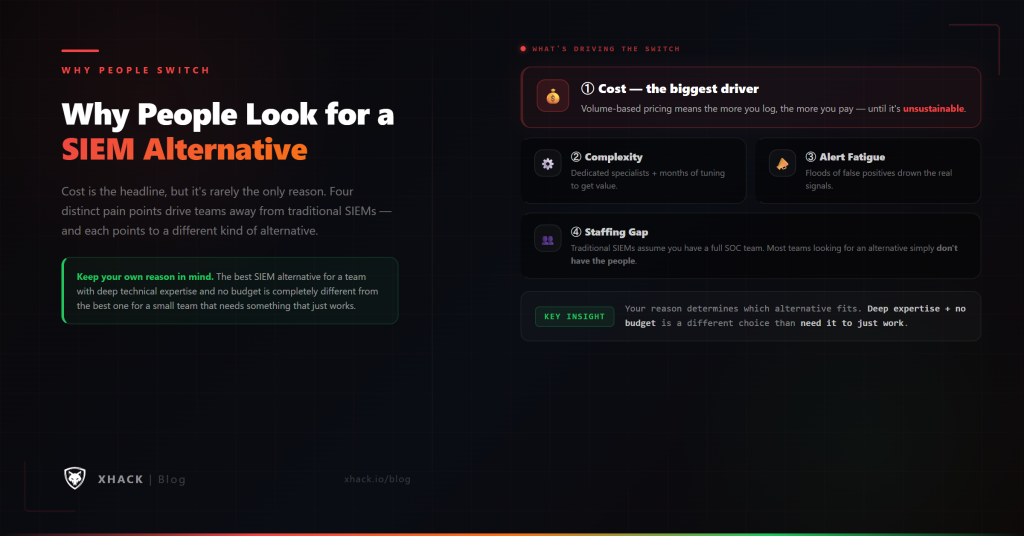
Before the options, it’s worth being clear about what’s actually driving people away from traditional SIEMs, because the reason determines which alternative fits.
Cost. This is the big one. Traditional enterprise SIEMs priced by data volume become eye-wateringly expensive as you log more. A SIEM alternative with predictable pricing solves the budget anxiety that volume-based billing creates.
Complexity. Enterprise SIEMs are notoriously hard to deploy and operate, often requiring dedicated specialists and months of tuning. Teams seek a SIEM alternative that they can actually run without hiring a security engineering team.
Alert fatigue. Traditional SIEMs generate floods of alerts, most of them false positives, that small teams can’t process. A modern SIEM alternative that uses AI to triage and prioritize is the answer to drowning in noise.
Staffing. A traditional SIEM assumes you have analysts to operate it. Many teams looking for a SIEM alternative simply don’t have the people, and need something that works without a full SOC team.
Keep your own reason in mind as you read. The best SIEM alternative for a team with deep technical expertise and no budget is completely different from the best one for a small team that needs something that just works.
Wazuh is the most complete open-source SIEM available, and for teams with the technical expertise to run it, it’s a genuinely powerful SIEM alternative at zero licensing cost. It combines SIEM and XDR capabilities, deploying lightweight agents across Windows, Linux, and macOS to collect data, monitor file integrity, detect intrusions, and assess vulnerabilities.
What makes Wazuh stand out is its completeness. It ships with native compliance templates for PCI DSS, HIPAA, and GDPR, active response that can automatically block IPs or disable accounts, and deep endpoint visibility through its agent-based architecture. For an organization with 50 to 200 endpoints and someone willing to learn it, Wazuh delivers commercial-grade capability for free.
The catch is the operational burden. Wazuh is consistently flagged for a steep learning curve and demanding configuration. It needs in-house security expertise to deploy and tune, and it can struggle when handling large alert volumes. Free in licensing does not mean free in effort. You pay with time and skill instead of money.
Best for: Technically capable teams that want deep endpoint visibility and built-in compliance, and have the expertise to run it.
Where Wazuh leads with endpoint agents, Graylog leads with logs. It’s a centralized log management platform with a security-focused tier, built around collecting, parsing, indexing, and searching logs at scale. If your core problem is “we have logs everywhere and no way to use them,” Graylog is the SIEM alternative built for exactly that.
Graylog’s search and ingestion experience is smoother and faster to operate than many alternatives, with a polished interface and broad protocol support. The open-core version gives you a solid foundation, and the platform now includes AI features that summarize dashboards and prioritize real risks. It serves more than 60,000 organizations worldwide, so it’s battle-tested.
The tradeoffs: some of the most security-relevant features live in the paid Graylog Security tier rather than the free version. It ships with less security content out of the box than Wazuh, so you supply more detection rules yourself. And it’s not an EDR, so it won’t give you the endpoint agent capabilities Wazuh does. Setup is also tricky for newcomers.
Best for: Teams whose primary need is making sense of high-volume log data across diverse infrastructure.
Security Onion is a free, open-source platform that bundles SIEM, network security monitoring, and threat hunting into one batteries-included stack. If you have a network to defend and people to watch it, Security Onion gives you network and host detection together, ready to run.
It combines respected open-source tools into a cohesive distribution purpose-built for threat hunting and enterprise security monitoring. For teams that want network-level visibility alongside host detection, this SIEM alternative delivers a comprehensive detection stack without licensing costs.
The honest caveat is the same as the other open-source options: it’s free in dollars but expensive in expertise and effort. Security Onion shines when you have analysts to operate it and a network worth the depth of monitoring it provides. For a team that just wants endpoint and compliance coverage, it’s heavier than you need.
Best for: Teams with network monitoring needs and the analysts to operate a full detection stack.
The ELK Stack (Elasticsearch, Logstash, Kibana) and Elastic Security give you the raw platform that many other SIEM tools, including Wazuh, are built on top of. Used directly, Elastic Security provides a free tier with SIEM detection rules, a detection engine, and an endpoint agent.
The appeal of this SIEM alternative is flexibility and power. If you already live in Elasticsearch and Kibana, building your security monitoring directly on the stack gives you enormous control and scalability, capable of handling massive data volumes. Official detection content and a maintained agent make it a legitimate security platform, not just a logging tool.
The cost is the do-it-yourself factor. The ELK Stack requires real engineering effort to assemble into a functioning SIEM. You configure the parsing, build the visualizations, and maintain the infrastructure. It’s the most flexible SIEM alternative on this list and also the one that demands the most hands-on engineering.
Best for: Engineering-heavy teams already using Elasticsearch who want maximum flexibility and control.
Blumira takes a deliberately different approach from the open-source tools. It’s built specifically for IT teams that aren’t security specialists, bundling SIEM, endpoint monitoring, and automated detection and response into a platform designed for fast deployment and easy operation.
What makes Blumira a strong SIEM alternative for small teams is the focus on removing burden rather than adding capability. It deploys quickly with no lengthy warm-up period, offers predictable pricing with unlimited data ingest rather than volume-based billing, provides prioritized findings curated by security engineers, and includes pre-built reports and response playbooks. Real-time alerts arrive fast, and the platform handles much of the manual alert analysis that overwhelms small teams.
The tradeoff is that you’re trading some of the deep customizability of the open-source options for ease of use. If you want total control over every detection rule, a managed-feeling platform may feel constraining. But for an IT team that needs working security monitoring without becoming SIEM experts, that tradeoff is usually worth it.
Best for: IT teams without dedicated security staff who want a SIEM alternative that just works.

For teams that want to escape volume-based pricing specifically, Falcon LogScale (formerly Humio) built its reputation on a pricing model that doesn’t punish you for logging more data. This makes it a notable SIEM alternative for teams whose main pain point is unpredictable bills.
LogScale is designed for fast, high-volume log ingestion and search, letting you log more without the cost spiraling the way it does with traditional volume-priced SIEMs. For teams that were burned by data-volume billing and want to keep comprehensive logs without budget anxiety, this addresses the core complaint directly.
The honest note is that LogScale sits more toward the higher end of the affordable range and is part of a broader commercial security ecosystem. It’s an excellent SIEM alternative for the specific problem of escaping volume-based pricing, but it’s a more substantial commitment than the free open-source options or the lightweight SMB platforms.
Best for: Teams that want to log comprehensively without volume-based pricing, and can invest in a commercial platform.
XHack SOC approaches the problem from the AI angle. Rather than giving you a powerful tool you have to operate, it uses AI to do the heavy lifting that traditionally required a roomful of analysts, making it a SIEM alternative built for teams that need real security operations without the staffing.
The core differentiator is AI-driven detection and triage. In live production testing, XHack SOC detected multiple attack patterns with near-zero false positives, automatically organizing events into AI-powered attack chains rather than dumping disconnected alerts on your team. That near-zero false positive rate matters most for a small team, because the whole problem with traditional SIEMs is the noise. XHack SOC also generates AI remediation guidance, lets you build custom detection rules with AI, and delivers alerts through email, n8n, webhooks, or whatever integration you use, so nobody has to stare at a dashboard around the clock.
The honest framing: XHack SOC is for teams that want the AI to handle correlation, triage, and remediation guidance so a small team can run real security operations. If you’re a team of engineers who want to build and tune every detection rule yourself, an open-source option gives you more raw control. If you want a SIEM alternative that removes the operational burden through AI, that’s exactly what XHack SOC was built to do.
Best for: Small teams that want AI-driven detection, near-zero false positives, and real security operations without a full SOC staff.
Seven options, wildly different. Here’s how to actually decide, based on your real constraint.
If your constraint is budget and you have technical expertise: Go open-source. Wazuh for endpoint and compliance, Graylog for log management, Security Onion for network detection, or the ELK Stack for maximum flexibility. They’re free in licensing, but budget real time and skill to run them. The license is free; the operation is not.
If your constraint is staffing and expertise: Go with a platform that removes operational burden. Blumira for an IT team that wants simple and managed-feeling, or XHack SOC for AI-driven detection and triage that keeps false positives down. These cost money but save you the expertise you don’t have.
If your constraint is unpredictable pricing specifically: Look at options with predictable models. Blumira’s unlimited ingest, LogScale’s non-volume pricing, or XHack SOC’s predictable approach all solve the budget-anxiety problem that volume billing creates.
If you need compliance out of the box: Wazuh’s built-in templates for PCI DSS, HIPAA, and GDPR are hard to beat among free options, and the commercial platforms generally include compliance reporting as well.
The honest truth is there’s no single best SIEM alternative. The right one depends entirely on whether your real bottleneck is money, expertise, staffing, or predictability. Be honest about which one is yours, and the choice narrows quickly.
Wazuh is widely considered the best free, open-source SIEM alternative because it’s the most complete, combining SIEM and XDR with endpoint agents, file integrity monitoring, vulnerability detection, and built-in compliance templates at zero licensing cost. Graylog and the ELK Stack are strong for log management, while Security Onion excels at network detection. The important caveat is that free in licensing doesn’t mean free in effort. All of these require significant technical expertise and time to deploy, tune, and operate, so the real cost is the people and skill needed to run them.
Traditional enterprise SIEMs typically price by data volume, meaning the more logs you ingest, the more you pay. This creates a trap where logging comprehensively, which is what good security requires, drives costs sky-high, while logging selectively to save money creates dangerous blind spots. On top of the licensing cost, traditional SIEMs require specialists to deploy and operate, adding staffing expense. A modern SIEM alternative addresses this with predictable pricing models like flat rate, per-asset, or unlimited ingest, plus AI that reduces the staffing burden.
Yes, but the choice of platform matters enormously. Open-source SIEM alternatives like Wazuh and Security Onion are powerful but demand real security expertise to operate, so they’re a poor fit for a team without dedicated staff. Platforms built for small teams, like Blumira or AI-driven options like XHack SOC, are designed specifically to work without a full SOC team. They use automation, AI triage, and curated detections to do the analytical work that would otherwise require analysts, letting a small or non-specialist team run real security operations.
A SIEM is the detection engine that collects logs, correlates events, and generates alerts. A SOC platform is the complete operation, adding triage, response, threat intelligence, and increasingly AI on top of the SIEM core. Many of the SIEM alternatives in this guide blur the line: tools like Wazuh add XDR and response capabilities, while platforms like XHack SOC and Blumira deliver full SOC-style operations. If you only buy a bare SIEM, you get alerts but still need people to act on them. A complete platform gives you detection plus the help to respond.
Yes, open-source SIEM alternatives can absolutely support compliance. Wazuh ships with pre-built templates for PCI DSS, HIPAA, and GDPR, and other open-source tools can be configured to produce the logging, monitoring, and reporting that compliance frameworks require. The challenge isn’t capability, it’s operation. You need the expertise to configure and maintain the platform correctly so it actually produces the evidence auditors expect. Many teams choose a managed or AI-driven SIEM alternative specifically because it delivers compliance-ready reporting without requiring deep in-house configuration expertise.
Those are the seven best affordable SIEM alternatives for 2026.
The traditional enterprise SIEM earned its bad reputation through volume-based pricing, brutal complexity, and alert floods that small teams couldn’t handle. Every option on this list addresses at least one of those problems. The open-source champions (Wazuh, Graylog, Security Onion, ELK) trade money for expertise. The SMB-friendly and AI-driven platforms (Blumira, XHack SOC) trade some customizability for ease of operation. And options like LogScale solve the specific pain of unpredictable pricing.
The right SIEM alternative comes down to your real constraint. If you have expertise and no budget, go open-source. If you have budget and no staff, go with a platform that removes the operational burden. If alert fatigue is killing you, prioritize AI-driven triage.
If you want a SIEM alternative that uses AI to handle detection, triage, and remediation so your small team can run real security operations without the noise or the staffing, XHack SOC was built for exactly that. See how it handles your environment, and judge it against the constraint that’s actually holding your security back.
Contact Us on X: @xhackio
Categories
Related articles