Table of contents
18
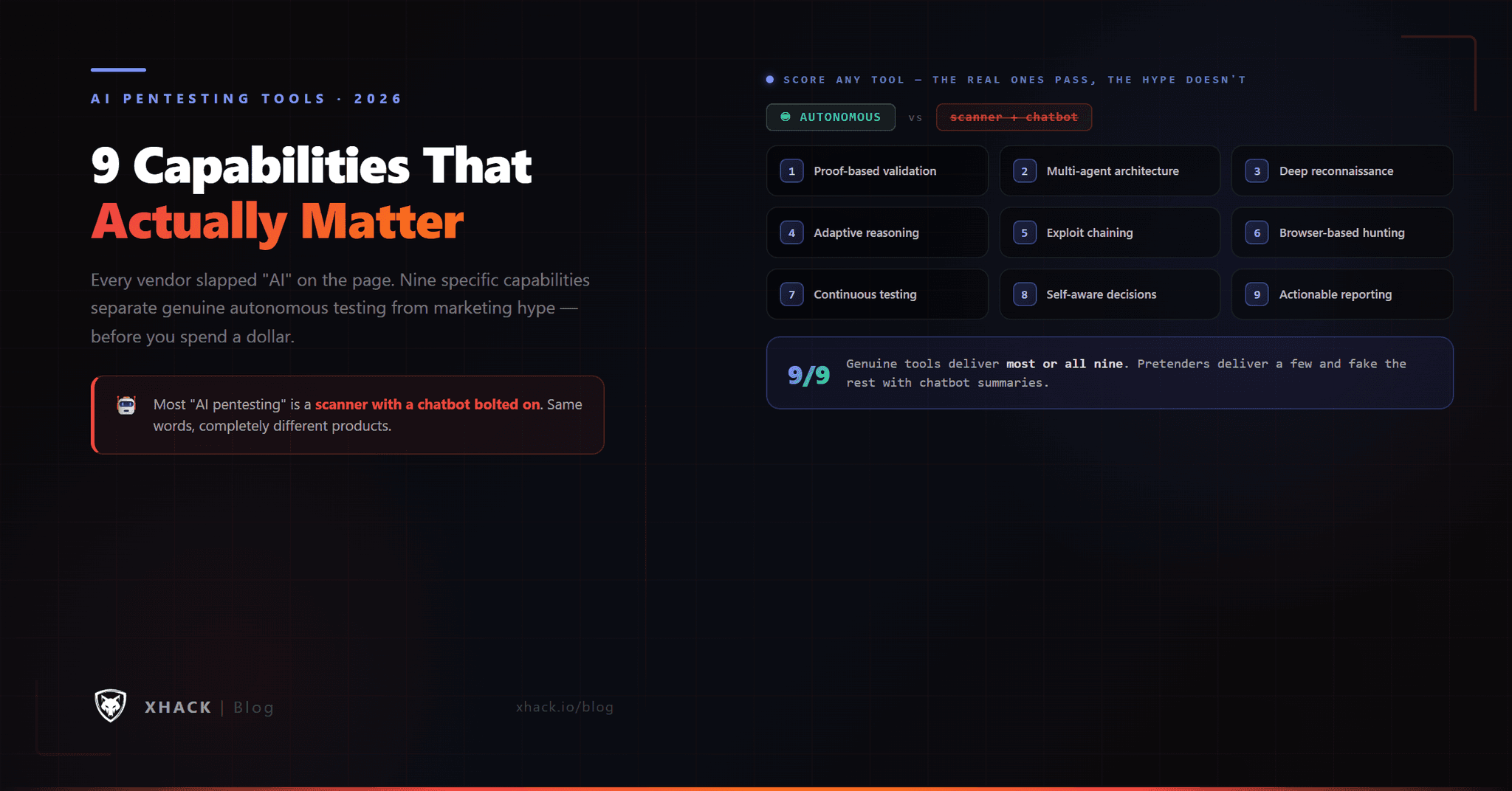
Read this in 30 seconds: Every security vendor slapped “AI” on their product page in 2025, so most AI pentesting tools are just a scanner with a chatbot bolted on. The real ones are separated by nine specific capabilities: proof-based validation, multi-agent architecture, deep reconnaissance, adaptive reasoning, exploit chaining, browser-based live hunting, continuous testing, self-aware decision making, and actionable reporting. This guide breaks down each capability, explains why it matters, and gives you a framework to tell genuine autonomous testing from marketing hype before you spend a dollar.
There are now hundreds of “AI-powered” pentesting tools on the market. Most of them are a vulnerability scanner with a chatbot stapled to the dashboard and a fresh coat of marketing.
The handful that are genuinely autonomous are doing something fundamentally different, and telling them apart is worth real money.
Here’s the problem buyers face in 2026. Every vendor learned that “AI” sells, so every product page now promises autonomous, intelligent, AI-driven testing. The marketing converged on the same buzzwords while the actual capabilities diverged wildly. One tool labeled “AI pentesting” reasons about attack paths and validates exploits with working proof. Another tool with the exact same label runs a Nessus scan and asks an LLM to summarize the output. Same words, completely different products.
So how do you cut through it? You stop reading marketing copy and start checking for specific capabilities. The genuine AI pentesting tools share a set of technical capabilities that the pretenders can’t fake, because faking them requires actually building the hard parts. This guide walks through the nine that matter most, so you can evaluate any AI pentesting tool against what it actually does rather than what its homepage claims.
This is the single most important capability, and it’s the one that separates real AI pentesting tools from glorified scanners more than any other.
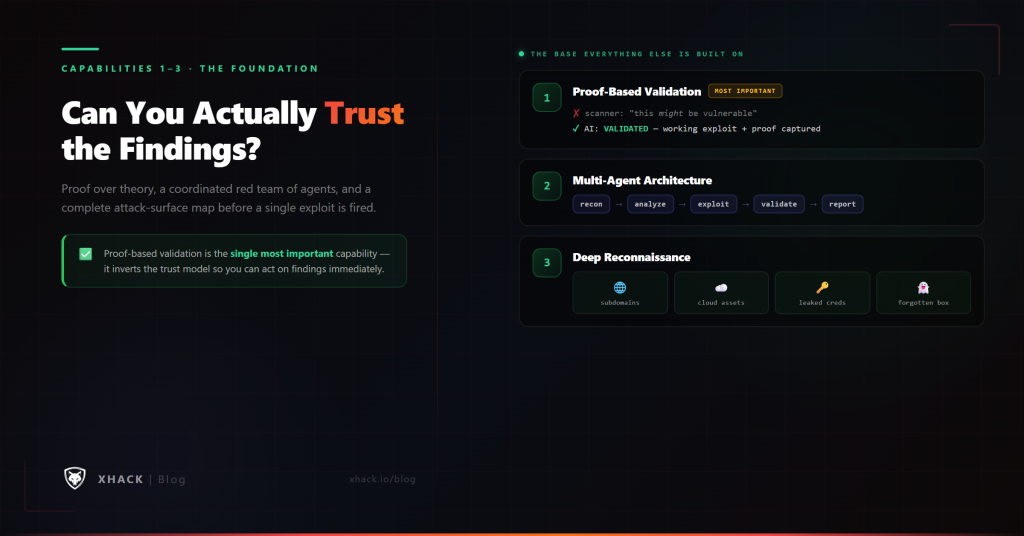
A scanner reports that a vulnerability might exist based on a signature or version match. It produces theoretical risk, which is why scanner reports are full of false positives that waste your team’s time chasing phantoms. Genuine AI pentesting tools validate findings by actually exploiting them and capturing proof. They don’t say “this might be vulnerable.” They say “this is vulnerable, here’s the working exploit and the evidence.”
This matters enormously because it inverts the trust model. With a scanner, you have to verify every finding yourself before acting on it. With proof-based AI pentesting tools, every reported finding comes with demonstrated exploitability, so you can trust it and act immediately.
When evaluating any AI pentesting tool, this is the first question to ask: does it validate findings by exploiting them, or does it just report theoretical risk? Tools that rely purely on LLM reasoning without a validation layer are notorious for hallucinating vulnerabilities that don’t exist. Proof-first architecture is the quality differentiator that everything else builds on.
The most capable AI pentesting tools don’t use a single AI trying to do everything. They use multiple specialized agents that coordinate, mirroring how a real red team divides labor among specialists.
In a multi-agent system, one agent handles reconnaissance, another reasons about findings and prioritizes attack paths, another attempts exploitation, another validates results, and another compiles reporting. These agents communicate and coordinate toward a shared objective. When the reconnaissance agent discovers a new asset, the analysis agent evaluates it and the exploitation agent tests it, all without human intervention.
Why does this matter? Because penetration testing is genuinely multidisciplinary. Reconnaissance, analysis, exploitation, and reporting require different kinds of reasoning. A single agent trying to do all of it does each part worse than a specialized agent focused on one job. Multi-agent AI pentesting tools produce more thorough, better-coordinated results.
Be skeptical of vendors who market the raw number of agents as a feature, as if more agents automatically means better. The number is an architecture detail, not a quality metric. What matters is whether the agents are genuinely specialized and well-coordinated, not whether there are ten of them or a thousand.
Reconnaissance is where a penetration test either builds a complete picture of the attack surface or misses half of it. Weak AI pentesting tools do surface-level scanning. Strong ones perform deep reconnaissance.
Deep reconnaissance goes far beyond basic port scanning and subdomain enumeration. It includes technology stack fingerprinting, exposed credential detection across breach databases, cloud asset discovery across AWS, Azure, and GCP, historical data analysis through archives and certificate transparency logs, and employee and organizational intelligence gathering. The goal is to map the complete attack surface before any exploitation begins, because you can’t test what you didn’t find.
This capability matters because most breaches happen through the asset nobody knew was exposed. The forgotten staging server, the undocumented API, the cloud bucket left public. AI pentesting tools with deep reconnaissance surface these blind spots, while shallow tools test only the obvious assets and leave the dangerous forgotten ones untouched.
When evaluating AI pentesting tools, look at how thoroughly they map the attack surface. A tool that only tests what you explicitly point it at is missing the entire category of risk that comes from assets you didn’t know you had.
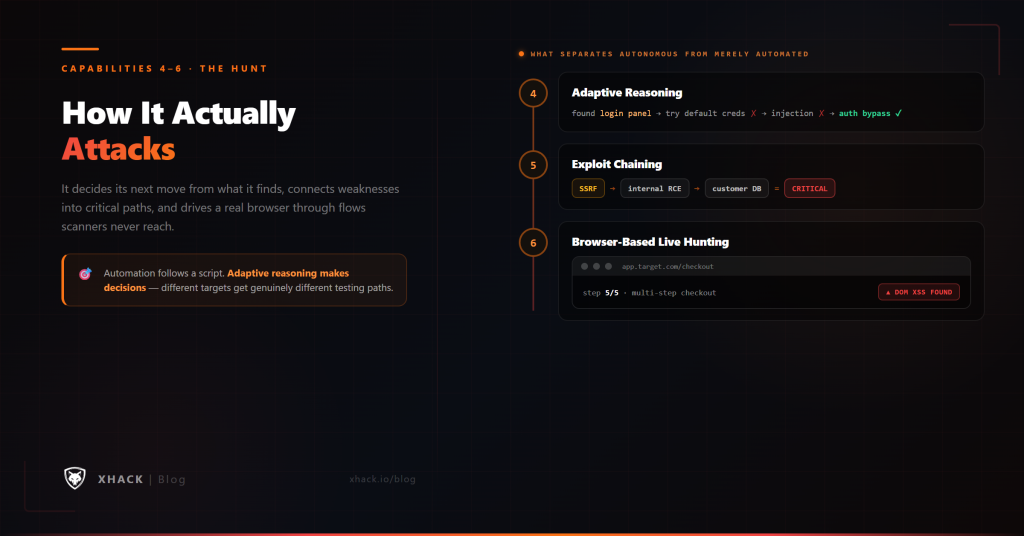
This is the capability that earns the “autonomous” label. Adaptive reasoning means the tool decides what to do next based on what it finds, rather than running a fixed sequence of checks.
A scanner runs the same checks every time, in the same order, regardless of what it discovers. Genuine AI pentesting tools reason about their findings and adapt. When the tool discovers a login panel on a known framework, it decides to test for default credentials, then a specific injection technique, then an authentication bypass, choosing each step based on the results of the last. When one attack path fails, it tries another. When it hits unexpected behavior, it investigates rather than ignoring it.
This adaptive, response-driven behavior is what makes autonomous testing genuinely different from automation. Automation follows a script. Adaptive reasoning makes decisions. It’s the difference between a tool that does exactly what it was programmed to do and a tool that figures out what to do based on the target in front of it.
When evaluating AI pentesting tools, probe whether the tool genuinely adapts or just runs a fixed playbook with an AI-generated summary at the end. Real adaptive reasoning produces different testing paths for different targets, because it’s responding to what it actually finds.
Individual vulnerabilities are often less dangerous than how they combine. The best AI pentesting tools connect individual findings into complete attack chains, revealing critical paths that isolated findings would hide.
Consider a server-side request forgery that seems like a medium-severity issue on its own. But if that SSRF can reach an internal service with a remote code execution vulnerability, which has access to a database containing customer data, the three findings together form a critical attack chain. AI pentesting tools with chaining capability map this path automatically, showing not just what’s vulnerable but how an attacker would move through your environment combining weaknesses.
This matters because real attackers think in chains, not isolated vulnerabilities. They combine a low-severity foothold with a privilege escalation and a lateral movement to reach their goal. A tool that only reports isolated findings, ranked by individual severity, misses the most dangerous thing about your environment: how those findings connect.
Graph-based reasoning is what powers this capability. When you evaluate AI pentesting tools, look for whether the tool maps attack paths across findings or just hands you a flat list of disconnected vulnerabilities sorted by CVSS score.
Most AI pentesting tools interact with targets through APIs and command-line tools. The more advanced ones control a real browser, testing applications the way a human attacker actually would.
Browser-based live hunting means the tool navigates real web pages, fills out forms, clicks buttons, follows multi-step workflows, and tests authentication flows through an actual browser engine. This catches an entire category of vulnerabilities that API-level and command-line testing miss completely: DOM-based cross-site scripting, client-side authentication bypasses, vulnerabilities in JavaScript-rendered content, and flaws that only appear when you click through a multi-step process.
If a vulnerability only manifests when a user clicks through a five-step checkout wizard, a command-line tool will never find it because it can’t replicate that interaction. AI pentesting tools with browser-based capability can, because they drive a real browser through the actual workflow.
This capability is increasingly important as modern applications push more logic to the client side. The richer and more interactive your application, the more vulnerabilities live in the browser-rendered experience, and the more you need AI pentesting tools that can actually operate a browser rather than just hitting endpoints.
A one-time test is a snapshot. The most valuable AI pentesting tools test continuously, integrating into your development pipeline so every change gets tested as it ships.
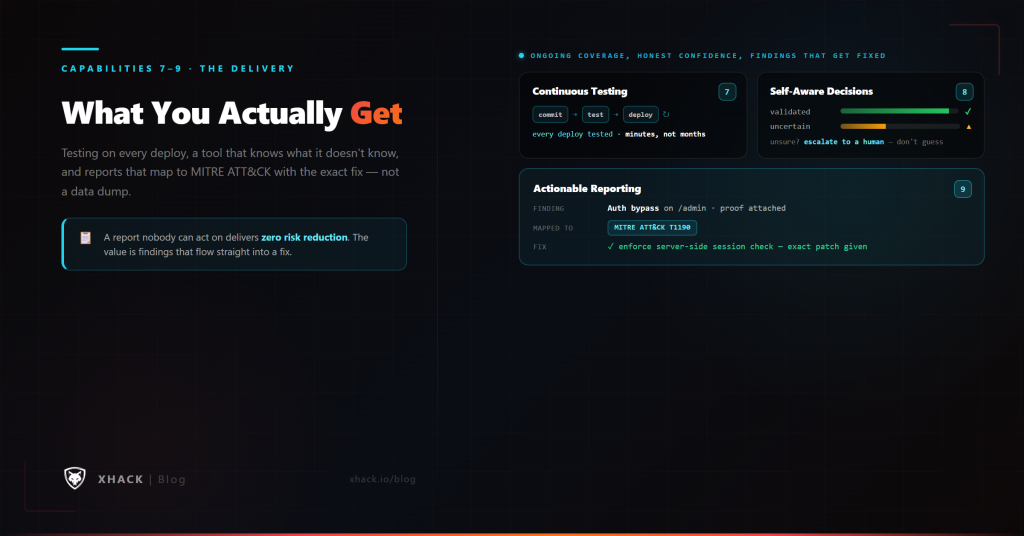
This is the capability that solves the core problem of modern security: you deploy faster than any human team can test. AI pentesting tools that integrate into CI/CD pipelines test every deployment automatically, shrinking the gap between “code shipped” and “code tested” from months to minutes. Instead of discovering a vulnerability in next year’s annual pentest, you catch it the moment it’s introduced.
Continuous testing also means your attack surface gets monitored as it changes rather than assessed once and forgotten. New endpoints, new services, and new configurations get tested as they appear. This is fundamentally different from the traditional model where you test once a year and hope nothing breaks in between.
When evaluating AI pentesting tools, look at how they integrate into your existing workflow. Do they plug into your CI/CD pipeline, your ticketing system, and your security operations? A tool that produces continuous findings nobody acts on is just expensive noise. The value comes from continuous testing that flows into action.
Genuine AI pentesting tools know their own limitations. This sounds abstract, but it’s one of the most practical capabilities for keeping false positives down and trust high.
Self-aware decision making means the tool recognizes when it’s confident versus when it’s uncertain. When it encounters something it can’t handle confidently, it flags the finding for human review rather than guessing or hallucinating a result. It knows the difference between “I have validated this exploit and I’m confident” and “I found something unusual but I’m not sure what it means.”
This capability is what prevents the false positive flood that plagues lesser AI pentesting tools. Tools without self-awareness confidently report everything, including the things they got wrong, burying your team in noise. Tools with self-awareness surface validated findings with high confidence and escalate genuinely ambiguous cases to humans, which is exactly what you want.
It also makes the tool safer. A self-aware system can recognize when it’s encountering something sensitive, like signs of an active compromise during testing, and escalate immediately rather than blindly continuing. When evaluating AI pentesting tools, ask how the tool handles uncertainty. The honest answer separates mature products from ones that just report everything and let you sort out the mess.
Finding vulnerabilities is half the job. The other half is communicating them in a way that gets them fixed. The best AI pentesting tools produce reporting that drives action, not just data dumps.
Actionable reporting means each finding comes with the evidence, a clear severity rating based on real exploitability, business impact context, and specific remediation guidance. The best AI pentesting tools map findings to frameworks like MITRE ATT&CK, so your defensive team can build detections for the exact techniques used. They generate remediation steps specific to the detected issue, so your developers know exactly what to fix rather than researching from scratch.
This matters because a report nobody can act on delivers zero risk reduction. The most common failure mode of security testing is a report that gets read once and filed away, with the vulnerabilities never fixed. AI pentesting tools that produce clear, prioritized, actionable reporting close that gap by making remediation obvious and easy.
When evaluating AI pentesting tools, ask to see a sample report. Look for evidence with each finding, clear remediation guidance, framework mapping, and prioritization based on real risk. If the report is a raw list of findings without context or guidance, the tool is leaving the hardest part, actually fixing things, entirely to you.
Now you have a framework. Instead of reading marketing copy, score any AI pentesting tool against these nine capabilities. The genuine autonomous tools deliver most or all of them. The pretenders deliver a few and fake the rest with chatbot summaries.
The single most important capability is proof-based validation, because it determines whether you can trust the findings at all. After that, adaptive reasoning and multi-agent architecture determine whether the tool is genuinely autonomous or just automated. Deep reconnaissance, exploit chaining, and browser-based hunting determine coverage depth. Continuous testing determines whether you get ongoing protection or a one-time snapshot. Self-aware decision making determines false positive rates. And actionable reporting determines whether findings actually get fixed.
Run a proof of concept against your own environment before committing to any AI pentesting tool. Vendor benchmarks are self-reported and run in controlled conditions. Your production environment is messier. Measure the real false positive rate, verify the findings are actionable, and confirm the capabilities the marketing promised actually exist in practice.
Since this guide is a framework for evaluating AI pentesting tools, here’s an honest look at how XHack AI maps to these nine capabilities, because we built it specifically around them.
XHack AI is a multi-agent autonomous penetration testing system, so capability two is foundational to its design. Rather than one AI doing everything, it deploys specialized agents for reconnaissance, analysis, exploitation, validation, and reporting that coordinate the way a real red team does.
On proof-based validation, the most important capability, XHack AI’s agents are self-aware about their confidence and validate findings rather than reporting theoretical risk. When the system encounters something it can’t handle confidently, it flags it for human review instead of hallucinating a finding. That self-awareness keeps false positives down, which is exactly what capabilities one and eight are about.
For deep reconnaissance, XHack AI performs technology fingerprinting, exposed credential detection, and cloud asset discovery, building a complete attack surface map before exploitation begins. For browser-based live hunting, its autonomous browsing engine controls a real browser to navigate applications, fill forms, and test workflows the way a human attacker would, catching the client-side vulnerabilities that API-level testing misses. And its adaptive reasoning lets it adjust its approach based on what it finds, while chaining individual findings into complete attack paths.
XHack AI is also fast but careful, throttling based on target behavior rather than blindly hammering systems, and it can make critical decisions autonomously, like escalating immediately if it detects signs of active compromise. Findings come with actionable reporting mapped to MITRE ATT&CK and specific remediation guidance.
Here’s the honest framing, the same one we apply to every tool in this space. XHack AI handles the autonomous breadth: continuous coverage, reconnaissance, validated exploitation, and chaining. Human experts handle the business logic flaws and judgment that AI still can’t replicate. That hybrid model is the right way to use any AI pentesting tool, ours included. If you want to see how XHack AI performs against these nine capabilities in your own environment, you can put it to the test directly.
Proof-based validation is the single most important capability. It means the tool validates findings by actually exploiting them and capturing evidence, rather than reporting theoretical risk like a scanner. This matters because tools that rely purely on LLM reasoning without validation are notorious for hallucinating vulnerabilities that don’t exist, flooding you with false positives. With proof-based validation, every reported finding comes with demonstrated exploitability, so you can trust it and act immediately. When evaluating any AI pentesting tool, ask this first: does it prove findings by exploiting them, or just report theoretical risk?
Check for adaptive reasoning and multi-agent architecture. A genuine autonomous tool decides what to do next based on what it finds, producing different testing paths for different targets, while a scanner runs the same fixed checks every time regardless of results. Ask whether the tool adapts its approach dynamically or runs a static playbook with an AI-generated summary at the end. Also look for proof-based validation and exploit chaining. The pretenders deliver a few capabilities and fake the rest with chatbot summaries, while genuine AI pentesting tools deliver most or all nine capabilities in this guide.
It depends entirely on the tool’s architecture. AI pentesting tools that rely purely on LLM reasoning without validation produce significant false positives because language models can confidently report vulnerabilities that don’t exist. Tools with proof-based validation and self-aware decision making produce far fewer, because they validate findings by exploiting them and escalate genuinely uncertain cases to humans rather than guessing. When evaluating tools, run a proof of concept against your own environment and measure the real false positive rate, since vendor benchmarks are self-reported and run in controlled conditions.
No. AI pentesting tools excel at breadth, speed, continuous coverage, and the capabilities in this guide, but they still struggle with business logic flaws, novel attack paths, and social engineering, and they cannot provide the qualified human sign-off that compliance frameworks require. The proven model is hybrid: AI pentesting tools handle the autonomous breadth and continuous coverage, while human experts handle the depth, creativity, and judgment that AI cannot replicate. The best results come from combining both, not replacing humans with tools or refusing to adopt tools at all.
Pricing varies widely by capability and model. Some continuous AI pentesting platforms start around $1,000 per month for ongoing coverage, while enterprise security validation suites run into six figures annually depending on scope. The cost advantage shows up at scale, since covering hundreds of assets continuously with AI pentesting tools costs a fraction of testing them all manually. Most organizations combine an AI tool for continuous breadth with periodic human testing for critical assets and compliance sign-off, which delivers better total coverage than spending the entire budget on either approach alone.
Those are the nine capabilities that actually separate real AI pentesting tools from marketing hype.
Proof-based validation, multi-agent architecture, deep reconnaissance, adaptive reasoning, exploit chaining, browser-based live hunting, continuous testing, self-aware decision making, and actionable reporting. The genuine autonomous tools deliver most or all of them. The pretenders deliver a few and paper over the gaps with chatbot summaries and marketing buzzwords.
The next time you evaluate AI pentesting tools, ignore the homepage and score the product against these nine capabilities. Ask whether it validates findings by exploiting them. Ask whether it adapts or just runs a fixed playbook. Ask to see a sample report. Run a proof of concept against your own environment. The real tools hold up to that scrutiny. The hype doesn’t.
If you want to see how XHack AI measures up against these nine capabilities in your own environment, put it to the test and judge it against the framework, not the marketing.
Follow Us on X: @xhackio
Categories
Related articles