Table of contents
16
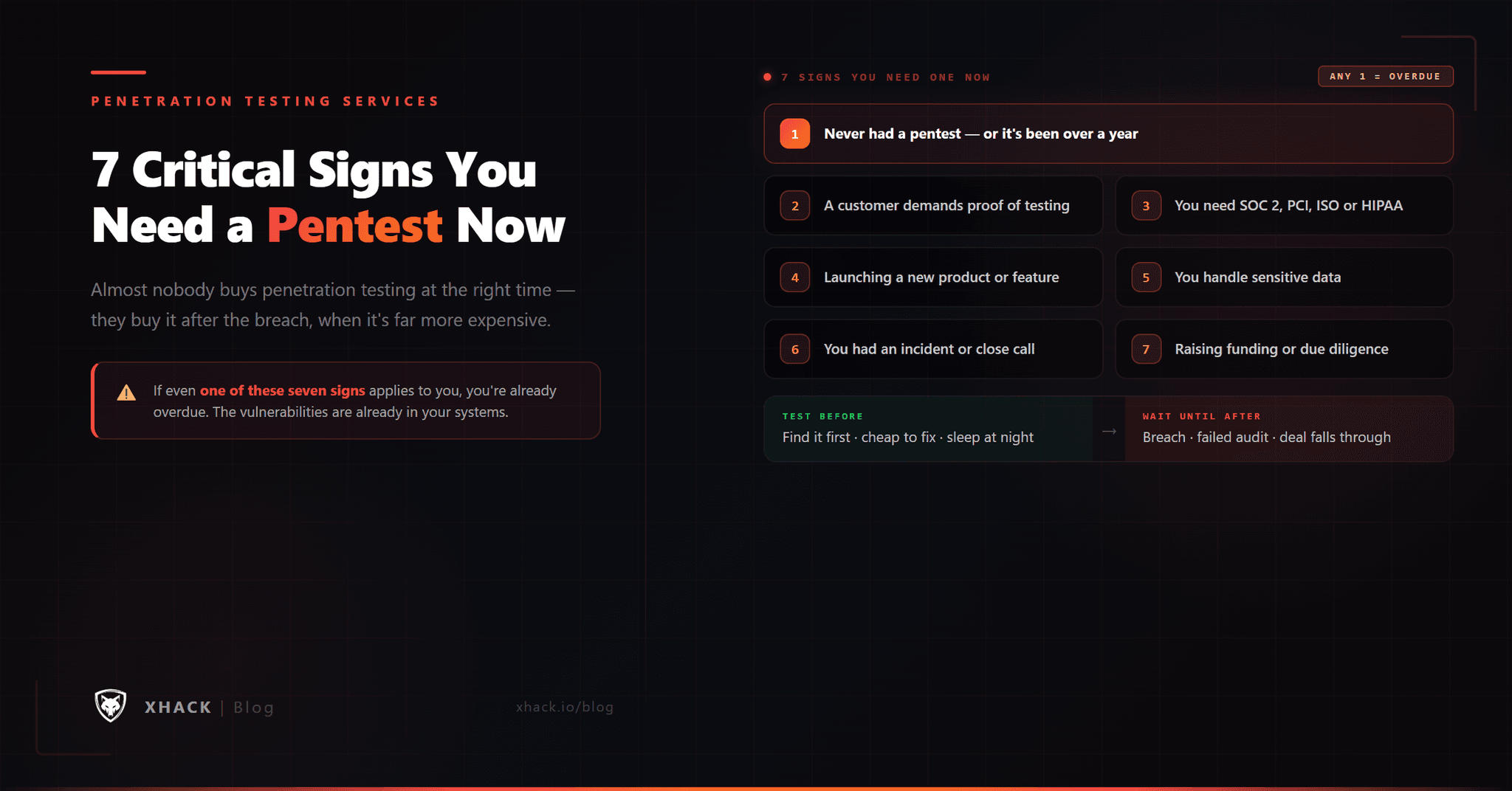
Read this in 30 seconds: Most companies wait until after a breach to buy penetration testing services. By then it’s too late and far more expensive. There are seven clear signs you need a pentest now: you’ve never had one (or it’s been over a year), a customer or partner is demanding proof of testing, you need compliance like SOC 2 or PCI DSS, you’re launching a new product or major feature, you handle sensitive data, you’ve had a security incident or close call, or you’re raising funding or going through due diligence. If any of these apply, you’re already overdue. This guide explains each sign and what to do about it.
Almost nobody buys penetration testing services at the right time. They buy them after the breach, after the failed audit, or after the enterprise deal falls through because they couldn’t produce a security report.
By then, the cheapest part of the problem is the pentest itself.
Here’s the pattern I’ve watched play out over and over. A company knows, somewhere in the back of its mind, that it should probably get its security tested. But there’s always something more urgent. A feature to ship, a deadline to hit, a fire to put out. Security testing stays on the someday list until something forces the issue. And the thing that forces the issue is almost always more expensive than the test would have been.
Penetration testing services exist to find your vulnerabilities before an attacker does. That timing, before instead of after, is the entire value. A pentest that finds a critical flaw in your payment system next week is worth a hundred times more than the breach notification you’d send next year.
So how do you know when you actually need penetration testing services, rather than just vaguely feeling like you should? There are seven specific signs. If any one of them applies to you, you’re already overdue. Let’s go through them.
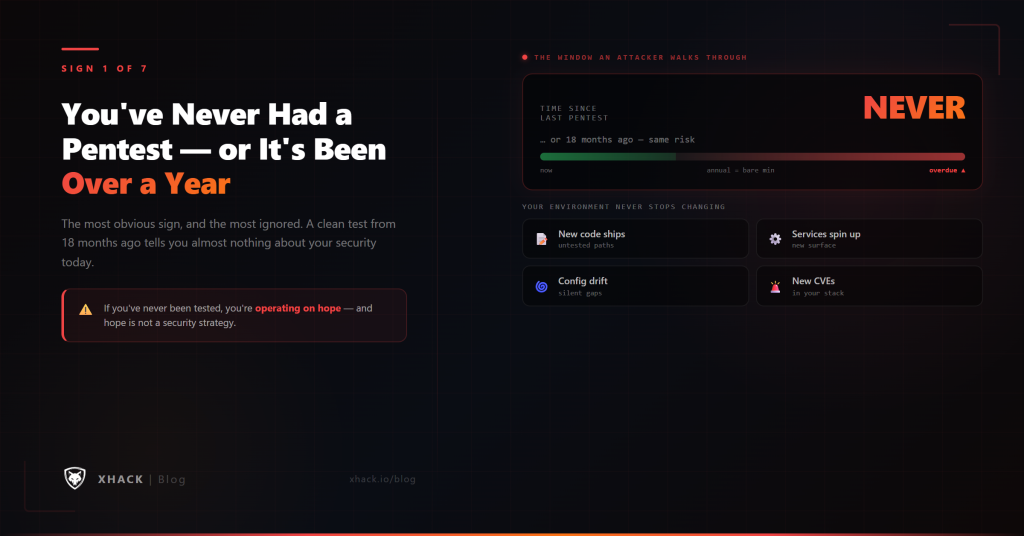
This is the most obvious sign and the most ignored. If your application, network, or infrastructure has never been professionally tested, you have no idea what an attacker could do to it. You’re operating on hope, and hope is not a security strategy.
The “over a year” part matters just as much. Your infrastructure changes constantly. New code ships, new services spin up, configurations drift, and new vulnerabilities get discovered in the software you depend on. A clean penetration test from 18 months ago tells you almost nothing about your security today. Most compliance frameworks require annual testing for exactly this reason, and even annual is increasingly considered the bare minimum.
If you’re reading this and realizing it’s been more than a year, or it’s been never, that’s your answer. Penetration testing services should be on your calendar now, not on your someday list. The gap between your last test and today is the window an attacker would love to walk through.
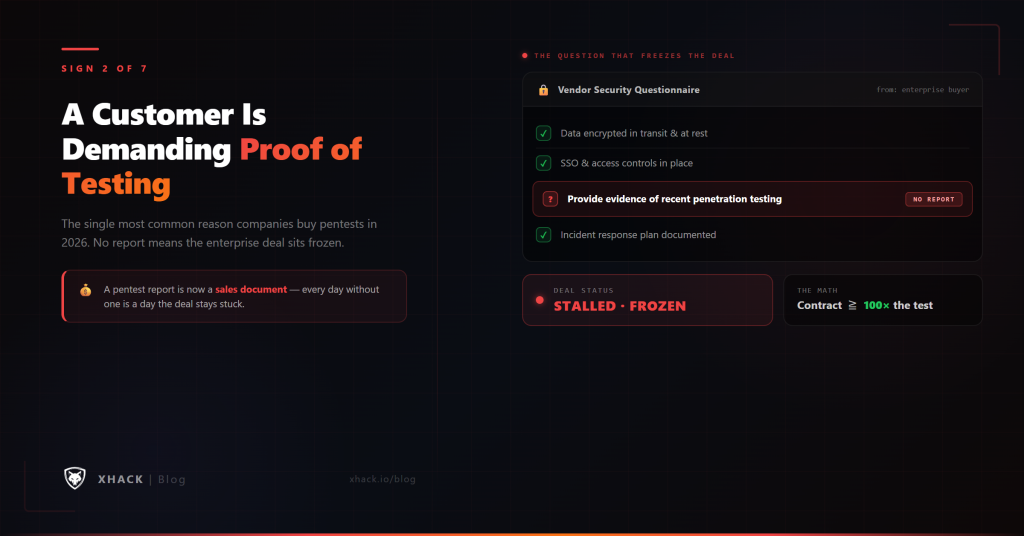
This one has become the single most common reason companies buy penetration testing services in 2026. You’re trying to close a deal with an enterprise customer, and their security team sends over a questionnaire. Somewhere in it is the question: “Provide evidence of recent penetration testing.”
You don’t have it. The deal stalls. Suddenly that pentest you kept postponing is standing between you and a contract worth far more than the test costs.
This has turned penetration testing services into a sales enablement tool, not just a security measure. Enterprise buyers won’t sign with vendors who can’t prove they take security seriously, and a recent pentest report is the proof they want to see. If a customer, partner, or prospect has asked for evidence of testing, you need penetration testing services immediately, because every day without that report is a day the deal sits frozen.
The smart move is to get ahead of this. If you sell to enterprises, you will eventually be asked for a pentest report. Getting one before the question comes means the deal never stalls in the first place.
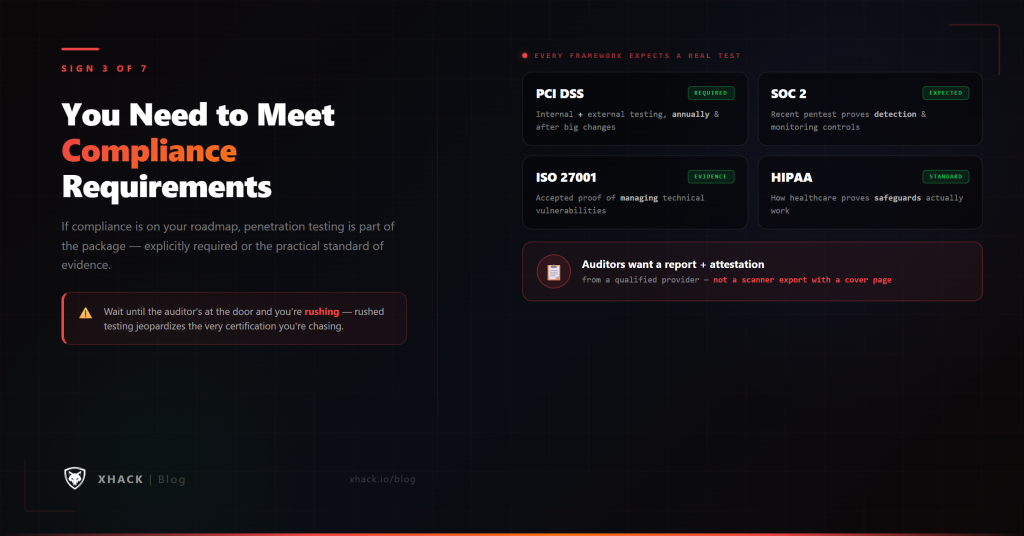
If you’re pursuing or maintaining compliance with any major framework, penetration testing services are almost certainly required, either explicitly or as the practical standard of evidence.
PCI DSS, for anyone handling payment card data, explicitly requires both internal and external penetration testing annually and after significant changes. SOC 2 audits expect to see a recent pentest as part of demonstrating your detection and monitoring controls. ISO 27001 requires managing technical vulnerabilities, and penetration testing is the accepted evidence. HIPAA requires regular evaluation of security controls, and penetration testing services are the standard way healthcare organizations prove their safeguards actually work.
The pattern is clear. If compliance is on your roadmap, penetration testing is part of the package. And compliance deadlines have a way of arriving faster than expected. Auditors want to see a real test from a qualified provider, complete with a proper report and attestation, not a scanner export with a cover page.
If you’re working toward any compliance certification, get your penetration testing services scheduled early. Leaving it until the auditor is at the door means rushing, and rushed testing produces incomplete results that can jeopardize the very certification you’re chasing.
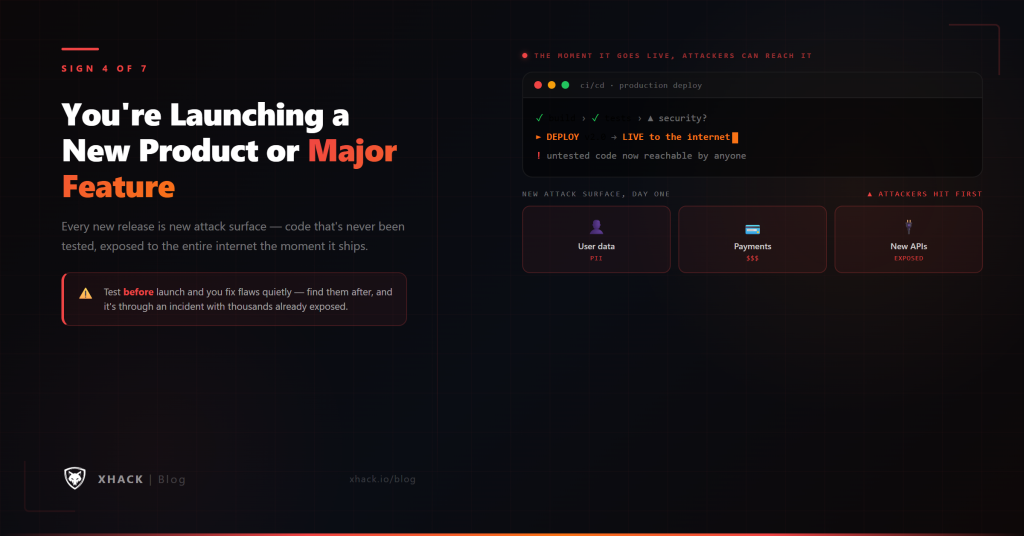
Every new product, application, or significant feature is new attack surface. Code that has never been tested. Functionality that has never been probed. And the moment it goes live, attackers can reach it.
Launching without security testing is how companies end up in breach headlines days after a big release. The excitement of shipping overshadows the reality that you just exposed untested code to the entire internet. New features that handle user data, process payments, or expose APIs are especially risky, because they’re exactly what attackers target first.
This is where penetration testing services should be part of your launch process, not an afterthought. Testing before launch catches the vulnerabilities while you can still fix them quietly, instead of discovering them through an incident after thousands of users are already exposed. If you’re about to launch something significant, or you just did, that’s a clear sign you need testing now.
The best teams build penetration testing into their release cycle so that major launches are tested as a matter of routine. If you’re not there yet, a new launch is the perfect moment to start.
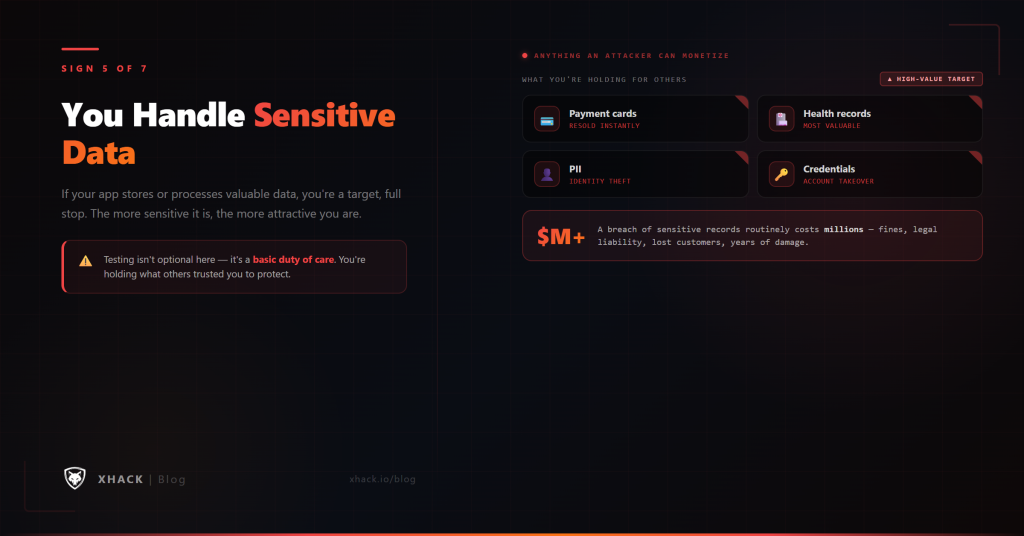
If your application stores or processes sensitive data, you’re a target, full stop. Payment card information, personal health records, personally identifiable information, financial data, credentials. Anything an attacker can monetize or weaponize makes you worth attacking.
The more sensitive the data you hold, the more attractive you are and the higher the stakes if you’re breached. A breach involving sensitive data brings regulatory penalties, legal liability, customer loss, and reputational damage that can take years to recover from, if you recover at all. The cost of a data breach involving sensitive records routinely runs into the millions.
Penetration testing services for companies handling sensitive data aren’t optional. They’re a basic duty of care. You’re holding something valuable that other people trusted you to protect, and you have an obligation to verify that protection actually works. If you handle sensitive data and you’re not regularly testing your defenses, you’re one vulnerability away from a very bad day.
Nothing focuses the mind like a near-miss. If you’ve experienced a security incident, a suspicious login you couldn’t fully explain, a phishing attack that got further than it should have, or an actual breach, that’s a flashing sign that you need penetration testing services now.
An incident, even a minor one, tells you that your defenses have gaps. The attacker who got in, or almost got in, found a way through. Penetration testing services after an incident serve two purposes. First, they help you understand the full extent of your exposure, because where there’s one gap, there are usually more. Second, they verify that whatever you fixed actually closed the hole, and that the attacker didn’t leave other doors open.
Too many companies respond to an incident by patching the one obvious hole and moving on, never checking whether the rest of their environment has the same class of vulnerability. That’s how companies get breached twice. A proper penetration test after an incident maps your actual exposure so you can fix the whole problem, not just the symptom you noticed.
If something happened, or almost happened, don’t wait. The attacker who probed you once may well come back.
Investors and acquirers increasingly scrutinize security during due diligence. If you’re raising a round, being acquired, or acquiring another company, security posture is part of the evaluation, and penetration testing services are part of demonstrating it.
A clean, recent pentest report signals maturity to investors and acquirers. It tells them you take security seriously and that you’re not hiding a ticking time bomb that could blow up the valuation after the deal closes. Conversely, the absence of any security testing is a red flag that can slow a deal, lower a valuation, or sink it entirely if due diligence uncovers serious unaddressed risk.
If you’re heading into any kind of funding round or transaction, getting penetration testing services done beforehand strengthens your position. It’s far better to walk into due diligence with a recent report and a remediation track record than to have the other side’s security team find your vulnerabilities first. In a transaction, surprises are bad, and a security gap discovered during diligence is exactly the kind of surprise that costs you leverage.
If you recognized your situation in even one of these seven signs, the next step is straightforward: get penetration testing services from a provider that does real testing, not just automated scanning.
The quality gap between providers is enormous, so a few things matter when you choose. Look for a provider that does significant manual testing by skilled humans, not just a scanner with a report template. Ask about their methodology and whether they reference established standards. Request a sample report to see whether you’d get actionable findings or just a list of scanner output. Confirm that retesting is included so you can verify your fixes worked. And make sure the report will satisfy whatever drove your need, whether that’s a compliance auditor, an enterprise customer, or an investor.
The worst outcome is paying for penetration testing services that turn out to be an automated scan dressed up with a cover page. That doesn’t satisfy a serious auditor, doesn’t reassure an enterprise buyer, and doesn’t actually find the vulnerabilities that matter. Real testing finds real risk, and that’s the entire point.
Since this guide is about recognizing when you need testing, here’s an honest look at how XHack approaches penetration testing services.
XHack combines expert human penetration testing with autonomous AI coverage and continuous monitoring. Our security researchers handle the deep manual testing that finds business logic flaws, authorization failures, and the chained exploits that automated tools miss. Our autonomous AI extends coverage and tests continuously between formal engagements, so your attack surface isn’t left unmonitored. And findings feed into our security platform, so even vulnerabilities you can’t immediately patch are watched for exploitation.
We’re built for exactly the situations these seven signs describe. Need a report for an enterprise customer or an investor? We deliver a professional report you can share with confidence. Pursuing compliance? Our testing and attestation align with the frameworks auditors expect. Launching something new or recovering from an incident? We scope the engagement to your specific need.
Our penetration testing services run $2,500 to $12,000 per engagement, combining human testers with XHack AI agents when the client authorizes AI-agent involvement, with final pricing scoped to your environment, complexity, and compliance requirements. We’d rather scope it to what you actually need than quote a flat rate for testing you don’t.
If any of the seven signs apply to you, the time to act is now, not after the breach or the failed audit. Get a quote scoped to your environment, or book a free consultation and we’ll help you figure out exactly what level of testing your situation calls for. Honest advice is part of the deal, even when the answer is that you need less than you thought.
At minimum, annually, which is what most compliance frameworks require. However, you should also test after any significant change, such as a major product launch, infrastructure update, or new feature handling sensitive data. Because your attack surface changes constantly, many organizations now move toward continuous or quarterly testing supplemented by AI-driven coverage between formal engagements. If it’s been more than a year since your last test, or you’ve never had one, you’re overdue regardless of your schedule.
Pricing varies by scope and depth, so the honest answer is a range rather than a number. Our own scoped engagements start at $2,500 for a single web application or up to 50 host IPs, $5,000 for up to three applications across web, host, API and mobile, and $12,000 for larger internal and external programmes, each with a retest included. Across the wider market, mid-sized engagements covering multiple assets commonly run $15,000 to $50,000, and enterprise programmes go higher. You can see the full breakdown on our pricing page.
What matters more than the number is what the number buys. Be cautious of anything sold as comprehensive penetration testing for $1,000 to $2,000, because that is almost always an automated scan with a cover page rather than a person testing your application. Ask what is actually manual, who is doing the testing and what they hold, whether a retest is included, and whether the report will satisfy the auditor or customer who asked for it. A cheap test that answers none of those is more expensive than no test at all.
A typical engagement runs one to three weeks depending on scope. A single web application might take one week, while a larger environment with multiple assets and compliance requirements takes longer. The process includes scoping, testing, and reporting. If you have a deadline driven by a compliance audit, customer requirement, or product launch, communicate it upfront so the provider can plan accordingly. Rushing the testing itself produces incomplete results, so build in adequate lead time.
Professional penetration testing services are designed to minimize disruption. Skilled testers use careful, non-destructive techniques and coordinate testing windows with your team. The rules of engagement define exactly what’s permitted, and reputable providers avoid actions that could cause downtime. For your most sensitive systems, you can discuss testing in a staging environment. A quality provider carries insurance and has emergency procedures, so disruption is rare when you work with professionals.
A vulnerability scan is automated. It runs tools that produce a list of known potential vulnerabilities without proving any of them are exploitable. Penetration testing services include scanning but add skilled manual testing where humans actively exploit vulnerabilities to prove real business impact, find issues scanners miss, and chain weaknesses together. A scan tells you what might be wrong. Real penetration testing proves what an attacker can actually do. Many cheap providers sell scans as penetration testing services, so always confirm how much of the work is manual.
Those are the seven signs you need penetration testing services now.
You’ve never been tested or it’s been over a year. A customer or partner is demanding proof. You need compliance. You’re launching something new. You handle sensitive data. You’ve had an incident or close call. Or you’re raising funding or going through due diligence. If any of these describe your situation, you’re already past the point where testing should have happened.
The companies that buy penetration testing services proactively, before the breach and before the deadline, spend far less and sleep far better than the ones who wait until something forces their hand. The vulnerabilities are already in your systems. The only question is whether you find them first, or an attacker does.
If you recognized your situation here, get a quote scoped to your environment or book a free consultation. The right time to test was before you needed to. The second-best time is now.
Follow Us on X: @xhackio
Categories
Related articles