Table of contents
18
By Salman Khan, OSCP+, Founder of XHack, SRT (Synack Red Team member)
Read this in 30 seconds: Multi-agent bug bounty work means splitting a hunt across specialist agents, one for recon, one to verify, one to report, that run at the same time and hand work to each other. The extra agents only pay off when they share a record of what is done, and every run needs a budget. This guide shows how XHack’s CoHunter does both, and what a local lab measured.
- Teams of agents beat a single agent on hard tasks. The HPTSA paper reported its team of agents improved over prior agent frameworks by up to 4.3x on a benchmark of 14 real-world vulnerabilities.
- They also cost more. Anthropic’s engineering team reported that its multi-agent systems use about 15x the tokens of a chat, so the task has to be worth it.
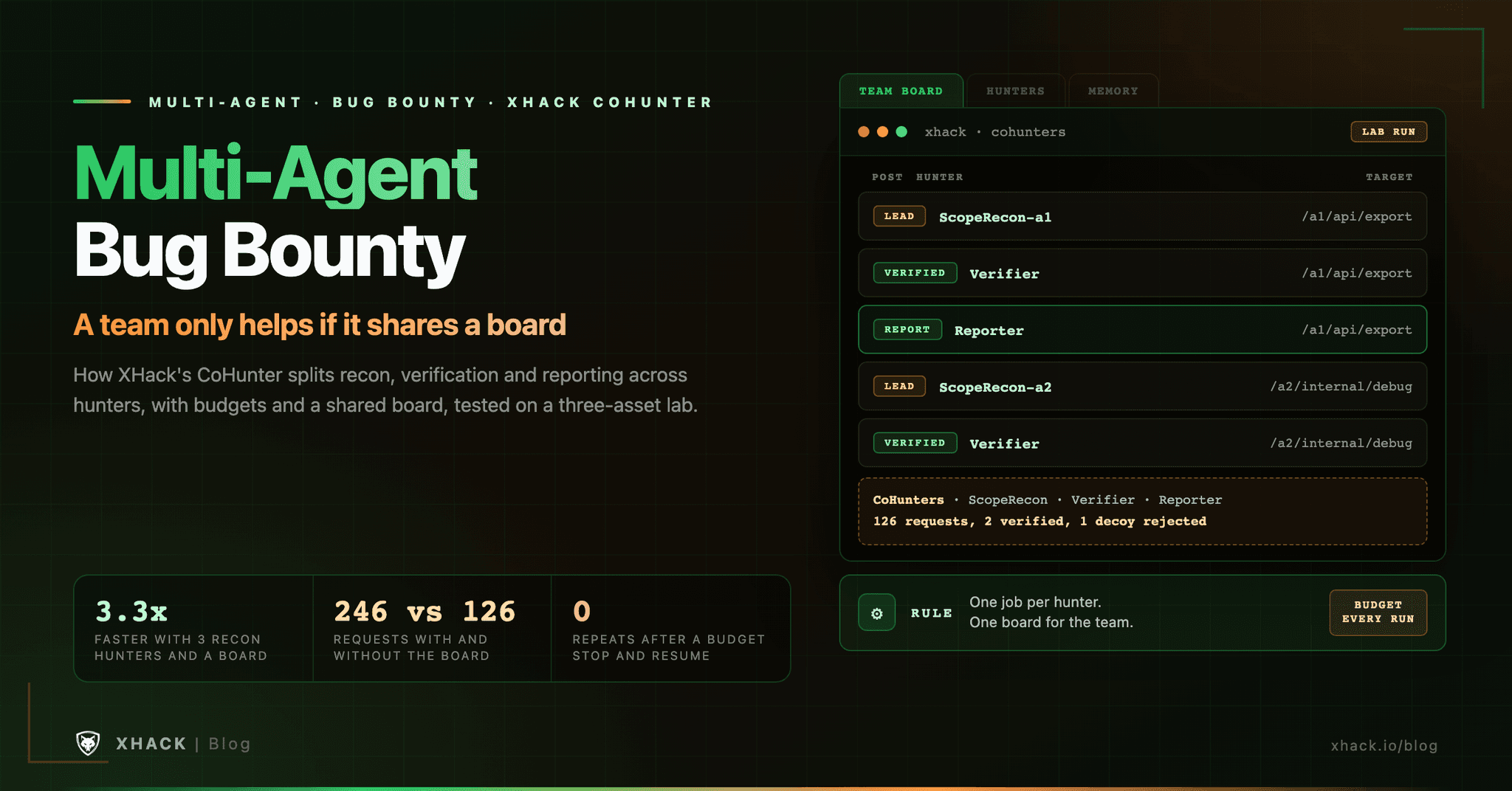
- The shared board is the multiplier. In my lab, three recon hunters with a shared board finished in 0.51 s against 1.69 s for one generalist, on the same 126 requests. Six hunters without a board sent 246 requests and were no faster.
- Budgets keep autonomy safe. A hunter that hit a 25-call budget stopped cleanly, and after the budget was raised it resumed at path 26 with 0 repeated requests.
- XHack CoHunter builds the team from one prompt. Each hunter gets a name, instructions, a model, tools, a budget and its own memory, and the team posts to a shared board.
A multi-agent bug bounty setup is only faster than one agent if the agents stop each other from doing the same work twice. Adding hunters adds throughput, but it also adds collisions: two recon agents walking the same paths, a reporter writing up a lead nobody verified, a run that keeps going after it should have stopped. The coordination is the product, not the agent count.
This guide covers multi-agent bug bounty work with XHack’s CoHunter as the worked example. It explains why teams of agents help, what they cost, how to design the roles, and what a local lab showed when I ran the same job four ways. The lab hunters are plain scripts, not language-model agents, so the numbers measure coordination (boards, budgets, handoffs), not skill.
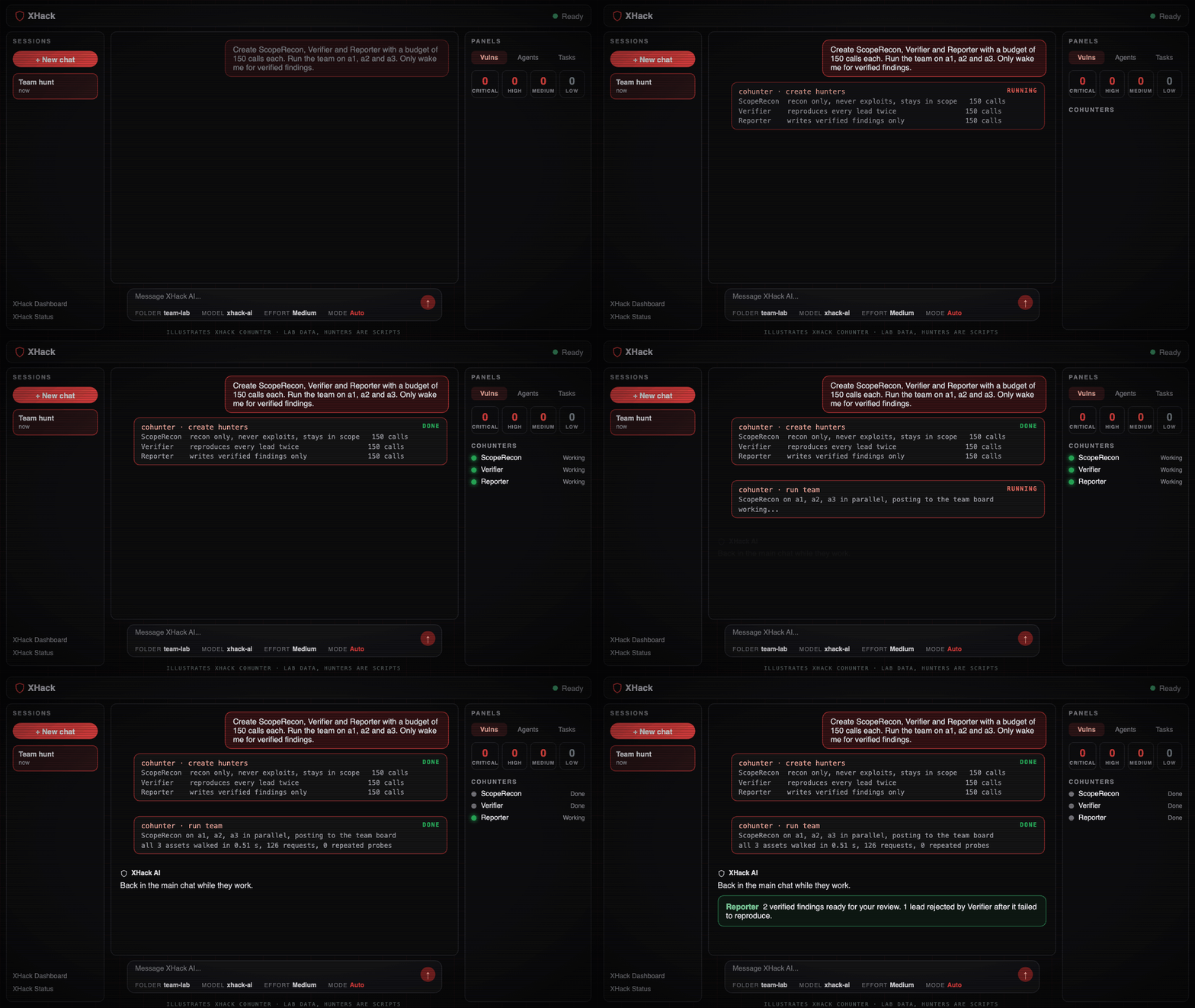
A multi-agent bug bounty team is a set of agents with separate jobs, separate context and a shared place to record what they found. One agent maps the target, another proves what the first one found, a third writes it up. They run in parallel, and each one only sees what it needs.
That split is the core of multi-agent bug bounty work, because a single agent doing everything carries every step in one context window. It forgets earlier work as the run gets long, and it cannot be in two places at once. Separate agents keep their own context and work on different assets at the same time.
The idea behind a multi-agent bug bounty team is not new. Human teams already split recon, exploitation and reporting. What changes with agents is that the team can be built in minutes, run all night and keep what it learned for the next target.
For multi-agent bug bounty work, the evidence says teams of agents solve harder problems, at a higher cost. Two sources make the case from different sides.
| Source | What it tested | Reported result |
|---|---|---|
| Teams of LLM Agents can Exploit Zero-Day Vulnerabilities (HPTSA, arXiv, 2024) | A planning agent that launches specialist subagents, on 14 real-world vulnerabilities | Improved over prior agent frameworks by up to 4.3x |
| How we built our multi-agent research system (Anthropic, 2025) | A lead agent with subagents on breadth-first research tasks | Beat a single agent by 90.2% on an internal eval, at about 15x the tokens of a chat |
The HPTSA authors put the reason plainly: single agents struggle with exploring many different vulnerabilities and with long-range planning. A planner that hands focused tasks to specialists fixes both.
Anthropic’s write-up adds the cost side. Agents use about 4x the tokens of a chat and multi-agent systems about 15x, so the task has to be valuable enough to pay for it. It also warns that tasks where every agent needs the same context, or with many dependencies between agents, are a poor fit. For multi-agent bug bounty work that means: split by asset and by role, not by tiny steps that all depend on each other.
CoHunter is XHack’s team of autonomous hunters, and you can build it by hand or ask the AI to build it for you. XHack’s documentation describes each hunter with five fields:
You can also skip the form and say it in the main chat, as the animation at the top shows: “Create ScopeRecon, Verifier and Reporter with a budget of 150 calls each. Run the team on a1, a2 and a3. Only wake me for verified findings.”
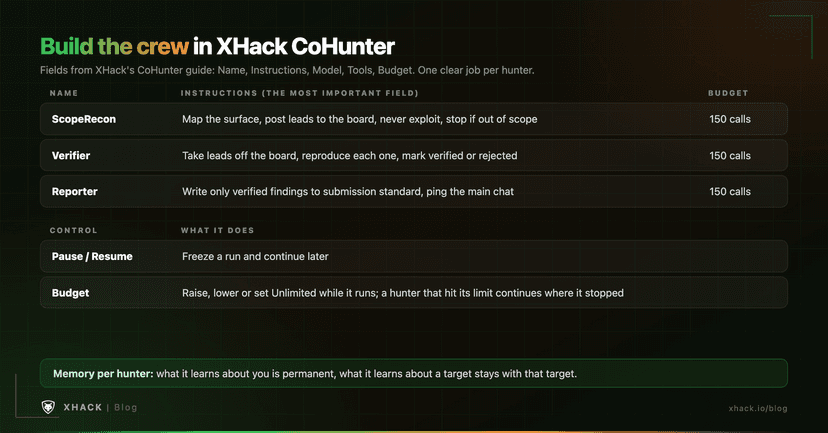
Once the multi-agent bug bounty team runs, the documented coordination does the rest. A hunter that finds something passes it to the teammate built to finish it, hunters post to a shared team board so nobody repeats work, and they ping you in the main chat only when something deserves your attention. Each hunter works in the same folder and on the same target as the chat it started from.
Each hunter also has its own memory that carries across sessions. XHack’s guide says what a hunter learns about you is permanent, while what it learns about a target stays with that target and does not appear on the next one. Correct a hunter once, for example “always prove impact before any handoff”, and it keeps the lesson.
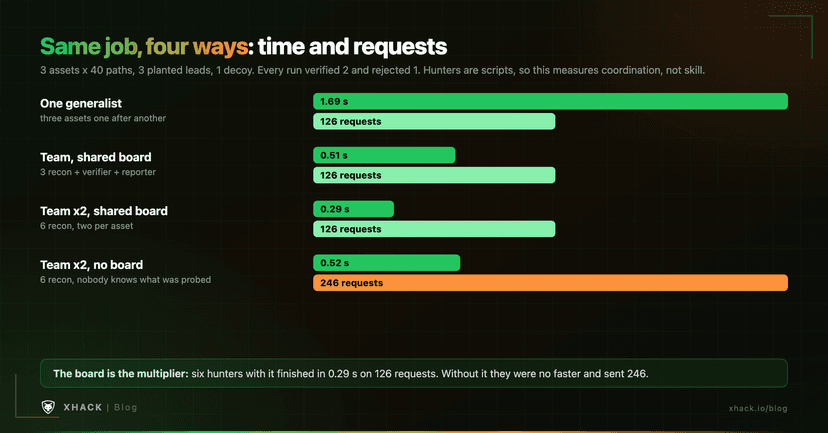
I built a three-asset target and ran the same multi-agent bug bounty job four ways to see what coordination actually buys. target_app.py listens on 127.0.0.1 and counts every request. Each asset has 40 paths, three of the 120 paths are planted leads, and one of those leads is a decoy that fails verification. team.py has three scripted roles, recon, verifier and reporter, and a shared board.
| Setup | Time to done | Requests | Repeated requests | Outcome |
|---|---|---|---|---|
| One generalist, assets one after another | 1.69 s | 126 | 3 | 2 verified, 1 rejected |
| Team: 3 recon + verifier + reporter, shared board | 0.51 s | 126 | 3 | 2 verified, 1 rejected |
| Team with 2 recon per asset, shared board | 0.29 s | 126 | 3 | 2 verified, 1 rejected |
| Team with 2 recon per asset, no shared board | 0.52 s | 246 | 123 | 2 verified, 1 rejected |
The 3 repeated requests in every row are planned: the verifier asks twice about each lead to reproduce it. Everything else is the point of the experiment.
In this multi-agent bug bounty lab, a team with a board was 3.3x faster than one generalist on the same number of requests. Doubling the recon hunters with a board cut the time again, to 0.29 s, still with 126 requests. Doubling them without a board did nothing for speed and nearly doubled the load on the target, because both hunters on each asset walked the same 40 paths.
That last row is the warning for any multi-agent bug bounty setup, and it is the most important result in this multi-agent bug bounty lab. Without a shared record, extra agents turn into extra traffic, which a program’s rate limit will notice before you see any benefit.
The board is where the team’s work becomes visible: every lead, verdict and report, in order. In the lab run, each lead reached the verifier and then the reporter within tens of milliseconds, and the decoy was rejected instead of reported.
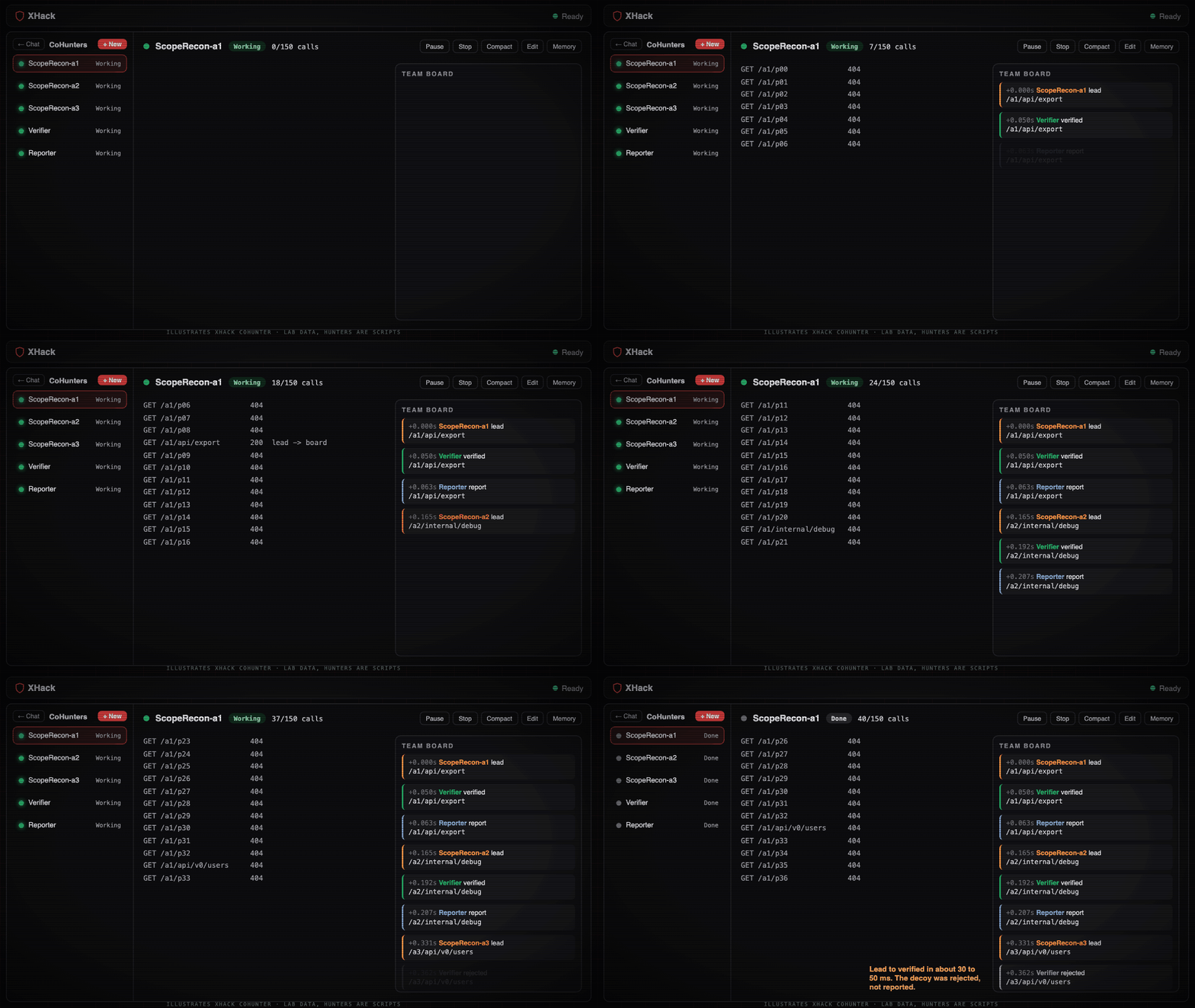
The order from the lab, as posted to the board:
/a1/api/export./a2/internal/debug./a3/api/v0/users failed both verification requests and was marked rejected. Nothing was written up.This is the handoff XHack’s CoHunter page describes in its example, where recon passes a likely SSRF to the exploit hunter, which proves it and hands it to the reporter. The difference in a real run is that each hop takes an agent’s reasoning, not a script’s lookup, but the structure is the same: one job per hunter, and a record everyone can read.
A budget turns “run until done” into “run until done or until this many calls”, and it has to stop cleanly. XHack’s guide describes the budget as the maximum number of tool calls for one task, and says a hunter that hits its limit continues where it stopped once you raise it.
I tested that multi-agent bug bounty behaviour on one recon hunter. With a budget of 25 calls it stopped at path 25 of 40 with the status “budget spent”. I raised the budget to 60 and resumed it: it carried on from path 26, finished all 40 paths in 40 calls, and sent 0 repeated requests to the target.
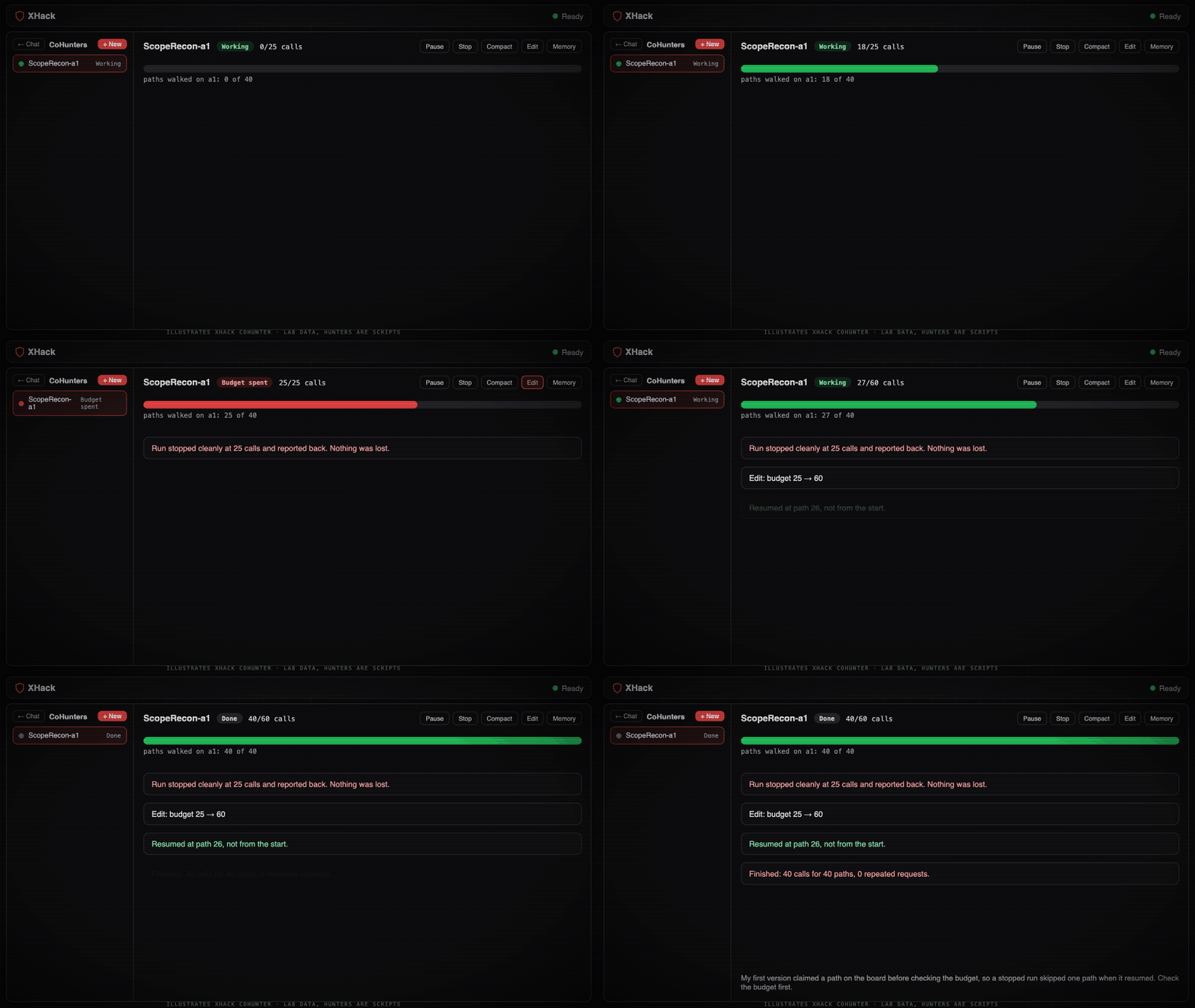
My first version had a bug worth sharing. It claimed a path on the board before checking the budget, so when the budget ran out the claimed path was never probed, and on resume the board said someone had already taken it. The run silently skipped one path. Checking the budget before claiming fixed it. Any team that shares a board needs the same rule: do not mark work as taken until you can actually do it.
Good multi-agent bug bounty crews come from narrow roles, honest instructions and small budgets that grow with trust. XHack’s guide gives the same advice, and the lab backs it up.
Most failed multi-agent bug bounty teams fail on coordination, not on intelligence.
The lab measures the plumbing of a multi-agent bug bounty team, not how well agents hunt. My hunters are scripts with fixed rules and a planted target, so a lead is a header, not a real bug, and every handoff is instant. Real agents spend most of their time reasoning, and a real target does not label its leads.
I also did not record a live XHack session for this article. The XHack sections follow its CoHunter guide and feature page, and the animations put the lab’s real counts and handoff times into the XHack and CoHunter layouts to illustrate that workflow. What the lab does show holds for any multi-agent bug bounty setup: a shared record decides whether more agents mean more speed or more noise.
So yeah, here is the part about XHack, and I am biased, it is my company. XHack combines three things most providers sell separately: an AI pentesting agent, a security operations platform and human penetration testers.
CoHunter is where the agent side becomes a multi-agent bug bounty team. You build hunters with their own instructions, model, tools, budget and memory, by hand or by asking the AI, and they run in the background, post to a shared board, hand work to each other and ping you when something is worth your time. Every hunter has Pause, Resume, Stop, Clear, Compact and Edit, a live feed with a context meter, and a budget you can change while it runs. Hunters can also be steps in the Workflow Engine, and the same team is available in the desktop app and on the web.
Underneath, the agent works with up to 12 sub-agents by default and three browsers, inside the permission mode you choose, and destructive commands stay blocked in every mode. For the wider hunting workflow, see our overview of the XHack AI agent for bug bounty.
Privacy matters more when a team runs all night on your targets. XHack does not store your data, and your agent chats and session data stay on your own computer, where you can delete them whenever you want.
Individual plans run $20, $49 and $150 a month, with a 7-day free trial. Nothing is charged for the trial period itself, and what you need to start depends on the requirements at the time, so check the sign-up page. If you want people to test your own systems instead, managed work starts from $2,500. If you want a cheap one-time scan with a cover page, we are not the right fit. Prefer to talk it through first? Book a free consultation, even if it turns out not to be us. Brutal honesty is kind of our thing.
Multi-agent bug bounty hunting splits a hunt across several AI agents with separate jobs, such as recon, verification and reporting, that run in parallel and hand work to each other through a shared record. Each agent keeps its own context, so the team can cover more assets at once than a single agent.
For wide or hard targets, usually yes. The HPTSA paper reported its team of agents improved over prior frameworks by up to 4.3x on 14 real vulnerabilities. The catch is cost: Anthropic reported multi-agent systems use about 15x the tokens of a chat. In my lab, the speed-up only appeared when the agents shared a board.
CoHunter lets you build hunters with a name, instructions, model, tools and a tool-call budget, by hand or by asking the AI. Hunters run in the background, post to a shared team board, hand findings to the right teammate and ping you in the main chat. Each one has its own memory and controls such as Pause, Stop and Compact.
Give the team one shared record of what has been done, and have every agent check it before starting a task. In my lab, two recon hunters per asset sent 126 requests with a shared board and 246 without one. Also check budgets before claiming work, so a stopped run does not leave tasks marked as taken.
Only within limits you set. Point hunters only at systems you own or are allowed to test, write the scope rules into their instructions, give each one a tool-call budget, and keep a verification role so nothing reaches a report unchecked. XHack keeps destructive commands blocked in every permission mode.
A multi-agent bug bounty team is worth building when the target is wide enough to split and valuable enough to pay for the extra tokens. What makes it work is not the number of agents but the coordination: one job per hunter, a shared board, a verifier between the finder and the report, and a budget on every run.
For your first multi-agent bug bounty crew, start with three hunters and small budgets, watch the board, and raise the limits for the hunters that earn it. If you want that team without building the plumbing yourself, ask XHack’s AI to create your CoHunter crew and run it on an authorized target.
Categories
Related articles