Table of contents
26
By Salman Khan, OSCP+, Founder of XHack, SRT (Synack Red Team member)
Read this in 30 seconds: Most lists of AI hacking tools are written for a security team with a procurement process, and you are one person with a laptop, a scope document and a budget. The useful question is which tools you can run or buy yourself for roughly $0 to $150 a month, point only at targets you are authorized to test, and validate by hand.
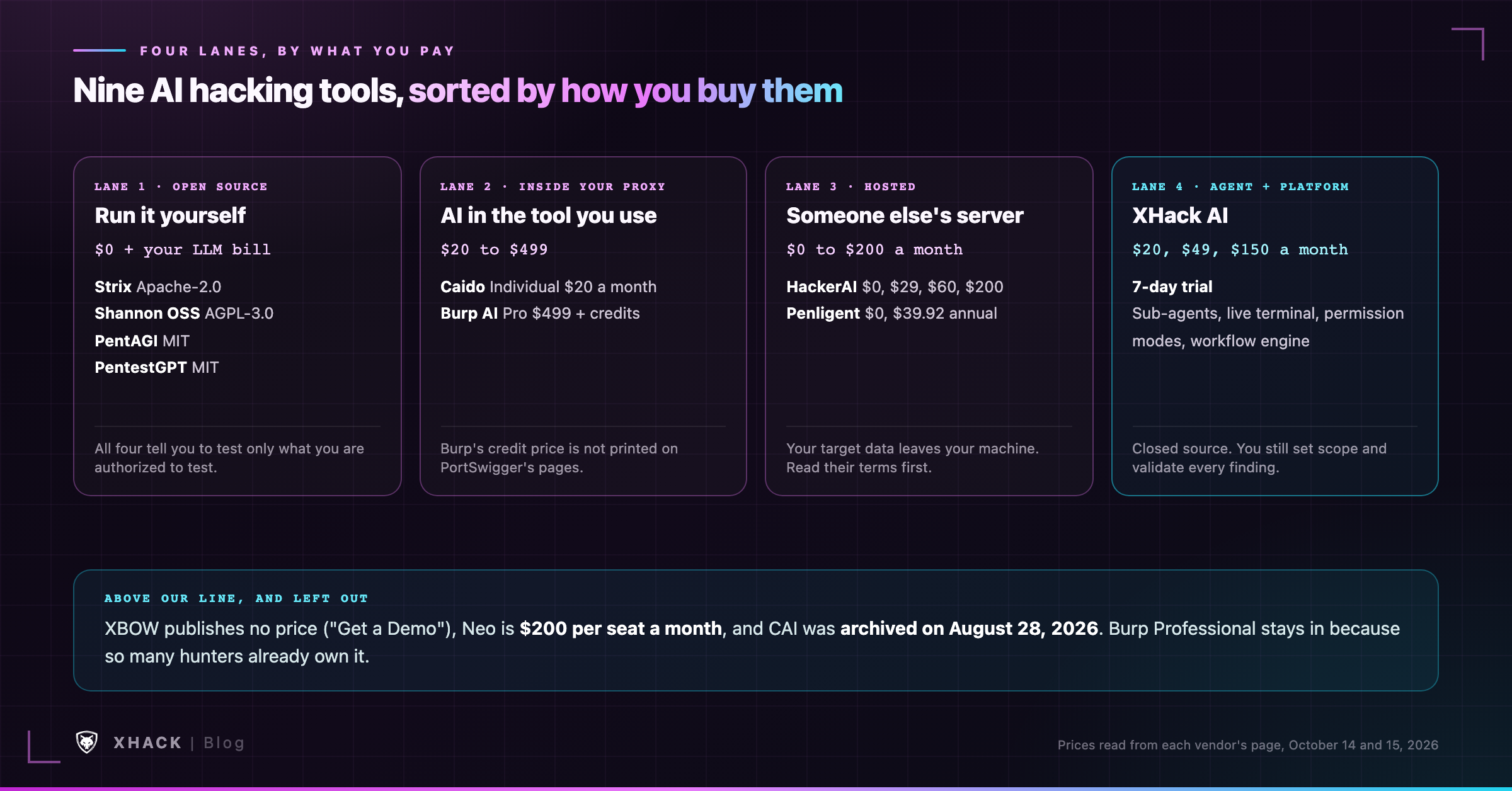
- Four of the nine AI hacking tools here are open source. Strix (Apache-2.0, v1.7.0, October 5, 2026), Shannon OSS (AGPL-3.0, v3.4.0), PentAGI (MIT, v2.2.0) and PentestGPT (MIT, v1.0.0) cost $0 plus your own model bill.
- Two sit inside your proxy. Caido’s Individual plan is $20 a month with an AI Assistant, and Burp AI needs Burp Suite Professional at $499 plus AI credits whose price PortSwigger does not print.
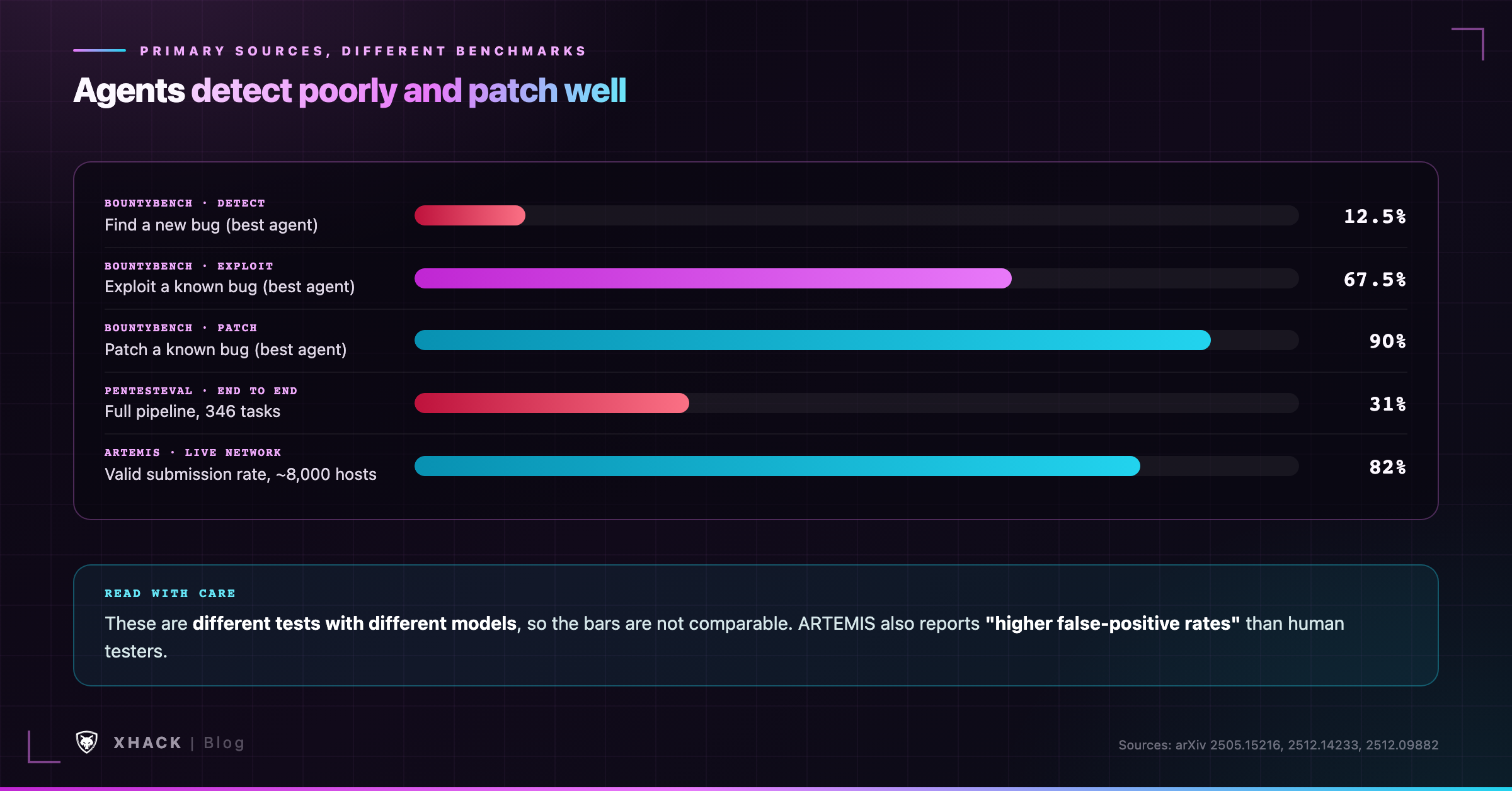
- Agents exploit known bugs better than they find new ones. BountyBench’s top agents scored 67.5% on Exploit but 12.5% on Detect, and PentestEval reports 31% end-to-end success.
- Platforms want a human in the loop. HackerOne’s hackbot rules say hackbots “must not operate in a fully autonomous manner,” with the word “yet” at the end, and Bugcrowd reviews accounts after ten consecutive invalid reports.
- XHack runs $20, $49 and $150 a month with a 7-day trial, and we are one entry on this list, not the verdict.
The best AI hacking tools for an individual are the ones you can afford without a sales call, run inside a scope you are authorized to test, and double-check yourself.
Search for AI hacking tools and you land on enterprise platforms priced by demo call. XBOW’s pricing page says “Pricing is scoped to your environment,” and its buttons say “Get a Demo.” That is a fine way for a security team to buy and no help to someone with a monthly ceiling.
We drew our line for AI hacking tools at about $150 a month. Everything below was checked against the tool’s own repository, pricing page or paper, and where we could not confirm something, the article says so.
“Best” here means best fit for one person: a price you can read, a maintained project, and authorization language you can follow. It is not a ranking, because no independent benchmark ranks these nine tools against each other.
We used four filters. The tool has to run or sell to an individual, show a recent release or a printed price, state its licence or terms, and, where it says anything about use, tell you to test only what you are authorized to test.
Burp Professional is the one entry above our $150 line. We kept it because so many hunters already own it.
Disclosure: we build XHack, so it is on this list. It gets the same treatment as the rest, including its limits.
Versions and prices for these AI hacking tools were read on October 14 and 15, 2026. “Your LLM bill” means you pay a model provider on top.
| Tool | Type | Cost to start | Targets | The catch |
|---|---|---|---|---|
| Strix | Open-source agent (Apache-2.0) | $0 plus your LLM bill | Apps and APIs, per its README | Docker required |
| Shannon OSS | Open-source agent (AGPL-3.0) | $0 plus your LLM bill | Web apps and APIs with source | White-box only |
| PentAGI | Self-hosted multi-agent (MIT) | $0 plus your LLM bill | Natural-language pentests | Docker-group risk |
| PentestGPT | Open-source agent (MIT) | $0 plus your LLM bill | CTFs and pentest mode | Needs Claude Code or Codex |
| Caido AI Assistant | Inside a proxy | $20 a month (Individual) | Web traffic you proxy | Not in the free Basic tier |
| Burp AI | Inside a proxy | $499 plus AI credits | Web traffic you proxy | Credit price not printed |
| HackerAI (hackerai.co) | Hosted assistant | $0, then $29, $60 or $200 a month | General pentest work | Free tier limits not printed |
| Penligent | Hosted agent | $0, then $39.92 a month billed annually | Asset discovery to validation | Monthly price not printed |
| XHack AI | Agent plus platform | $20, $49 or $150 a month | Recon to report | You still validate and set scope |
Benchmarks for AI hacking tools are a vendor’s best day, so read them as ranges and not as promises. Here is what the primary sources say.
Detection is the weak spot. BountyBench ran agents on 25 systems with 40 real bounties worth $10 to $30,485. The top results were 12.5% on Detect, 67.5% on Exploit and 90% on Patch.
End to end is harder. PentestEval tested 9 models on 346 tasks across 12 scenarios and found “End-to-end pipelines reach only 31% success rate.”
On a live network, it is mixed. ARTEMIS found 9 valid vulnerabilities at an 82% valid submission rate on a university network of about 8,000 hosts, and “placed second overall.” The same abstract says “AI agents exhibit higher false-positive rates and struggle with GUI-based tasks.”
Benchmark numbers also age. PentestGPT’s README claims “86.5% success rate (90/104 benchmarks)” on an XBOW validation suite, then adds that it is “a historical research result, not a current” regression guarantee.
Then there are the rules. HackerOne’s hackbot policy, dated February 3, 2025, says “Hackbots must operate within the published vulnerability disclosure policies of the program they’re engaging with” and that operators are “responsible for their Hackbots.” Bugcrowd’s March 2026 rules put accounts under review after ten consecutive invalid reports.
For the longer version of this argument, see our look at whether AI helps you win bug bounties.
These AI hacking tools cost nothing to install and plenty to run, because every one of them calls a language model. All four tell you to test only what you are authorized to test.
Strix describes itself as “Autonomous AI hackers that find and fix your app’s vulnerabilities.” Its latest release is v1.7.0, dated October 5, 2026, under Apache-2.0.
The README’s quickstart is three lines, and it supports local models through an API base setting:
export STRIX_LLM="openrouter/z-ai/glm-5.3"
export LLM_API_KEY="your-api-key"
strix --target ./app-directory

# Local model, e.g. Ollama or LM Studio
export LLM_API_BASE="your-api-base-url"
Its README is direct about scope: “Authorized use only,” with “explicit, written permission” and the agreed scope. A hosted Strix Pro plan exists at $29 per seat per month, with pentests billed separately and a 7-day trial.
Shannon is “an autonomous, AI pentester for web applications and APIs.” Its latest release is v3.4.0, dated October 6, 2026, under AGPL-3.0.
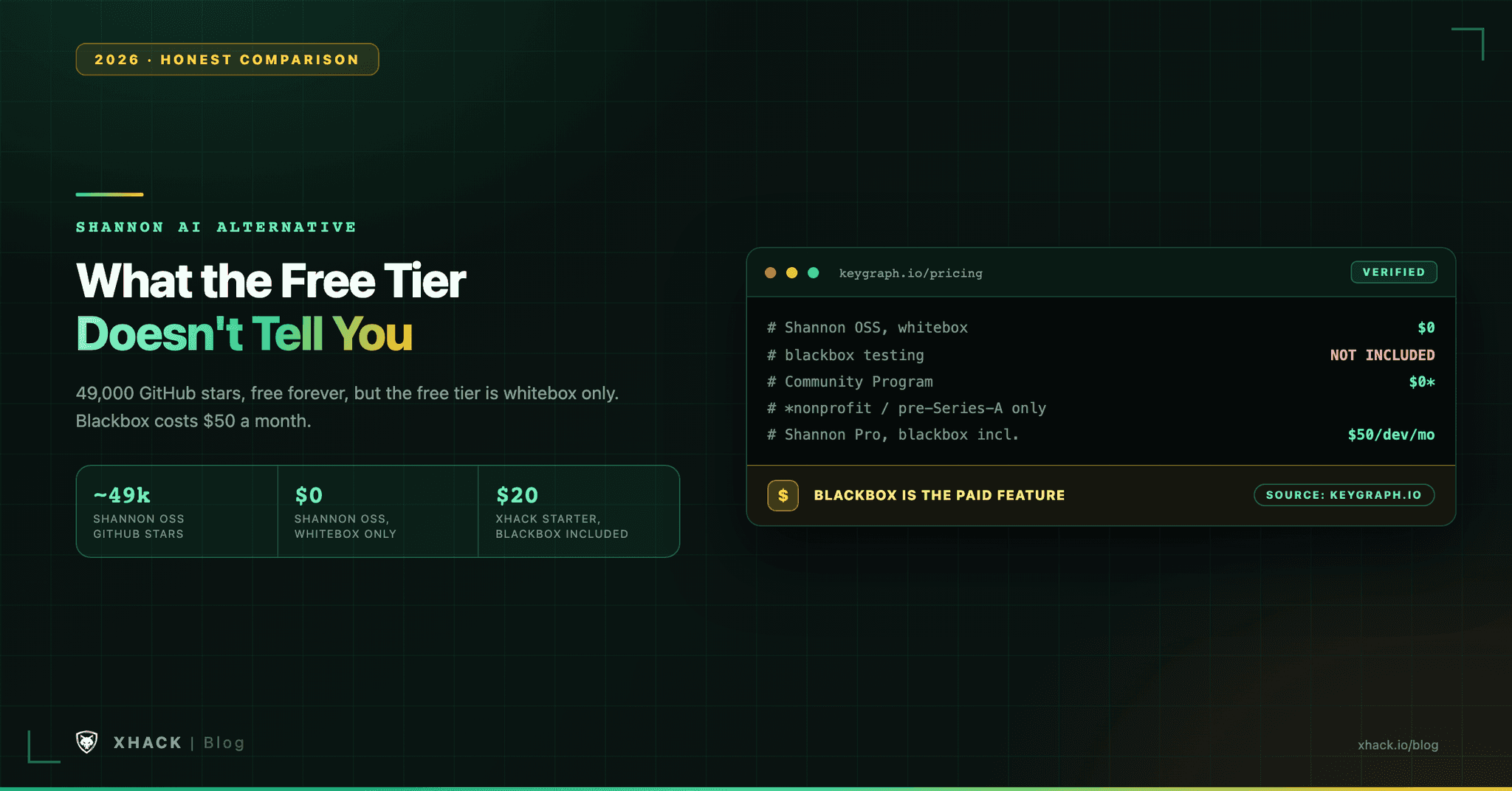
Here is the catch for bounty hunters: the open-source edition runs “against a source-available target,” and Keygraph’s own pricing page marks black-box pentesting as a paid-tier feature. If you do not have the repository, Shannon OSS is not your tool.
npx @keygraph/shannon@latest setup
npx @keygraph/shannon@latest start -u https://your-app.com -r /path/to/your/repo
Its README is the most candid of the four. “Shannon actively executes exploits,” it says, so “Do not run Shannon against production systems,” and “Findings still require human review.” A full run “can take roughly 1 to 1.5 hours and may incur LLM API costs.”
PentAGI calls itself “an open-source, self-hosted multi-agent system for autonomous penetration testing.” Its latest release is v2.2.0, dated October 5, 2026, under MIT.
Operations run in a sandboxed Docker environment, and the README flags a real risk: adding a user to the docker group “grants root-equivalent privileges.” Treat the machine that runs it as disposable.
PentestGPT’s autonomous agent “Drives Claude Code or Codex to run tools and reason without human intervention.” Its latest release is v1.0.0, dated December 24, 2025, under MIT.
So you need Claude Code or Codex installed and authenticated. It leans toward CTF-style work, and its README says the tool is “for educational purposes and authorized security testing only.”
If you already live in a proxy, the cheapest AI hacking tools are the ones built into it.
Caido’s pricing page lists Basic as free, without the AI Assistant, and Individual at $20.00 plus tax billed monthly, with the AI Assistant, unlimited projects and workflows. Its homepage says you can connect your own model provider, including Anthropic, Google and OpenAI via OpenRouter.
PortSwigger’s Professional page shows “BUY – $499” and describes Burp AI as “Your AI assistant for daily workflows.” Using it needs credits: “Unused credits expire 12 months after purchase,” and “You must have a Burp Suite Professional license associated with your account to buy AI credits.”
The credit price is not on the credits page, so budget the $499 and treat credits as an unknown until you see the checkout.
Hosted AI hacking tools trade control for convenience. Your target data goes to someone else’s servers, so read their terms before you paste in anything sensitive.
HackerAI’s pricing runs Free at $0, Pro at $29, Pro+ at $60 and Ultra at $200 a month, with Team at $40 per seat. Free includes “Agent mode with local sandbox,” and its page says “Local mode runs commands on your own machine. Cloud agents run in an isolated sandbox we host.”
Note the name collision. A separate product at hackerai.sh calls itself an open-source assistant with credit packs, and the page we read shows no terms, licence text or authorized-use wording. Make sure you are looking at the one you mean.
Penligent’s pricing lists a Free plan with “200+ pentest tools available on demand,” and Pro at “$39.92/mo billed annually” with 6,000 monthly credits, roughly 5 targets. The monthly price is not printed, so confirm it before you commit.
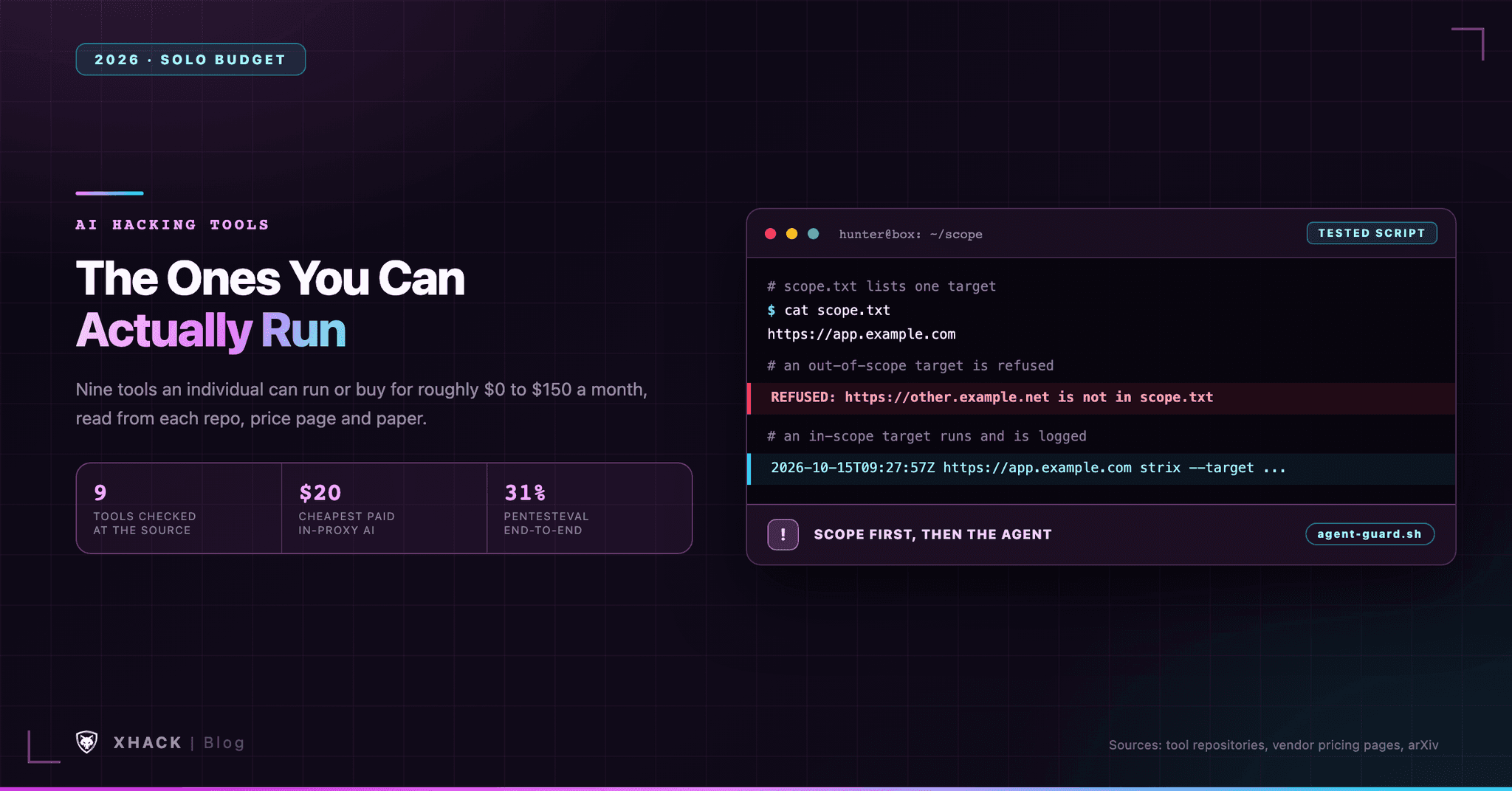
None of the AI hacking tools above enforce your scope for you, and several of their own READMEs say as much. A ten-line wrapper does the one job a README cannot: it refuses to start an agent against a target you have not written down.
#!/usr/bin/env bash
# agent-guard.sh <target> <command...>
target="$1"; shift
[ -n "$target" ] && [ "$#" -gt 0 ] || { echo "usage: $0 <target> <command...>"; exit 2; }
grep -qxF "$target" scope.txt || { echo "REFUSED: $target is not in scope.txt"; exit 1; }
echo "$(date -u +%FT%TZ) $target $*" >> agent-runs.log
exec "$@"
We tested it: an in-scope target starts the command and logs a UTC timestamp, and anything else exits with REFUSED. Use it like this:
./agent-guard.sh https://app.example.com strix --target https://app.example.comThe log doubles as evidence that you tested only what the program listed.
So yeah, here is where we talk about XHack. We build it, so weigh this section as a vendor’s.
Most AI hacking tools on this list do one job. XHack combines an AI agent you run yourself, a platform around it, and expert human testing when you want a person on the work.
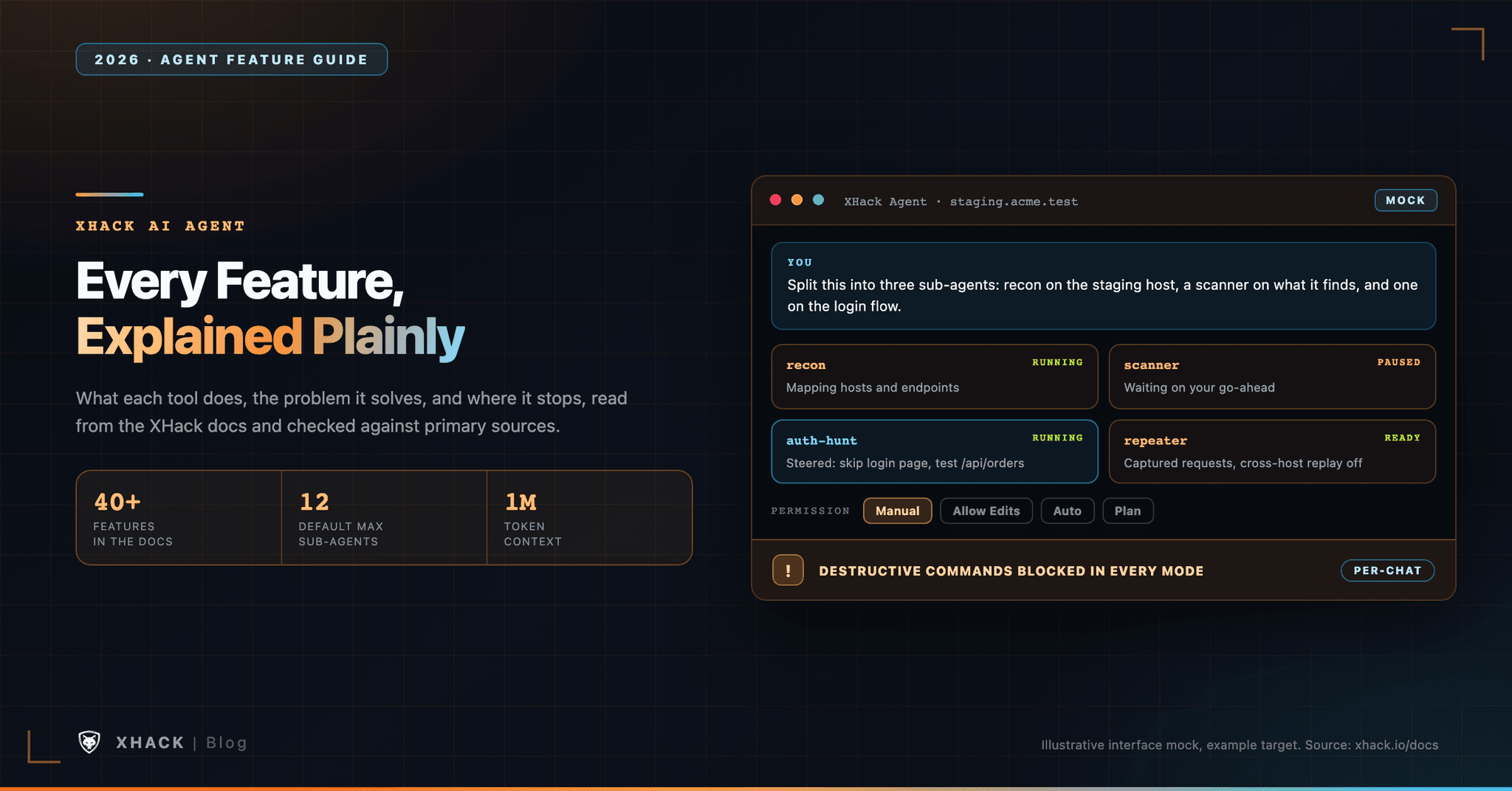
What the agent does. It runs recon, scanning and exploitation sub-agents in parallel, up to 12 of them by default, and its pages list port scanning, service enumeration and credential testing on network targets. Long scans stream to a live terminal, and you can pause, stop or redirect any agent while it runs.
What you control. Permission modes range from approving every action to read-only planning, and destructive commands such as wiping disks are blocked in every mode. You can save a methodology as a workflow the agent runs step by step, and project memory keeps your scope and targets between sessions.
What it costs. The individual plans are $20 a month for Starter at an introductory launch price, $49 for Professional and $150 for Elite, with a 7-day free trial. Professional and Elite support BYOK, and the agent can run local models through Ollama or llama.cpp. XHack does not store your data, and your session data stays on your own computer.
The honest part. XHack is a proprietary service, and we are not quoting a benchmark score for it here, so treat any accuracy number from any vendor, ours included, as a claim. The pages do not describe an automatic scope-enforcement control, so the guard script above applies here too. Our terms say AI output may be incomplete, inaccurate or wrong, and you validate every finding before you submit it.
If you want a free agent, use Strix or PentAGI, because they cost nothing and work. Want to try ours on targets you are authorized to test? Start the trial, or compare us with the others in our Strix comparison and our cheapest AI pentest tool guide. Brutal honesty is kind of our thing, even when the answer is “you do not need us.”
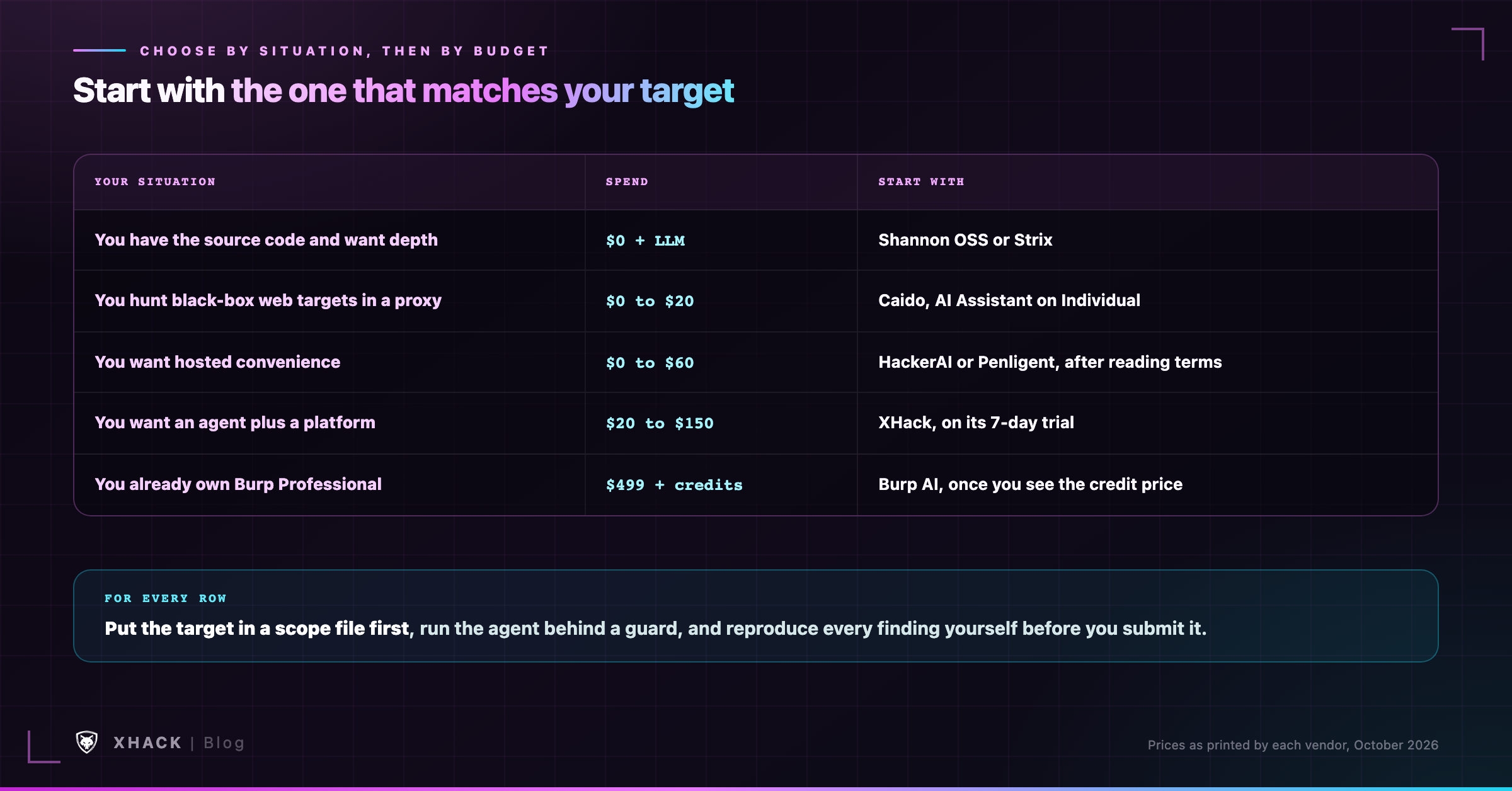
| Your situation | Spend | Start with |
|---|---|---|
| You have the source code and want depth | $0 plus LLM bill | Shannon OSS or Strix |
| You hunt black-box web targets in a proxy | $0 to $20 a month | Caido, with its AI Assistant on Individual |
| You want hosted convenience | $0 to $60 a month | HackerAI or Penligent, after reading their terms |
| You want agent plus platform | $20 to $150 a month | XHack, on its 7-day trial |
| You already own Burp Professional | $499 plus credits | Burp AI, once you see the credit price |
Start with Strix or Caido’s AI Assistant. Strix needs a Docker install and a model key, and Caido’s Individual plan is $20 a month. Both are easy to inspect, and both teach you what the AI is doing before you trust it.
Run them like any AI hacking tools that execute real commands: in an isolated machine, against targets you own or are authorized to test. PentAGI warns that Docker-group access is “root-equivalent,” and Shannon’s README says not to run it against production.
Usually, yes. Strix takes a LLM_API_KEY, or a local model through LLM_API_BASE, and Shannon says “You bring your own key.” PentestGPT’s autonomous mode needs Claude Code or Codex installed and authenticated.
They allow them with conditions. HackerOne says hackbot operators are responsible and hackbots must follow program policy, and Bugcrowd holds the researcher accountable for each submission’s accuracy. Check each program’s own rules, because programs can add their own.
Not on this evidence. ARTEMIS beat 9 of 10 human participants on one network but showed higher false-positive rates, and PentestEval found end-to-end success of only 31%. Treat AI as a fast junior who needs checking.
The plans here run from $0 to $200, and open-source tools add a model bill that varies with your provider and usage. Shannon’s README says a full run can take 1 to 1.5 hours and “may incur LLM API costs,” so set a spending cap with your provider first.
The best AI hacking tools for a solo researcher are mostly free or under $60 a month, and the expensive mistakes are about scope, trust and unvalidated output. Pick one open-source agent and one proxy feature, run them behind a scope guard, and keep every finding in your own hands until you have reproduced it.
If one agent could save you the repetitive hours, test it on a trial and measure the time it saves, not the features it lists.
Categories
Related articles