XHack Logo
XHack
Products
Services
Compliance
Pricing
Resources
Company
Sign upLogin
XHack Logo
XHackOffensive Security

Certified offensive security team delivering penetration testing evidence written for your auditor.

OSCP+OSCPC-AI/MLPenCASA
support@xhack.io

24/7 SOC Operations

XHack Status
Under attack? Get help now
Services
  • VAPT Services
  • Red Teaming
  • SOC Services
  • Threat Intelligence
  • Incident Response
  • Managed Testing
Pricing
  • Platform Plans
  • Services Pricing
Compliance
  • SOC 2
  • PCI DSS
  • ISO 27001
  • GDPR
  • HIPAA
  • ISO 42001
  • AI Maturity Assessment
  • TX-RAMP
  • NBFC / SECP
  • All Frameworks
Products
  • Vulnerability Assessment
  • GitGuard
  • AI Probe
  • SOC Dashboard
  • AI Agent
  • Cloud Investigation
Comparison
  • XBOW vs XHack
  • Horizon3 vs XHack
  • Strix vs XHack
  • Pentera vs XHack
Resources
  • Platform Tour
  • All Features
  • Install the Agent
  • XHack AI
  • Documentation
  • Blog
  • Case Studies
  • Documents
  • FAQ
Company
  • About Us
  • Our Team
  • Certifications
  • Security and Trust
  • VAPT Explained
  • Contact

© 2026 XHack. All rights reserved.

Security & TrustVulnerability DisclosurePrivacy PolicyTerms of ServiceRefund Policy
Blog/Security

MCP Server Vulnerabilities: A Bug Hunter’s Guide to Finding and Reporting Them

XHack

XHack

Author

October 19, 2026

14 min read

MCP Server Vulnerabilities: A Bug Hunter’s Guide to Finding and Reporting Them

Table of contents

17

Why MCP Server Vulnerabilities Are a Real Target, Not a Theoretical One

CVE-2026-30623: Command Injection in LiteLLM’s MCP Server Creation

CVE-2026-13341: Confused Deputy via Indirect Prompt Injection in Kong Konnect

The MCP Server Vulnerabilities Worth Testing For

How to Actually Find MCP Server Vulnerabilities, Step by Step

Where MCP Server Vulnerabilities Actually Fit in Bug Bounty Scope Today

Writing Up MCP Server Vulnerabilities as a Finding

How XHack Helps With MCP Server Testing

Common Mistakes When Hunting for MCP Server Vulnerabilities

FAQ: MCP Server Vulnerabilities Questions Answered

What are the most common MCP server vulnerabilities?

Does CVE-2026-30623 affect every MCP SDK?

Can I get paid for finding an MCP server vulnerability?

What’s the difference between tool poisoning and prompt injection among MCP server vulnerabilities?

How do I write up a reproducible report on MCP server vulnerabilities?

Is MCP server security the same as regular API security?

The Bottom Line on MCP Server Vulnerabilities

By Salman Khan, OSCP+, Founder of XHack, SRT (Synack Red Team member)

Read this in 30 seconds: MCP server vulnerabilities, the kind of MCP server vulnerabilities worth a hunter’s time, are a real, current, under-tested attack surface, confirmed by NVD-verified CVEs like a 9.8 command injection in LiteLLM’s MCP server creation flow and a confused-deputy prompt injection in Kong’s Konnect MCP server, and most bug bounty programs haven’t caught up to how to scope or pay for them yet.

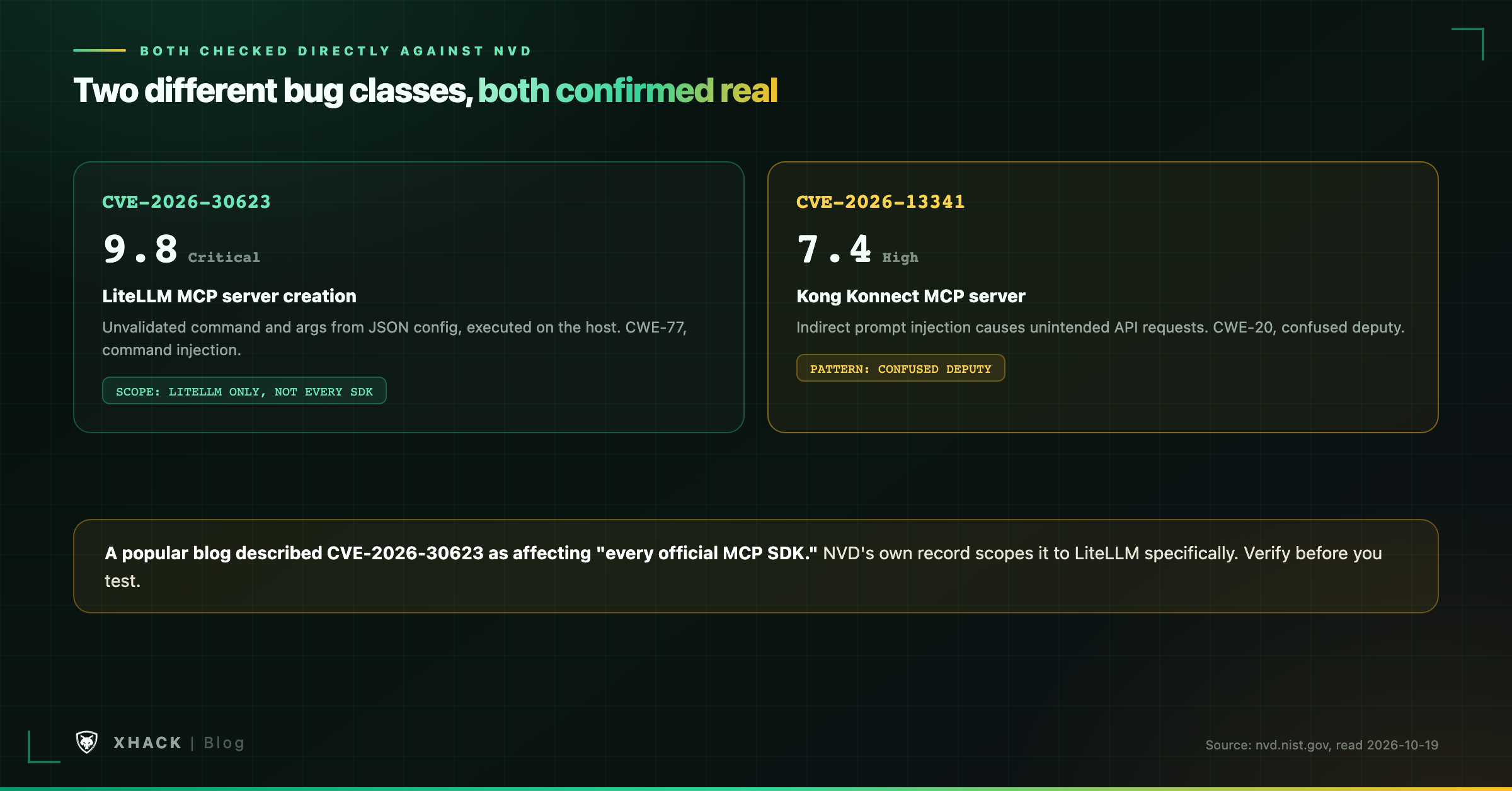
  • A 9.8 in a mainstream MCP implementation, confirmed on NVD. CVE-2026-30623 is command injection (CWE-77) in LiteLLM’s MCP server creation flow: it executes attacker-supplied command and args values from a JSON config with no validation.
  • Confused deputy isn’t theoretical. CVE-2026-13341 in Kong’s Konnect MCP server (CVSS 7.4) lets an indirect prompt injection make the server execute API requests the caller never intended.
  • A secondary blog’s broader claim didn’t hold up against NVD. One widely shared write-up described CVE-2026-30623 as a flaw in “every official MCP SDK.” NVD’s actual record scopes it to LiteLLM specifically, a reminder to verify vendor claims yourself before you test or report.
  • Scope is genuinely unclear right now. Anthropic’s own bounty terms exclude its reference MCP servers and cover only the maintained SDKs, which means a vulnerability in a popular community MCP server may have nowhere obvious to go yet.
  • Tool poisoning needs no CVE to be real. A malicious or compromised MCP server can return tool descriptions that instruct an agent to act against the user’s intent, a vulnerability class current CVE databases mostly don’t capture well.

MCP servers are a genuinely new attack surface, not a rebrand of API security, and the bug bounty ecosystem’s scope rules haven’t caught up to that yet.

The Model Context Protocol connects AI agents to tools, files, and APIs, and its own specification states plainly that it does not enforce security at the protocol level. That gap is where real, confirmed MCP server vulnerabilities live, not hypothetical ones. This guide to MCP server vulnerabilities covers the classes worth testing for, two real CVEs we verified directly against NVD rather than repeated from a blog, how to actually find these issues, and the honest state of where they currently fit in bug bounty scope.

We already cover the defender’s side of this in our MCP server security guide, lockdown controls for teams running MCP servers. This article is the opposite angle: what to actually test and report if you’re hunting, not deploying.

Why MCP Server Vulnerabilities Are a Real Target, Not a Theoretical One

An MCP server sits in an unusual position: it’s a piece of infrastructure that an AI agent trusts by design, often with far less scrutiny than a human would apply to a new API integration. That trust relationship is exactly what makes MCP server vulnerabilities worth testing for.

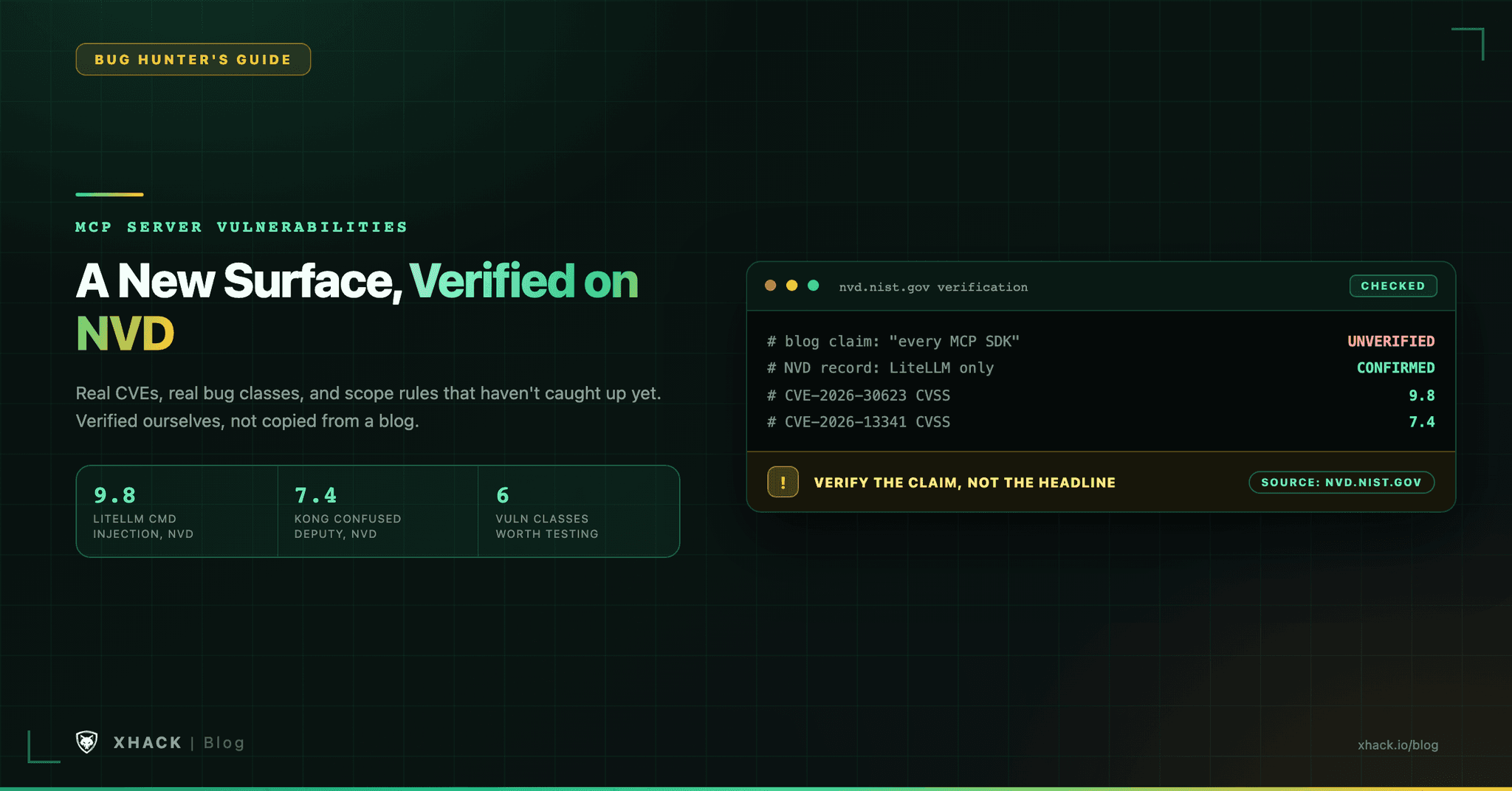
Two verified, current CVEs make these MCP server vulnerabilities concrete rather than hypothetical. We checked both directly against NVD’s own record rather than relying on secondary write-ups, since one of them turned out to be described incorrectly by a popular blog post.

CVE-2026-30623: Command Injection in LiteLLM’s MCP Server Creation

NVD’s record describes it exactly: “LiteLLM 1.18.10 contains a remote code execution vulnerability in its MCP server creation functionality. The application allows users to add MCP servers via a JSON configuration specifying arbitrary command and args values. LiteLLM executes these values on the host without validation.”

  • Severity: 9.8, Critical, CVSS 3.1, AV:N/AC:L/PR:N/UI:N/S:U/C:H/I:H/A:H.
  • Weakness: CWE-77, command injection.
  • The honesty check: a secondary blog post we read while researching this guide described CVE-2026-30623 as a flaw in “every official MCP SDK,” tied to the STDIO transport. NVD’s own description scopes it specifically to LiteLLM’s MCP server creation feature, not a cross-SDK flaw. We’re flagging this discrepancy explicitly rather than repeating the broader claim, because it matters for scope: if you’re hunting, test the actual product, not the headline a blog gave it.

The lesson for a hunter testing for MCP server vulnerabilities: any feature that lets a user or admin configure how an MCP server is launched, especially a command plus arguments pattern, deserves the same scrutiny you’d give a classic OS command injection point. The fact that “MCP” is in the product name doesn’t make the underlying bug class new.

CVE-2026-13341: Confused Deputy via Indirect Prompt Injection in Kong Konnect

Kong’s own security advisory and NVD both describe this as an indirect prompt injection in the Kong Konnect MCP server, versions before 1.0.0, that causes the server to execute API requests the caller never intended.

  • Severity: 7.4, High, CVSS 3.1, AV:N/AC:L/PR:N/UI:R/S:C/C:H/I:N/A:N.
  • Weakness: CWE-20, improper input validation.
  • Why it’s a confused deputy, specifically: the MCP server has legitimate permission to make API calls on a user’s behalf. The flaw is that content the server processes, not a direct command from the authenticated user, can steer which API calls it actually makes. That’s the textbook confused deputy pattern, just expressed through a prompt instead of a crafted request.
Two NVD-verified MCP CVEs: command injection in LiteLLM and confused-deputy prompt injection in Kong Konnect
Two real, verified CVEs, two different bug classes

The MCP Server Vulnerabilities Worth Testing For

Beyond the two CVEs above, these are the recurring classes of MCP server vulnerabilities a bug hunter should actively probe for in any server in scope:

  1. Command or argument injection in server launch configuration, the exact pattern behind CVE-2026-30623. Test anywhere a user, even an authenticated one, can influence how a server process gets started.
  2. Indirect prompt injection and confused deputy, the CVE-2026-13341 pattern. Test whether content the server reads (a file, a webpage, an email, a tool response) can change which actions the server takes on your behalf.
  3. Tool poisoning. A server can return tool descriptions or metadata containing hidden instructions aimed at the agent, not the user. This rarely gets its own CVE because it’s a behavior pattern, not a code flaw, which makes it easy to miss if you’re only scanning for known vulnerability signatures.
  4. Authentication gaps on the MCP endpoint itself. We covered a real example of this directly: CVE-2026-59822, an empty UserAPIKeyAuth() fallback in LiteLLM’s MCP implementation, the first MCP flaw CISA ever added to its KEV catalog. Test every MCP endpoint for the basics: is authentication actually enforced, or does a missing or malformed credential silently fall through to an authenticated default.
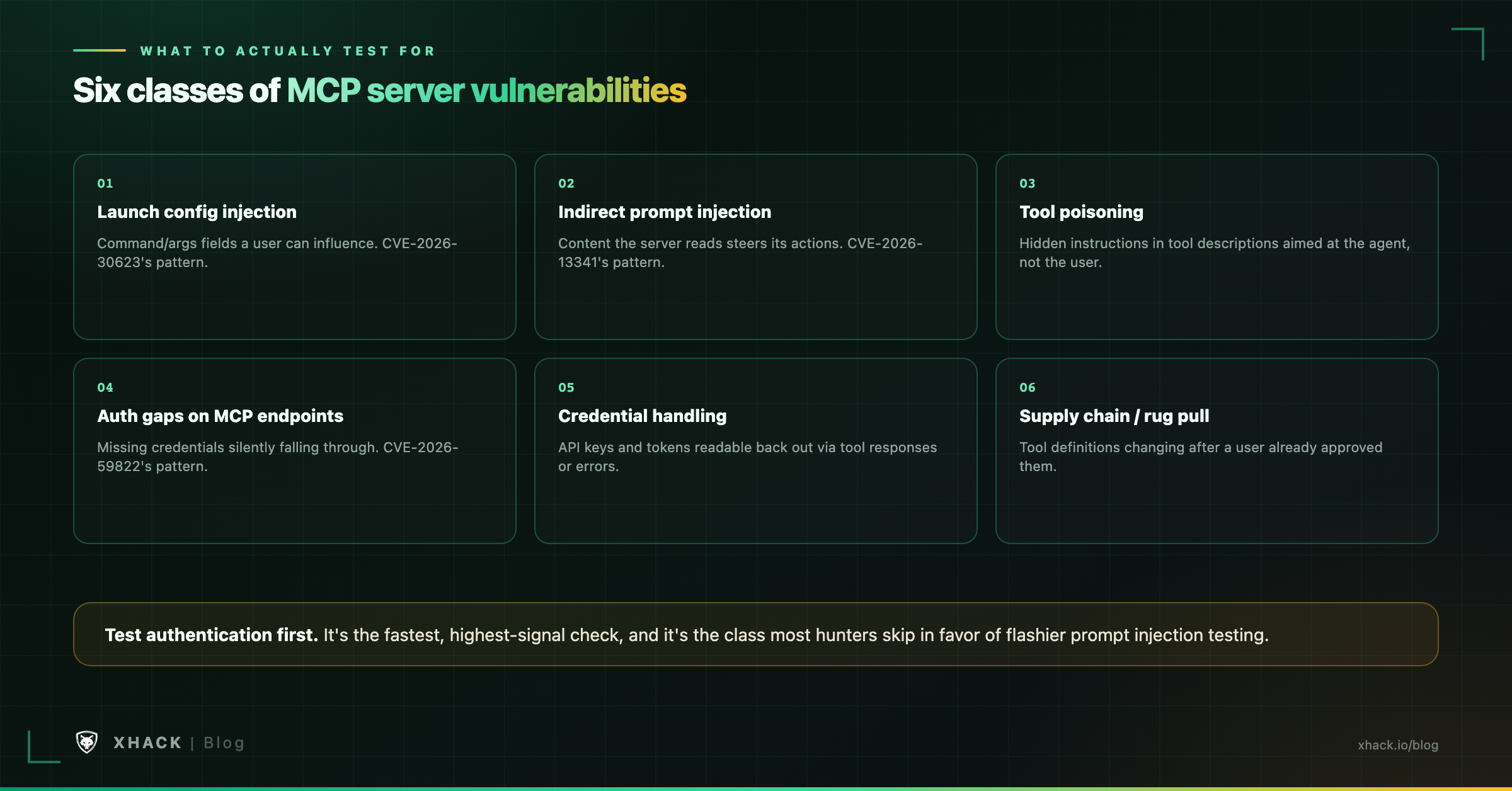
  5. Credential and secret handling. Where does the server store the API keys and tokens it uses to reach downstream tools, and can a lower-privileged caller read them back out through a tool response or error message.
  6. Supply chain and “rug pull” risk. An MCP server’s tool definitions can change after a user has already approved them, silently expanding what the server is allowed to do. This is harder to test for directly, but worth documenting as a finding if you can demonstrate a server changing its declared tool behavior post-approval.
Six MCP server vulnerability classes a bug hunter should test for, from command injection to supply chain rug pulls
Six classes worth testing for, ranked by how testable each one is

How to Actually Find MCP Server Vulnerabilities, Step by Step

  1. Enumerate every MCP server and endpoint in scope, not just the obvious ones. Agent tooling often wires up MCP servers as an afterthought, a common source of MCP server vulnerabilities, so check configuration files, environment variables, and any agent framework config the target exposes.
  2. Test authentication first, on every endpoint. This is the fastest, highest-signal check: send a request with no credential, a malformed credential, and an expired one, and confirm each is actually rejected rather than silently treated as authenticated. This is exactly the class of bug CVE-2026-59822 was.
  3. Read every tool description the server returns, not just the tool names. Tool poisoning hides in the description text an agent reads, not in a function signature a human would normally review.
  4. Find every place a server’s launch behavior is configurable, and test command and argument fields specifically for injection, the CVE-2026-30623 pattern.
  5. Trace what a server does with content it reads, not just commands it receives. If the server fetches a URL, opens a file, or reads an email as part of its normal operation, test whether instructions embedded in that content can redirect its actions, the CVE-2026-13341 pattern.
  6. Document reproduction carefully. MCP findings are often behavior-dependent on the specific agent and model in the loop, so a triager needs your exact client, model, and prompt sequence to reproduce it, not just a description of what happened.
# Illustrative: a quick first pass checking whether an MCP endpoint
# actually enforces auth, versus silently accepting no credential.
curl -s -o /dev/null -w "no-auth: %{http_code}\n" https://target/mcp
curl -s -o /dev/null -w "bad-auth: %{http_code}\n" https://target/mcp \
  -H "Authorization: Bearer not-a-real-token"

A 200 on either line, where the server should require a valid credential, is the first signal worth digging into.

Where MCP Server Vulnerabilities Actually Fit in Bug Bounty Scope Today

Be honest with yourself about this before you invest hours: scope for MCP server vulnerabilities is genuinely unsettled right now. Anthropic’s own reference-server security policy states its bounty applies “exclusively to the MCP SDKs maintained by Anthropic,” and that “bug bounties are not awarded for security vulnerabilities found in these reference servers.” That means a real vulnerability in a popular, widely-deployed reference implementation may have no paying home at Anthropic specifically, even though it’s a genuine risk.

This doesn’t mean MCP findings aren’t valuable. It means you need to check each individual program’s scope carefully, since the answer varies by vendor and isn’t standardized yet the way web app scope generally is. A finding in a vendor’s own MCP server, inside their product, is a much clearer fit than a finding in a shared open-source MCP server nobody specifically owns the bounty for.

Writing Up MCP Server Vulnerabilities as a Finding

A strong report on MCP server vulnerabilities needs a few things a typical web finding doesn’t:

  • The exact client and model combination you used. Agent behavior on a prompt injection or tool poisoning finding can vary by model, so a triager needs to know what you actually tested with.
  • The full prompt or content sequence, not just a summary. If the bug depends on specific wording in a tool description or injected content, that wording is the proof of concept.
  • A clear statement of which action the agent took that it shouldn’t have, tied to a concrete impact: data exfiltrated, an unintended API call made, a file written outside the expected scope. “The agent behaved unexpectedly” isn’t a finding; a specific unauthorized action is.
  • The CWE that actually fits, which for most of these is CWE-20 (improper input validation), CWE-77 (command injection), or CWE-290 (authentication bypass by spoofing), depending on the specific mechanism, not a generic “AI vulnerability” label that doesn’t map to anything a triager can act on.

How XHack Helps With MCP Server Testing

So yeah, here’s the part where we talk about our own angle, clearly marked as that.

XHack’s agent supports MCP connections, so testing an MCP integration is part of the same workflow as testing any other tool surface, not a separate specialty you need a different product for. For the classes above specifically, the agent’s recon and exploit-development capabilities apply directly: tracing how a server handles configurable launch behavior, checking authentication on every discovered endpoint, and reading tool descriptions the same way the hunting methodology above describes doing manually.

The honest part. Agent behavior on the prompt injection and tool poisoning classes of MCP server vulnerabilities is genuinely hard to make fully deterministic, for any tool, including ours. You are still the one who confirms a finding is real and reproducible before you submit it, and our terms are explicit that AI output can be wrong.

If MCP testing is part of your bug bounty workflow already, our coverage of AI exploit development and agentic pentesting go deeper on the exploit-chaining side of this. Start the trial or book a free consultation if you want to see how it fits your specific targets.

Common Mistakes When Hunting for MCP Server Vulnerabilities

  • Repeating a secondary source’s CVE scope without checking NVD. We caught exactly this mistake while researching MCP server vulnerabilities for this guide; verify the actual affected product before you test or report.
  • Treating tool poisoning as out of scope because it has no CVE. Behavior-based MCP server vulnerabilities are real findings; document them with the same rigor as a code-level bug.
  • Skipping the boring auth check. CVE-2026-59822 and the no-auth test above exist because basic “is this endpoint actually authenticated” checks get skipped in favor of flashier prompt injection testing.
  • Submitting a prompt injection finding without the exact reproduction sequence. A triager who can’t reproduce your exact client, model, and prompt combination will close the report as unverifiable.
  • Assuming every program pays for MCP findings the same way. Check scope per program; Anthropic’s own reference-server exclusion is proof this isn’t standardized yet.

FAQ: MCP Server Vulnerabilities Questions Answered

What are the most common MCP server vulnerabilities?

The most common MCP server vulnerabilities, the ones worth prioritizing first, are command or argument injection in server launch configuration, indirect prompt injection leading to confused-deputy behavior, tool poisoning through malicious tool descriptions, authentication gaps on MCP endpoints, and credential exposure. Two of these are backed by specific, NVD-verified CVEs: CVE-2026-30623 (LiteLLM, command injection) and CVE-2026-13341 (Kong Konnect, confused deputy).

Does CVE-2026-30623 affect every MCP SDK?

No. A secondary blog described it that way, but NVD’s own record scopes CVE-2026-30623 specifically to LiteLLM’s MCP server creation functionality, not a cross-SDK flaw. Verify a CVE’s actual scope against NVD before you test or report based on a blog’s framing.

Can I get paid for finding an MCP server vulnerability?

It depends entirely on the program. Some vendors’ bounty programs cover vulnerabilities in their own MCP implementations clearly. Others, including Anthropic’s own reference-server policy, explicitly exclude certain MCP servers from the bounty and cover only specific maintained SDKs. Check each program’s scope individually before investing time.

What’s the difference between tool poisoning and prompt injection among MCP server vulnerabilities?

Prompt injection is content steering an agent’s behavior, which can come from anywhere the agent reads untrusted content. Tool poisoning is a specific case of it: the MCP server’s own tool descriptions or metadata, which the agent is expected to trust by design, contain the malicious instructions.

How do I write up a reproducible report on MCP server vulnerabilities?

Include the exact client and model you tested with, the full prompt or content sequence that triggers the behavior, and a specific unauthorized action as the impact, not a vague description of unexpected behavior. Agent behavior can vary by model, so precision in your reproduction steps is what gets a finding triaged instead of closed as unverifiable.

Is MCP server security the same as regular API security?

No. It shares some overlap, but MCP introduces specific new patterns like tool poisoning and prompt-injection-driven confused deputy behavior that don’t have a direct equivalent in traditional API security testing. Our MCP server security guide covers the defensive controls side if you’re securing a deployment rather than testing one.

The Bottom Line on MCP Server Vulnerabilities

MCP server vulnerabilities, as this guide has shown, are real, current, and confirmed by specific CVEs you can check against NVD yourself, not a speculative future risk category. CVE-2026-30623 and CVE-2026-13341 prove the bug classes are concrete: command injection in launch configuration, and confused deputy through indirect prompt injection.

What’s genuinely unsettled about MCP server vulnerabilities is scope and payout, not whether they’re real. Test the classes above, verify any vendor or blog claim against NVD yourself before you rely on it, document reproduction with the precision these findings need, and check each program’s actual scope before assuming a payout exists for what you found.


Categories

Security

Previous

CVE-2026-0322: Why “Authenticated” Doesn’t Mean Low-Risk on a PAN-OS Firewall

Next

CVE-2026-105134: The Ahsay Backup Server Patch That Took Three Tries

On this page

Why MCP Server Vulnerabilities Are a Real Target, Not a Theoretical One

CVE-2026-30623: Command Injection in LiteLLM’s MCP Server Creation

CVE-2026-13341: Confused Deputy via Indirect Prompt Injection in Kong Konnect

The MCP Server Vulnerabilities Worth Testing For

How to Actually Find MCP Server Vulnerabilities, Step by Step

Where MCP Server Vulnerabilities Actually Fit in Bug Bounty Scope Today

Writing Up MCP Server Vulnerabilities as a Finding

How XHack Helps With MCP Server Testing

Common Mistakes When Hunting for MCP Server Vulnerabilities

FAQ: MCP Server Vulnerabilities Questions Answered

What are the most common MCP server vulnerabilities?

Does CVE-2026-30623 affect every MCP SDK?

Can I get paid for finding an MCP server vulnerability?

What’s the difference between tool poisoning and prompt injection among MCP server vulnerabilities?

How do I write up a reproducible report on MCP server vulnerabilities?

Is MCP server security the same as regular API security?

The Bottom Line on MCP Server Vulnerabilities

Related articles

Continue reading

Bug Bounty Report Writing: What Actually Gets You Triaged Fast

Security

Bug Bounty Report Writing: What Actually Gets You Triaged Fast

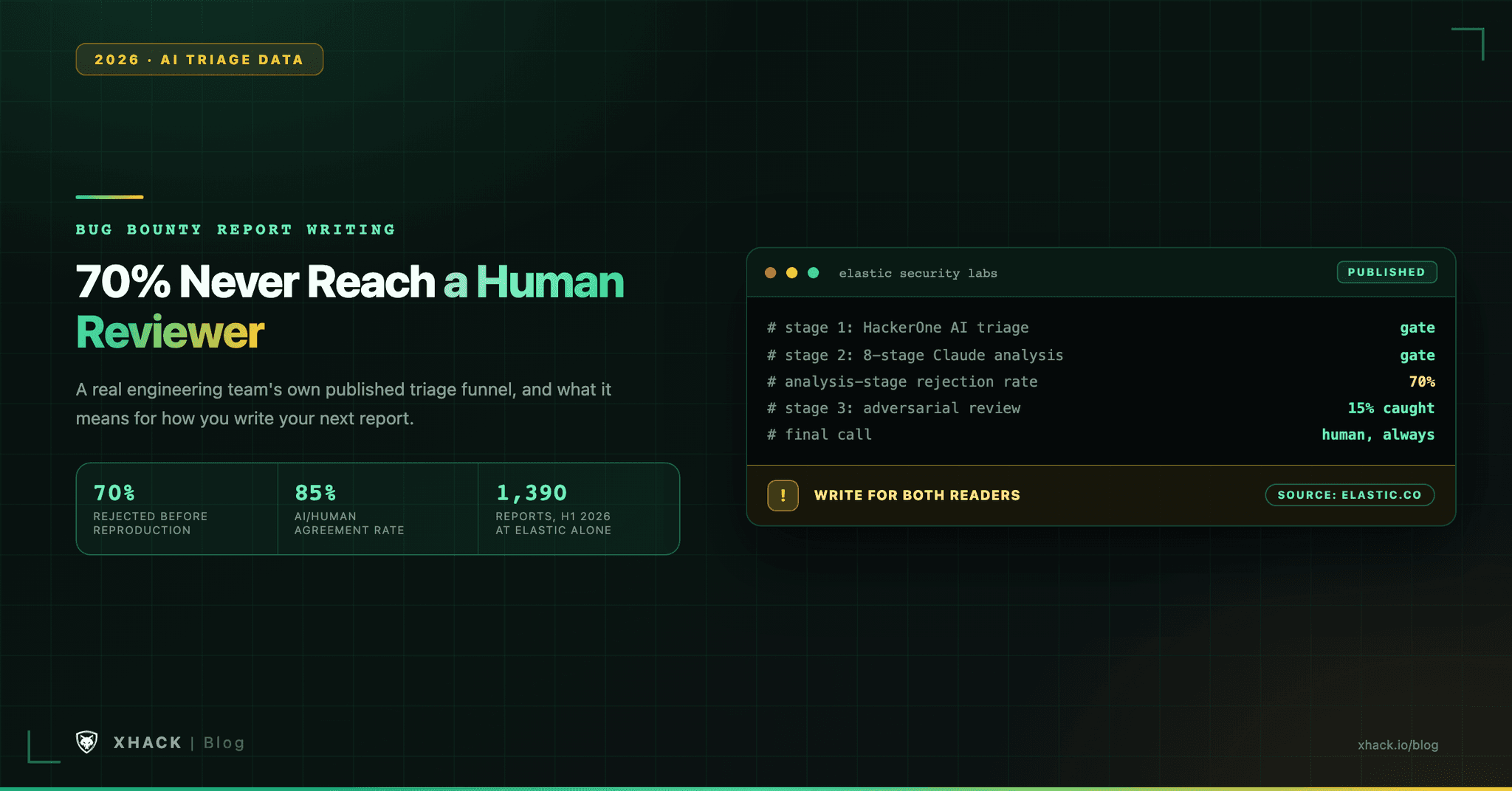
Bug bounty report writing advice backed by real data: 70% of reports are rejected by AI triage before a human sees them....

Read article
Shannon AI Alternative for Bug Hunters: The Honest 2026 Comparison

Security

Shannon AI Alternative for Bug Hunters: The Honest 2026 Comparison

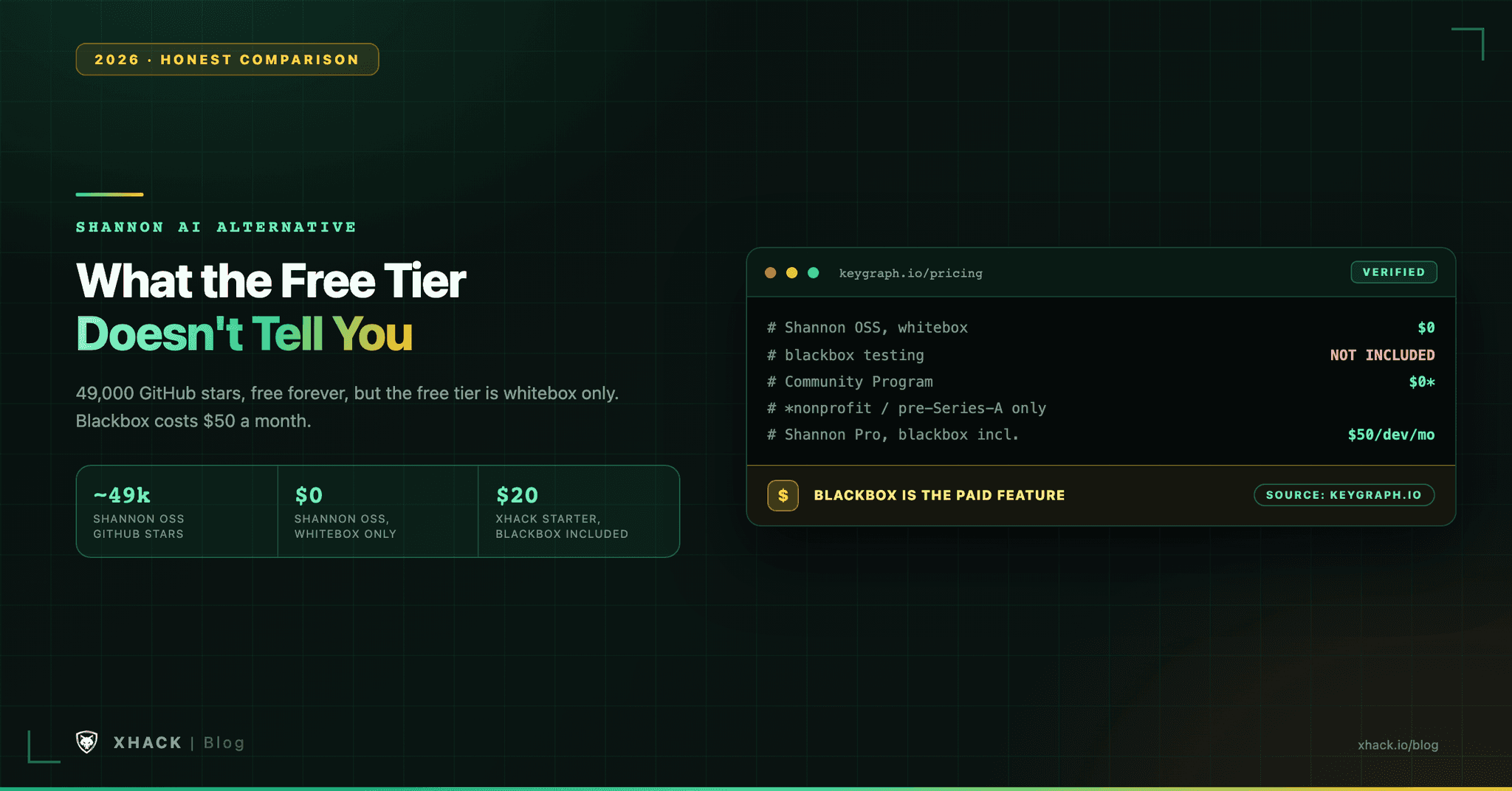
A Shannon AI alternative comparison: its free tier is whitebox only, blackbox testing costs $50 a month. See where XHack...

Read article
Bug Bounty Toolkit on a Budget: The Complete 2026 Stack

Security

Bug Bounty Toolkit on a Budget: The Complete 2026 Stack

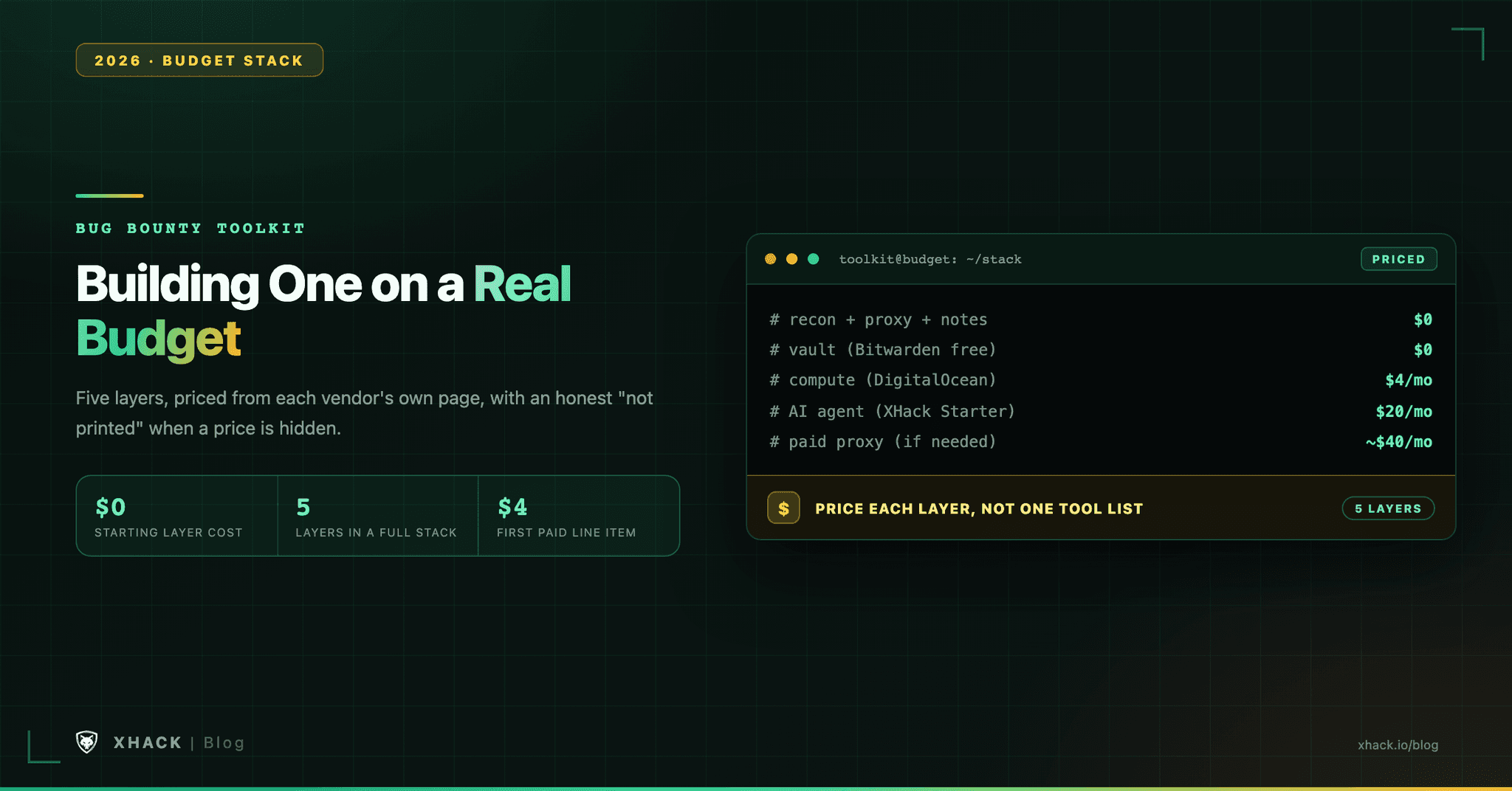
A bug bounty toolkit on a budget, priced layer by layer: a $0 free stack, a $4 VPS, paid proxies and AI, sourced from ea...

Read article