Table of contents
24
By Salman Khan, OSCP+, Founder of XHack, SRT (Synack Red Team member)
Read this in 30 seconds: Every CTF solver repo and product claims it solves challenges, but none of the ones I checked lets you score your own solver on the same tasks. This guide gives you the public evidence, the event rules, and a small test harness that does the scoring.
- A CTF solver is only as good as its test, and the public tests are thin. The best-known repo,
verialabs/ctf-agent(MIT, 950 GitHub stars), reports one aggregate result of 52 of 52 at BSidesSF 2026, which is self-reported, with no per-category numbers and no harness.- Difficulty decides the outcome, not the model. In the Cybench benchmark of 40 professional tasks, agents solved tasks that took human teams up to 11 minutes, while the hardest task took 24 hours and 54 minutes.
- Easy challenges are already lost to AI. In a Hack The Box event with 403 teams, 5 of 8 AI teams solved 19 of 20 challenges, and the best AI team placed 20th.
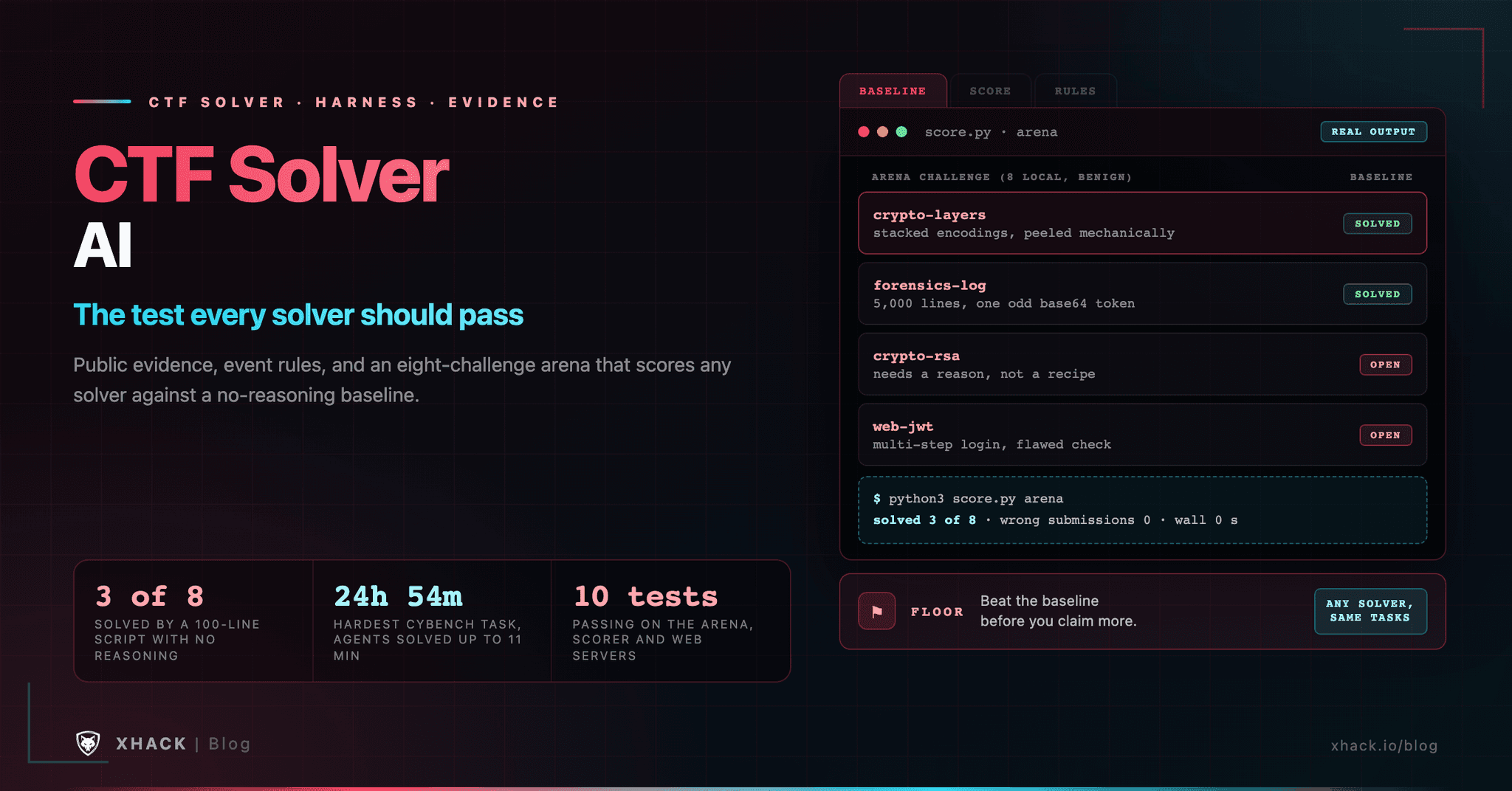
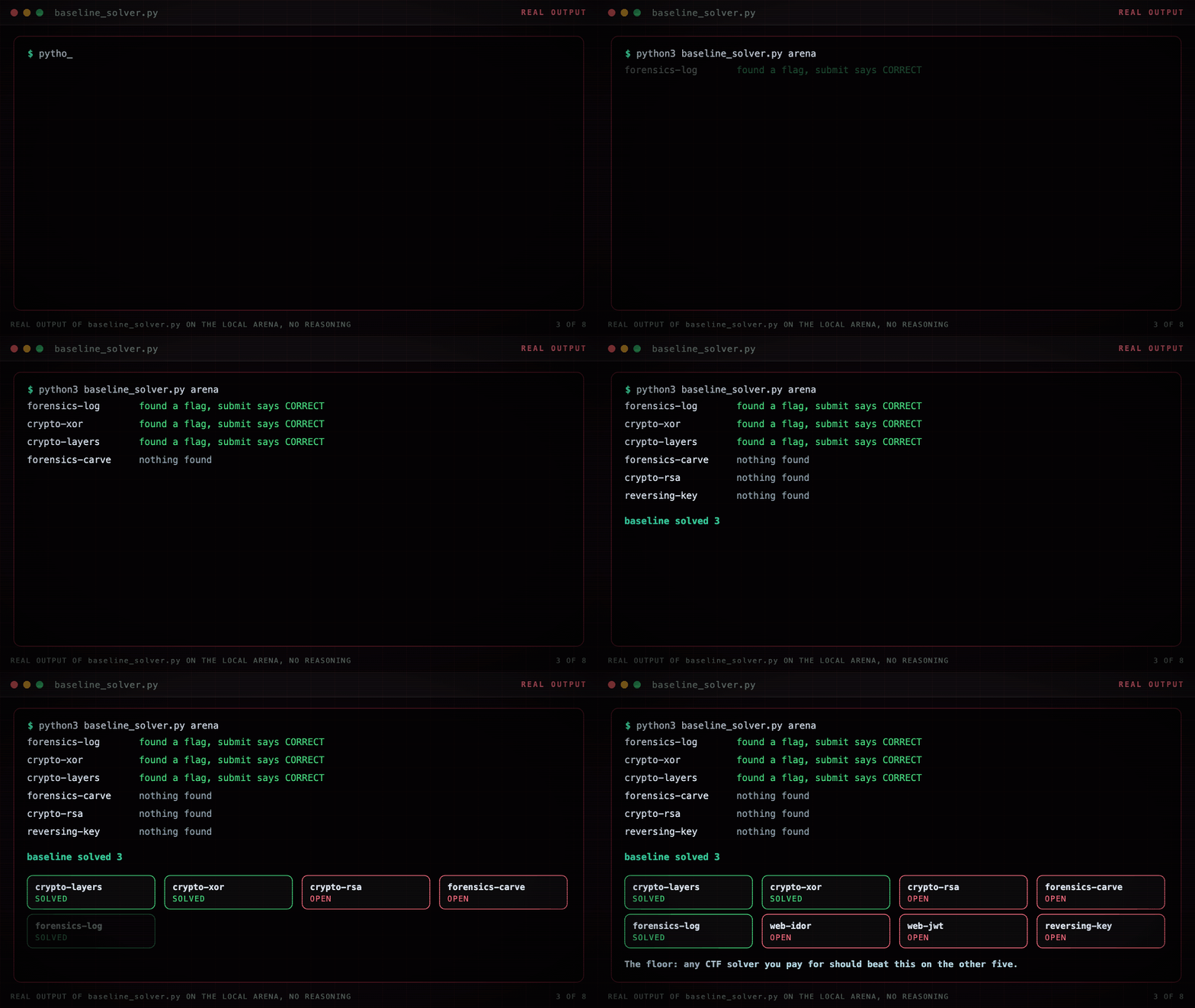
- A script with no reasoning solves 3 of 8 in my arena. It handles layered encodings, a one-byte XOR and a log search in 0.1 seconds, which is the floor any AI CTF solver has to beat.
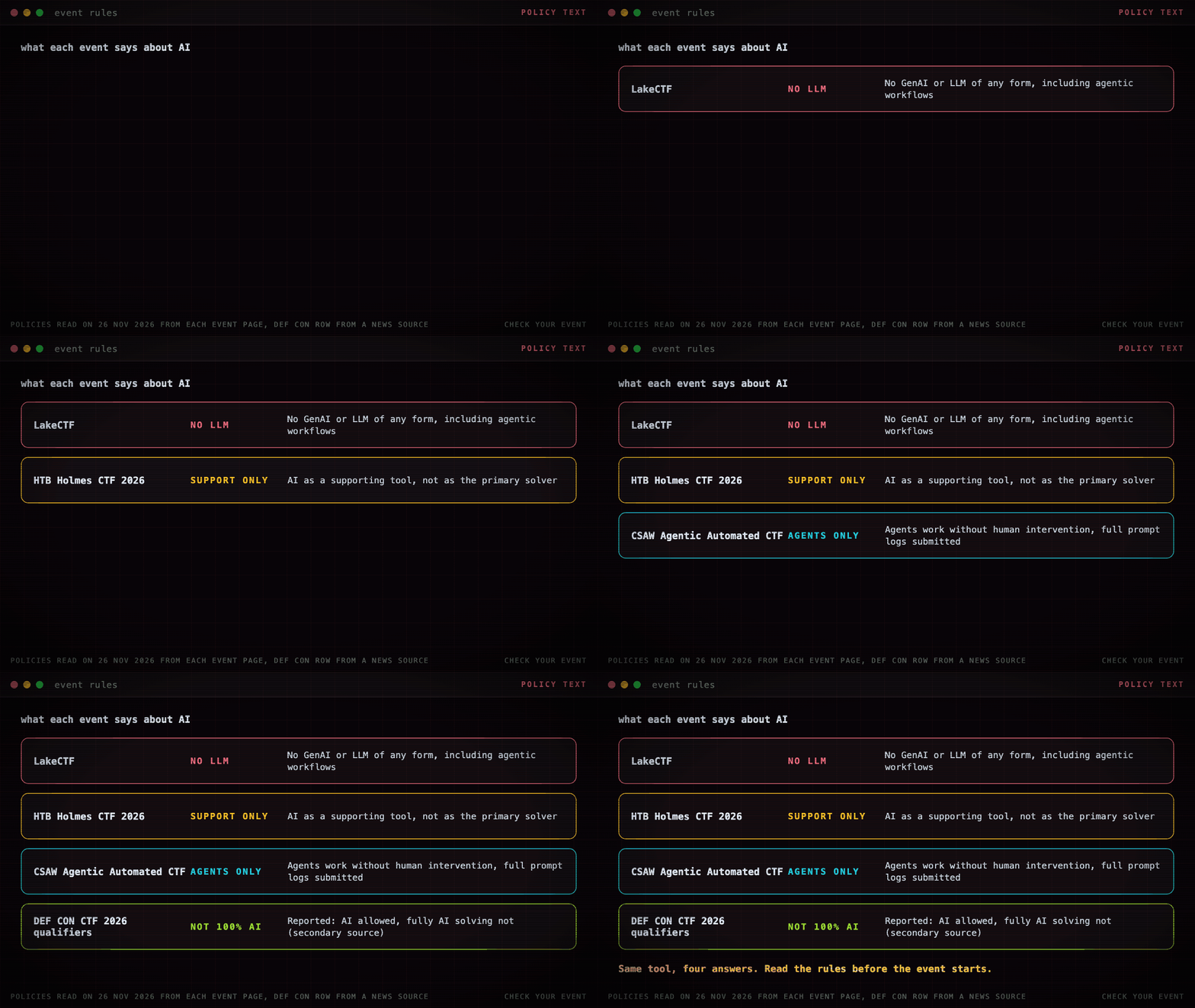
- Rules differ by event. LakeCTF bans all LLM use, Hack The Box Holmes 2026 allows AI only as a supporting tool, and CSAW runs a track for fully autonomous agents.
A CTF solver is a loop that reads a challenge, runs tools, watches the output and submits a flag, and the honest question is not whether it works but on which kind of challenge. The public answer is that it works well on short, well-defined tasks and falls off fast as the human solve time grows.
This guide to the AI CTF solver covers four things: what the public evidence says, who publishes what, how the event rules differ, and an eight-challenge local arena with a scorer you can point at any solver, XHack’s agent included. For the practical side of using one, see AI for CTF and Claude Code for CTF.
A CTF solver is five parts, and most repos only ship two of them. The parts are a model that decides what to try, a set of tools it can call, a sandbox where those tools run, a flag checker that says right or wrong, and a budget that stops the run.
Here is why that matters for choosing one. The model and the tools get all the attention. The sandbox decides whether a wrong command can hurt you. The flag checker and the budget decide whether you can trust and afford the result, and almost no project publishes either.
The loop itself is simple. The solver reads the challenge text and files, picks a tool, runs it, reads the output and updates its plan. It repeats until it submits a flag or runs out of steps. The Cybench and EnIGMA research papers describe the same loop, and EnIGMA’s contribution was letting the agent use interactive tools such as a debugger and a server connection, which the authors say improved results on three benchmarks.
A solver handles a challenge that has a known pattern: a decoding chain, a standard crypto weakness, a file with something appended to it. It struggles where the path needs a new idea, or a long chain of steps where one wrong move wastes the rest. That pattern shows up in every result below.
The popular open-source projects publish claims, not a way to check them. I opened the GitHub pages on 26 November 2026. Stars, licence and last push come from the GitHub API. The descriptions come from the READMEs.
| Project | What it is | Stars, licence | What it publishes |
|---|---|---|---|
| verialabs/ctf-agent | A coordinator model driving a swarm of models, each in a Docker sandbox, first flag wins | 950, MIT | One aggregate claim (52 of 52 at BSidesSF 2026), self-reported |
| foxibu/CTF-Solver | A bridge that exposes 55+ Kali tools to an assistant, not an autonomous solver | 80, README says MIT, the API reports none | Coverage percentages per category with no method |
| NYU nyuctf_agents | The research agent behind NYU CTF Bench | 183, MIT | Benchmark results in the paper |
| Cybench | A benchmark of 40 professional tasks, not a solver | 360, Apache-2.0 | Per-task data and subtasks |
| CTF-Dojo | 658 Docker challenges for training agents, not a solver | 78, CC BY-NC per its README | An environment, no solver |
| XHack agent | A desktop agent with a built-in browser, sub-agents and permission modes | Commercial, plans from $20 a month | No solve-rate benchmark yet, see the brand section |
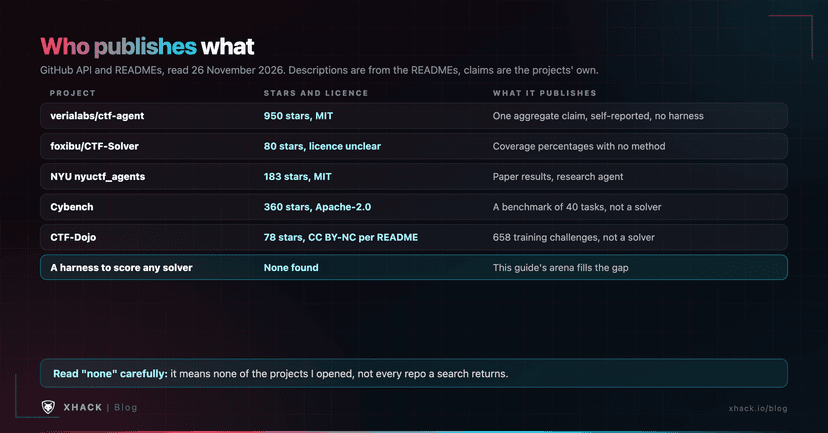
The gap is clear. Benchmarks such as Cybench and CTF-Dojo measure models, and solver repos advertise results. Nobody ships a small, runnable harness that takes any solver, runs it on the same challenges, and prints a per-category scoreboard with time and wrong submissions. That is what the arena below is.
I did not check every repo that a search returns, so read “none” as “none of the ones I opened”. I also did not verify the 52-of-52 claim, which comes from the repo’s own README.
The most reliable results are the ones with a defined task set and a human baseline. Four are worth knowing, and I read each source page or abstract myself.
The Hack The Box challenges were short and well-defined, and the AI teams did very well. The Cybench tasks were long and open-ended, and the unguided ceiling was low. SageCTF needed a custom system, hours per challenge and up to $200 on each one. The pattern is a gradient, and that is why the arena below mixes easy, medium and multi-step tasks.
The animation shows the Cybench spread on a time ruler, using only the two figures the abstract gives.
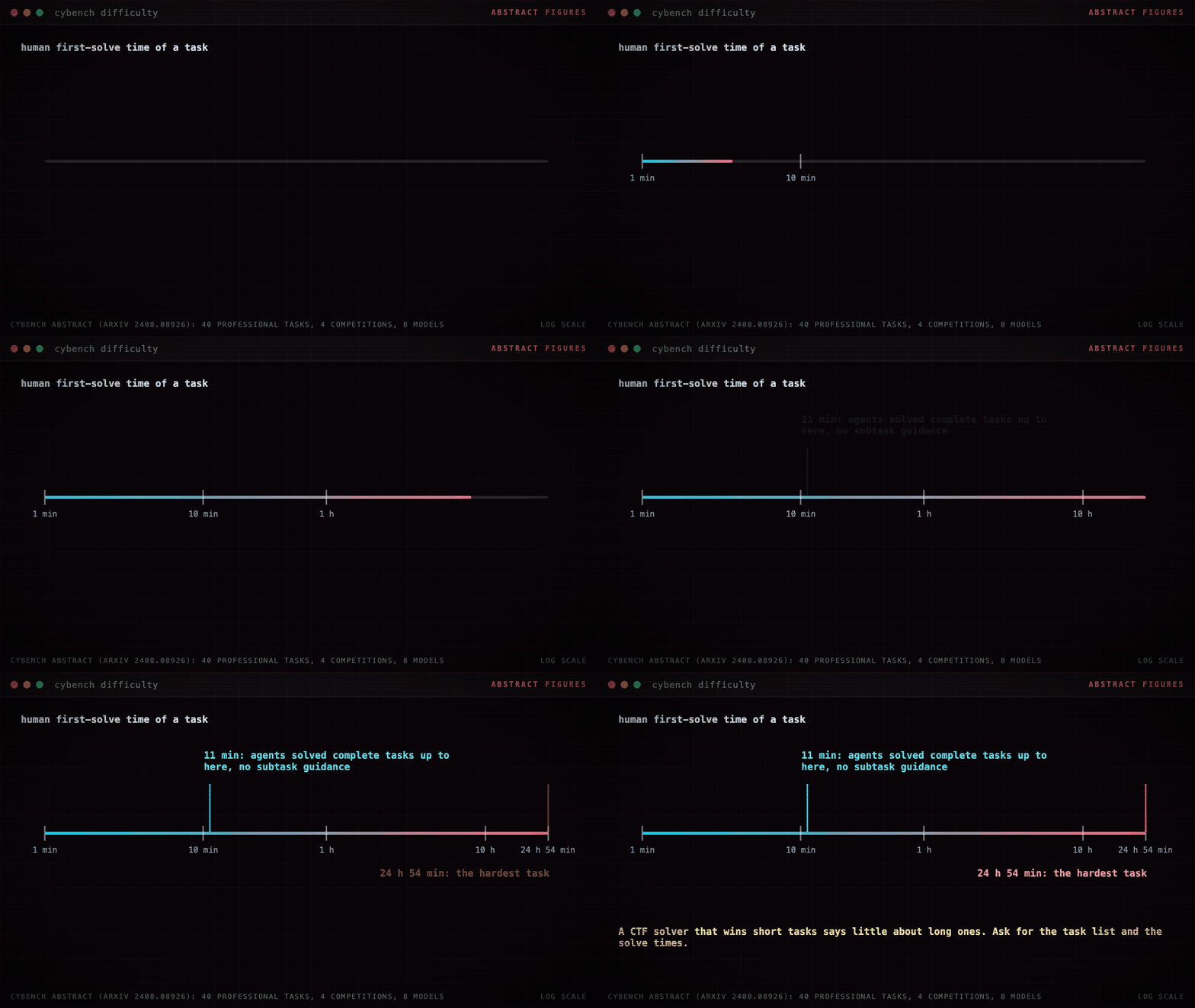
Difficulty is not one number for a CTF solver, because a challenge can be short and still need an idea. Human first-solve time is the best public proxy, and Cybench uses it. It rises with the number of steps, the amount of niche knowledge and how much trial and error the path needs.
Three things go wrong with a CTF solver as the time rises, according to the papers. The agent gives up early or hits a round limit, which NYU CTF Bench lists among its failure causes. It invents observations instead of running tools, which EnIGMA names soliloquizing. Or it misses one fact the challenge needs. SageCTF’s write-up describes a near miss on a reversing challenge where it recovered most of the pipeline but read the decoded bytes in the wrong display order.
For a buyer that means two things. A CTF solver that wins easy rounds says little about hard ones, and a result with no task list says nothing at all. Ask what the tasks were, how long humans took, and how many attempts the solver got.
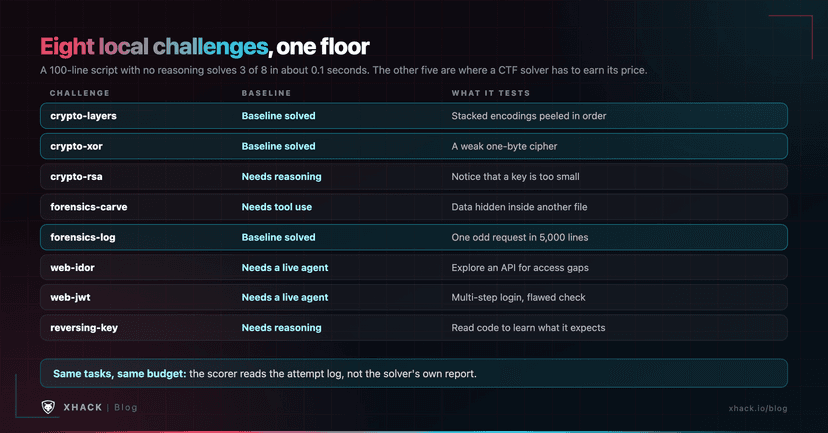
To compare solvers I built a small local arena, because a fair test needs the same tasks, the same budget and a checker the solver cannot fake. It has eight benign challenges that I made, each with a flag in the form XCTF{...}. Everything runs on your own machine.
| ID | Category | What the solver gets | What it tests |
|---|---|---|---|
| crypto-layers | Crypto | A text file | Spotting and peeling stacked encodings |
| crypto-xor | Crypto | A hex file | A weak one-byte cipher |
| crypto-rsa | Crypto | Numbers and ciphertexts | Noticing that a key is too small |
| forensics-carve | Forensics | A PNG file | Finding data hidden inside another file |
| forensics-log | Forensics | A 5,000-line web log | Finding one odd request in noise |
| web-idor | Web | A local site on port 8101 | Exploring an API for access control gaps |
| web-jwt | Web | A local site on port 8102 | A multi-step login flow with a flawed check |
| reversing-key | Reversing | A stripped arm64 executable | Reading code to learn what it expects |
Three design choices make it a fair test.
The flag checker is a script the solver can run but not read its way around. submit.py stores salted hashes, not flags, so reading it reveals nothing. It logs every attempt with a timestamp. The solver starts the clock with submit.py begin, then submits with submit.py <id> <flag> and sees only CORRECT or WRONG.
The solver sees only a public folder. The web servers, their source and the plaintext flags live outside it, and the servers listen on 127.0.0.1 only. A solver told to stay in the folder and on those two ports is working in the same conditions every time.
The scorer reads the log, not the solver’s own report. score.py prints, per challenge, whether it was solved, how many wrong submissions came first, and the seconds from the clock start. It also prints a per-category tally.
challenge        solved  wrong  seconds
crypto-layers    yes     0      0.1
crypto-xor       yes     0      0.1
crypto-rsa       no      0      -
forensics-carve  no      0      -
forensics-log    yes     0      0.0
web-idor         no      0      -
web-jwt          no      0      -
reversing-key    no      0      -
solved 3 of 8, wrong submissions 0, wall 0 s
by category: crypto 2/3, forensics 1/2, web 0/2, reversing 0/1
The arena builder is deterministic, so the same script writes the same files every time. Ten tests check that no plaintext flag appears in the public files, that the checker accepts only the right flag, and that the web servers behave. All ten pass.
A baseline sets the floor for any CTF solver, and the floor here is 3 of 8. baseline_solver.py is 100 lines of standard-library Python. For each file it searches for the flag, peels base64, hex and rot13 layers up to depth 4, decodes long base64-looking tokens, and tries every single-byte XOR key. It knows nothing about the challenges and opens no sockets.
It solved the layered encoding, the one-byte XOR and the log search, all in about 0.1 seconds. It solved nothing in web, nothing in reversing, and neither the RSA task nor the file-carving task.
That result is the useful part. If a CTF solver sold to you cannot beat a 100-line script on these eight, it is not adding reasoning. And any solver that solves the five the baseline misses is doing something a script cannot: noticing a key is too small, finding data inside a file, driving a web flow, or reading code.
Six numbers make a CTF solver comparable, and only the first needs a flag checker. Use the same tasks and the same budget for every solver you compare.
begin to the first CORRECT.Two cautions from the papers apply. EnIGMA measured data leakage, which means a challenge may be in a model’s training data, so use new or self-made tasks for anything you publish. And the scaffold around a model matters as much as the model, which is why Cybench compares four scaffolds, so test the whole solver, not just the model.
The rules vary from a flat ban to a dedicated track for agents, and you must read the one for your event. These are the policies I opened on 26 November 2026.
| Event | Policy | Source |
|---|---|---|
| LakeCTF | “You may not use Generative Artificial Inteligence (GenAI) or Large Language Model (LLM) technology of any form”, including agentic workflows | LakeCTF no-LLM page |
| Hack The Box Holmes CTF 2026 | AI allowed as a supporting tool, but using it as a primary solver is prohibited, and hosts may ask for a walkthrough | Holmes 2026 FAQ |
| CSAW Agentic Automated CTF | Agents must work without human intervention, and a submission includes full prompt and response logs | CSAW page |
| DEF CON CTF 2026 qualifiers | Reported to allow AI but not fully AI solving, per a secondary news source | Not an official rulebook, check it yourself |
I could not read picoCTF’s 2026 rules because the page returned an error, and I found no AI policy on CTFtime. Do not assume.
The practical rule for any CTF solver is the one in my AI for CTF guide: read the event’s rules before you start, ask the organisers if a rule is unclear, and keep the logs. A solver you use in practice on your own arena or on a lab you own breaks no one’s rules.
A CTF solver runs real tools, so treat it like any agent with a shell. Run it in a sandbox, keep it to the targets you are allowed to touch, and log what it does.
For a competition, the targets are the challenge servers the organisers give you. For practice, use labs you own, such as the arena in this guide, which listens on localhost only. Do not point a solver at a host you do not have written permission to test. It will not know the difference.
Keep one more habit. Read every flag the solver submits and check how it got there. A solver that submits a flag it never derived has guessed or leaked, and in a ranked event that can cost a team.
The common mistakes come from trusting a headline number. Here are the ones I see most.
The arena is built to be run against a real agent, and XHack’s agent is the worked example. The steps keep the run fair, with the same tasks and a flag checker the agent cannot read.
python3 build_arena.py, then copy the public arena/ folder to a fresh working folder and run python3 private/web_server.py & for the two web challenges. The salted flag hashes live in submit.py, which only prints CORRECT or WRONG.arena/README.md: stay inside the folder and ports 8101 and 8102, run python3 submit.py begin once, and submit with python3 submit.py <id> <flag>.python3 score.py <working folder>. It reads the attempt log, not the agent’s own report, and prints solved per category, wrong submissions, time to the first flag and wall time.Record the permission mode, the model setting and the date next to the scoreboard, and keep the attempt log. That is the evidence for any per-category number you quote.
The arena is small and mine, and the honest limits are these. Eight challenges cannot rank solvers finely, and I wrote the challenges, so a solver tuned on them will look better than it is. The baseline was written by me too, so a cleverer script could solve more.
Finally, one reversing challenge needs an arm64 Mac, and the arena was built and tested on macOS only.
So yeah, here is where I tell you what XHack brings, with the bias of someone who built it.
XHack combines three things most providers sell separately: expert human penetration testing, an autonomous AI agent and a continuous security operations platform. For CTF work the agent is the part you use, and I will be specific about what is and is not proven.
What I can say from my own use. I ran XHack’s agent through a live YesWeHack CTF challenge called Deadbolt, and it solved it autonomously in 3 minutes. The arena above is the lab for measuring it per category, and the steps are in the section before this one.
The tools a CTF needs are in the agent. It has a built-in browser, an HTTP repeater, sub-agents that run in parallel (12 by default), project memory, and a one-click mobile toolchain for APK and IPA tasks. Permission modes (Plan, Manual, Allow Edits, Auto) decide who approves each command, and destructive commands are blocked in every mode.
Privacy and control are built in. XHack does not store your user data and is privacy-focused by design. Your chats and session data stay on your own computer, you can delete them any time, and the agent can run on a local model so a challenge file never leaves your machine. Exploitation unlocks after identity verification, which suits events but means exploitation work waits for verification, while finding vulnerabilities works from the start.
Individual plans start at $20 a month (Starter $20, Professional $49, Elite $150), with a 7-day free trial. Run the arena against it and judge the scoreboard yourself. If you want testers on a real engagement instead, managed work starts at $2,500 at a fixed price. Book a free consultation, even if the answer turns out not to be us. Brutal honesty is kind of our thing.
A CTF solver is a program, usually an AI agent with tools, that reads a capture-the-flag challenge and tries to produce the flag. It reads the task, runs tools such as a decoder, debugger or HTTP client, reads the output and repeats. A good CTF solver also logs its steps and stops when its budget runs out.
There is no verified best CTF solver, because none of the popular ones publish a result you can reproduce. The leading repo, verialabs/ctf-agent, reports 52 of 52 at BSidesSF 2026, self-reported. Use a harness on the same tasks, and compare solved count, wrong submissions, time and cost per category.
No, and the public evidence shows a steep drop with difficulty. In Cybench, agents solved tasks that took humans up to 11 minutes, and the hardest task took humans 24 hours and 54 minutes. A CTF solver does best on short, pattern-based tasks.
It depends entirely on the event. LakeCTF bans all LLM use, Hack The Box Holmes 2026 allows AI as a supporting tool but not as a primary solver, and CSAW runs a track for autonomous agents. Read the rules before you start, and ask the organisers if they are unclear.
Yes, several open-source ones exist, and they differ a lot. verialabs/ctf-agent is MIT licensed and nyuctf_agents is MIT. Some tools only expose security tools to an assistant and do not solve anything alone. Free software still needs a model, and model calls cost money.
XHack’s agent is a general security agent that works well on CTF tasks, with a built-in browser, HTTP repeater and sub-agents. I ran it through a live YesWeHack CTF and it solved the challenge in 3 minutes, on one challenge. Chats and session data stay on your computer, and a 7-day free trial is available.
A CTF solver is worth trusting only as far as its test goes. Pick a few tasks, fix the budget, score per category with a flag checker the solver cannot read, and compare against a no-reasoning baseline. If a solver cannot beat a 100-line script on the easy five, it is not solving anything you could not script.
To start, build the arena, run the baseline and score your own solver. If you want an agent to try it, try XHack’s agent on challenges you own, and keep the scoreboard in your own hands.
Categories
Related articles