Table of contents
12
By Salman Khan, OSCP+, Founder of XHack, SRT (Synack Red Team member)
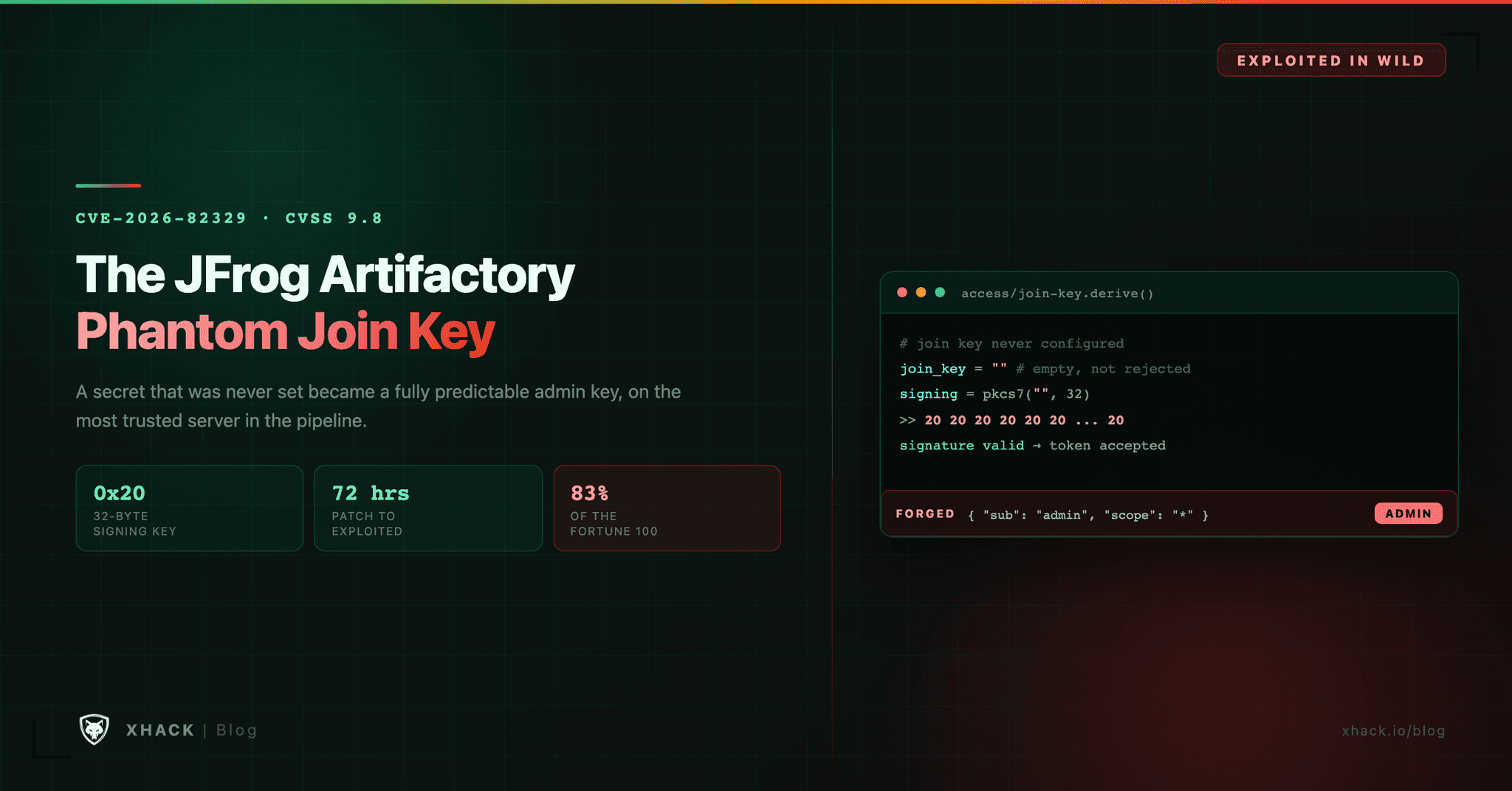
Read this in 30 seconds: CVE-2026-82329 is a critical authentication bypass in JFrog Artifactory, and it took attackers three days to go from patch to admin.
- CVSS 9.8, and the vector earns it. the CVSS vector is
AV:N/AC:L/PR:N/UI:N/C:H/I:H/A:H. Network-reachable, no credentials, no clicks, full read-write on your artifacts.- The bug is a secret that isn’t secret. Instances that never set a join key fall back to a “phantom” one researchers can reconstruct, and that key signs admin tokens.
- Patched August 28, exploited September 1. watchTowr saw attackers minting admin tokens and creating backdoor users within 72 hours. CISA added it to KEV on September 2.
- This is a supply-chain bug wearing an auth-bypass costume. Artifactory sits at the center of CI/CD for 83% of the Fortune 100. Admin there means you can swap trusted artifacts for malicious ones.
- The fix is a version bump, but only if you check for backdoor admins first. Patching a box that already has a planted admin user changes nothing.
A leaked password is bad. A secret that was never secret in the first place is worse, because there is nothing to leak and nothing to rotate.
That is the ugly heart of CVE-2026-82329. JFrog Artifactory signs its internal access tokens with a shared secret called the join key. Hold the join key, forge a token. Forge a token, forge an administrator’s token. And on a large number of self-hosted instances, that join key was never actually set to anything, which turns out to be a very different thing from “unknown.”
I have spent enough time inside build pipelines to tell you why this one stings more than a typical CVSS 9.8. Artifactory is not an app on the edge. It is the thing every other system trusts.
Artifactory runs a component called JFrog Access that handles authentication and issues tokens. When several Artifactory nodes cluster together, they trust each other using a join key, a shared secret that proves “I am part of this deployment.” Anyone holding that key can mint a valid signed token, including a token that claims to be the built-in admin.
The vulnerability is in the fallback. On instances where an operator never explicitly configured an additional join key, the system does not fail closed. It falls back to what researchers analyzing CVE-2026-82329 named a phantom join key: a value the product derives on its own, without a human ever choosing it.
The problem with a machine-derived secret is that anyone who knows the derivation knows the secret. There is no entropy to guess. An unauthenticated attacker on the network reconstructs the phantom key, signs an access token that says admin, and Artifactory validates it happily, because the signature checks out against a key the attacker just rebuilt from scratch.
That is the whole bug. No password spray, no memory corruption, no race condition. Just a secret that was hiding in plain sight.
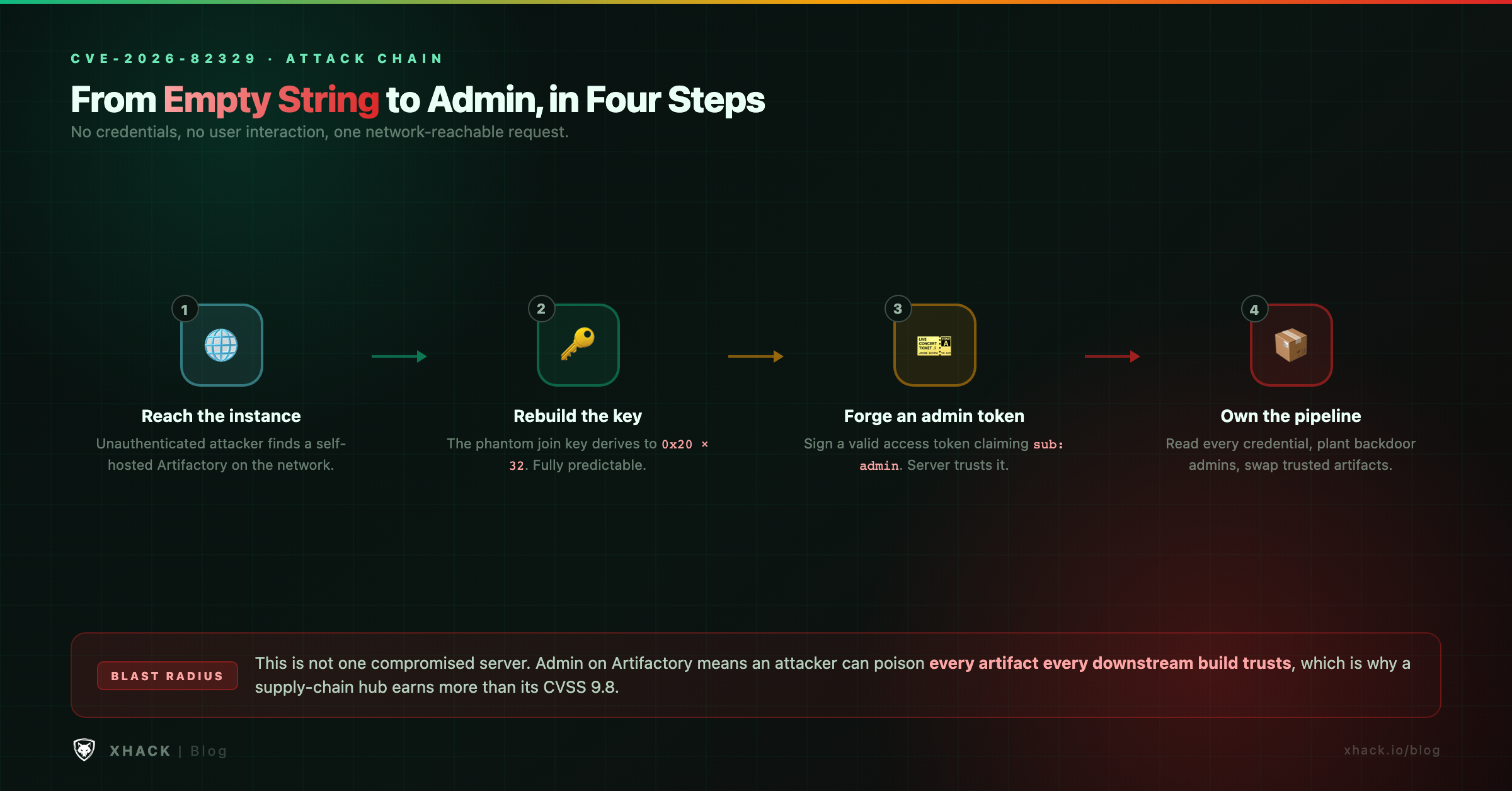
Here is the part that should make every engineer wince, and it is a lesson worth more than the CVE itself.
Per the technical analyses that reconstructed CVE-2026-82329, the vulnerable versions accept an empty string as a valid join key. An empty secret is not treated as “no secret, refuse to sign.” It is treated as a real key of zero length, and then it gets run through the normal key-derivation path anyway.
Cryptographic key derivation pads its input to a fixed block size. Pad an empty input to 32 bytes using PKCS#7 and you do not get randomness. You get 32 copies of the same byte, because PKCS#7 fills the space with the padding length itself. Here is the concept, not a weapon:
# Illustrative: why an empty join key is catastrophic.
# PKCS#7 pads to the block size using the pad-length as the fill byte.
def pkcs7_pad(data: bytes, block: int = 32) -> bytes:
    pad_len = block - (len(data) % block)
    return data + bytes([pad_len]) * pad_len

derived = pkcs7_pad(b"")     # empty join key
print(derived.hex())
# 2020202020202020...2020   -> 32 bytes of 0x20, fully predictable
Thirty-two bytes of 0x20. A signing key with zero secrecy, identical on every affected instance that never set a join key. Once you know the key, forging the admin token is just standard token signing, which is exactly why I am not going to print that half. The point is the failure of reasoning: empty was accepted where “impossible” should have been enforced.
I have written before about how supply-chain trust collapses when one link is poisoned. This is the same shape, one layer down. The link here is the secret that the entire authentication system rests on.
Admin on Artifactory is not admin on one app. Artifactory stores and distributes your binaries, containers, packages, and increasingly your AI models. It is used by over 6,600 organizations, including 83% of the Fortune 100. When it says an artifact is trusted, every downstream build believes it.
So with a forged admin token, an attacker exploiting CVE-2026-82329 can:
That last point is why I rank this above a normal CVSS 9.8. Most critical bugs compromise a system. This one compromises everything that system vouches for.
The speed of CVE-2026-82329 is the story, so keep this sequence in mind the next time someone argues a patch can wait for the maintenance window.
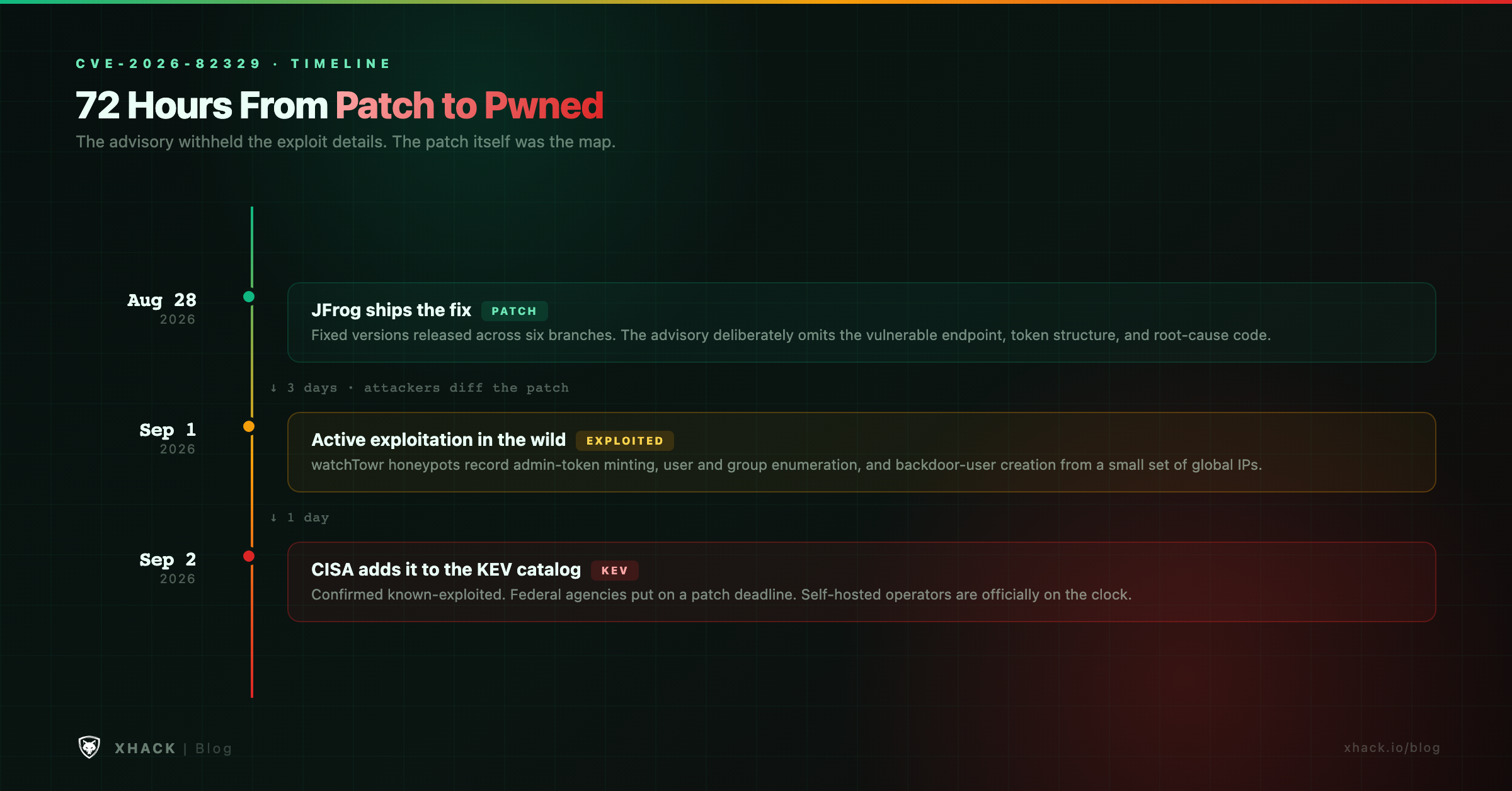
Attackers reverse-engineered a patched, undocumented auth bypass and weaponized it in three days. The advisory hid the details on purpose. It did not matter, because the fix itself was a map to the flaw.
CVE-2026-82329 hits self-hosted Artifactory only. JFrog Cloud (SaaS) instances were remediated by the vendor. If you run your own, act in this order.
1. Check your version. Anything in these branches below the fix is vulnerable:
# Artifactory prints its version at an unauthenticated endpoint
curl -s https://YOUR-ARTIFACTORY/artifactory/api/system/ping
curl -s https://YOUR-ARTIFACTORY/artifactory/api/system/version | grep -i version
Fixed versions: 7.161.20, 7.146.38, 7.133.29, 7.125.20, 7.117.28, 7.111.21. Upgrade to your branch’s fix or later. This is the only real remediation. There is no config-only mitigation that beats patching, because the flaw is in how the secret is handled, not in a setting you can flip.
2. Assume compromise if you were exposed and unpatched between August 28 and your upgrade. Then hunt for what the attackers actually did:
3. Rotate everything Artifactory could see. Any credential stored in or reachable from Artifactory should be treated as burned. That includes the join key itself, now that you know what it should never be.
Quick and honest, because this is a news piece, not a pitch. When a patch like CVE-2026-82329 drops with the mechanics withheld, the winning move is to treat the patch as the disclosure, the same way watchTowr did. That is exactly the kind of work the XHack AI agent is built to accelerate: diff the fixed and vulnerable versions, reason about the changed authentication path, and generate a detection check for your own estate, with a human verifying before anything ships. Findings feed the SOC dashboard so an exposed, unpatched Artifactory gets flagged as an active risk, not a line item for next quarter. Your data stays on your machine while you do it. That is the part that matters when you are investigating your own build pipeline.
CVE-2026-82329 is a critical authentication bypass in self-hosted JFrog Artifactory, rated CVSS 9.8. Under default configurations where no additional join key was set, an unauthenticated attacker on the network can reconstruct a predictable “phantom” join key, forge a signed administrator access token, and take full control of the instance. JFrog patched it on August 28, 2026, and active exploitation began three days later.
If you run self-hosted Artifactory in versions 7.111.4 through 7.161.19 (across the 7.111, 7.117, 7.125, 7.133, 7.146, and 7.161 branches) and never explicitly configured a join key, you are affected. JFrog Cloud SaaS instances were remediated by the vendor. Check your version at the /artifactory/api/system/version endpoint and upgrade to the fixed release for your branch.
Look for administrator accounts you did not create, access tokens you cannot account for, and short bursts of enumeration across users, groups, and federation topology in your audit logs. watchTowr observed attackers creating backdoor admin users specifically to survive a simple token revoke, so patching alone is not enough. If you were internet-exposed and unpatched after August 28, hunt before you trust the box again.
Because Artifactory is a supply-chain hub. Admin access lets an attacker replace a trusted artifact with a malicious one, and every downstream build that pulls from Artifactory inherits the compromise while believing the package is legitimate. A single owned Artifactory can poison everything an organization ships, which is a far larger blast radius than compromising one application server.
CVE-2026-82329 is a clean lesson in a boring truth: the most dangerous secrets are the ones nobody chose. An empty join key felt like a non-configuration, a blank you would fill in later. Instead it was a fully predictable admin key sitting on the most trusted server in the pipeline.
Patch to your branch’s fixed version tonight if you self-host. Then, and this is the part people skip, go looking for the admin user you did not create. The attackers who moved in the 72-hour window were not there to knock. They were there to stay.
Categories
Related articles