
30-Second Summary: AI cybersecurity risk is now the SEC’s top examination priority for 2026, displacing cryptocurrency. NIST released its Cyber AI Profile in December 2025 mapping AI risks to the Cybersecurity Framework. The EU AI Act is phasing in enforcement through 2027. California, New York, and Colorado all have AI governance laws active or effective in 2026. Meanwhile, one third of organizations already experienced a cloud breach involving an AI workload in 2025.
Shadow AI costs $670,000 more per breach than traditional incidents. Cyber insurers are now requiring AI-specific security controls for coverage. If your organization uses AI (and it does), AI cybersecurity risk is no longer an IT problem. It’s a board-level governance problem, and the regulatory window to get ahead of it is closing fast.
Most executive teams treat AI as a productivity tool and cybersecurity as an IT budget line. In 2026, that separation is about to get very expensive.
Here’s the thing. AI cybersecurity risk sits at the intersection of two disciplines that most organizations manage completely separately. The AI team reports to the CTO or Chief Data Officer. The security team reports to the CISO. Neither team fully understands the other’s risk landscape. And the regulatory bodies catching up to this gap are not interested in your org chart as an excuse.
The SEC’s 2026 examination priorities shifted AI cybersecurity risk above cryptocurrency as the top concern. NIST published its Cybersecurity Framework Profile for Artificial Intelligence (NIST IR 8596) in December 2025, explicitly mapping AI risks to the six CSF 2.0 functions. The EU AI Act is phasing in obligations through 2027 with penalties up to 7% of global turnover. California, New York, Colorado, and Texas all have AI governance laws either active or taking effect in 2026.
And while all of this regulation is materializing, real AI-related breaches are happening right now. Not theoretical ones. Real incidents with real dollar amounts.
This article is for executives and board members who need to understand what AI cybersecurity risk actually looks like, why existing security programs don’t cover it, and what governance structures need to exist before regulators or attackers force the issue.
The AI Cybersecurity Risk Landscape in 2026
Let’s be real about what’s changed. AI is no longer an experimental tool sitting in a sandbox. It’s embedded in production workflows, vendor ecosystems, and customer-facing products across most industries. And every one of those integrations creates attack surface that traditional cybersecurity programs were never designed to assess.
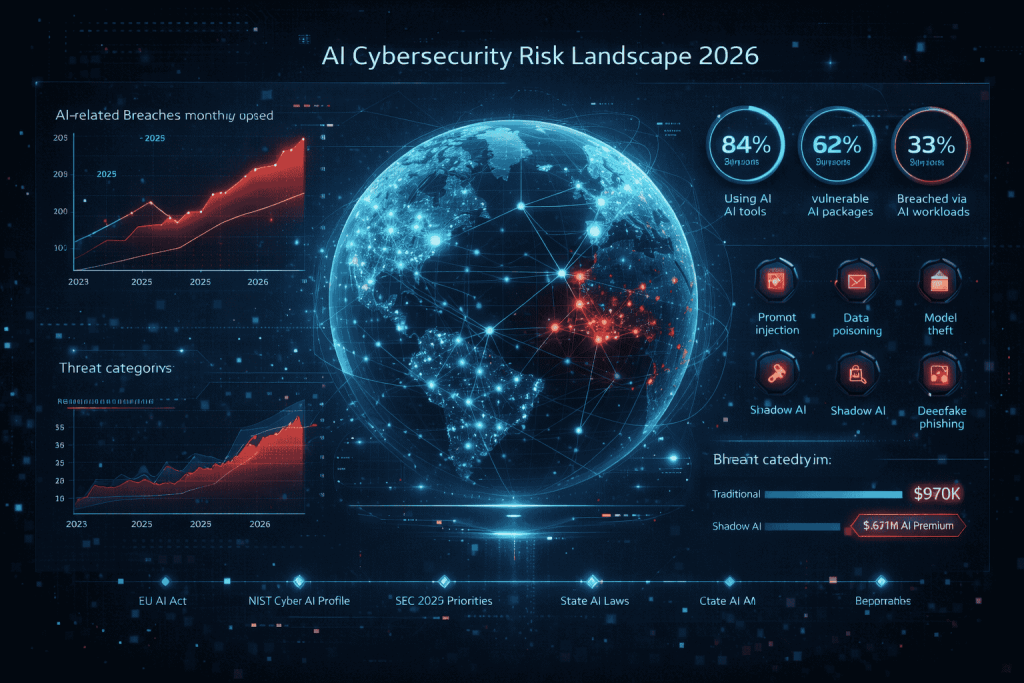
The Cloud Security Alliance reported that one third of organizations experienced a cloud data breach involving an AI workload in 2025. Of those incidents, 21% were caused by vulnerabilities in AI components, 16% by misconfigured security settings, and 15% by compromised credentials or weak authentication. Orca Security’s 2025 State of Cloud Security report found that 84% of organizations now use AI-related tools in the cloud, but 62% had at least one vulnerable AI package in their environments.
IBM’s 2025 Cost of a Data Breach Report found that shadow AI breaches (incidents involving unsanctioned AI tools employees connected on their own) cost an average of $670,000 more than traditional breaches. That premium exists because shadow AI creates data flows, access patterns, and third-party connections that security teams can’t see, can’t monitor, and can’t contain when something goes wrong.
The first widely reported zero-click AI vulnerability emerged in 2025 when researchers discovered EchoLeak, a prompt injection flaw in Microsoft Copilot that enabled data exfiltration from OneDrive, SharePoint, and Teams without any user interaction. No click required. No alert surfaced. The activity moved through approved Microsoft channels with zero visibility at the application or identity layers.
This is the AI cybersecurity risk landscape executives need to internalize: AI systems introduce attack vectors that operate at the semantic layer, not the network layer, which means traditional perimeter defenses, endpoint detection, and even SIEM platforms don’t catch them.
Why Existing Security Programs Miss AI Cybersecurity Risk
Your current cybersecurity program almost certainly has blind spots when it comes to AI. Not because your security team is incompetent, but because AI risks are structurally different from the risks those programs were built to address.
AI systems blur the boundary between data and code. In a traditional application, you have inputs, logic, and outputs. Each layer has established security controls. In an AI system, the “logic” is the training data itself. Poison the data, and you’ve changed the application’s behavior without touching a single line of code. Traditional vulnerability scanners, static analysis tools, and code review processes don’t detect this.
AI supply chains are ungoverned. Your developers are pulling open-source models from Hugging Face, fine-tuning them on internal data, and deploying them in production. How many of those models have been audited for backdoors? How many of those training datasets have been verified for integrity? In January 2025, researchers documented how hidden prompts in GitHub code comments poisoned a fine-tuned model, creating a backdoor that activated months later. The OWASP Top 10 for LLM Applications 2025 explicitly calls out data poisoning and supply chain vulnerabilities as top risks.
AI agents have permissions that traditional security models don’t account for. When you give an AI assistant read access to your CRM, email system, and document repository, you’ve created a single identity with cross-system access that can be manipulated through prompt injection rather than credential theft. NIST’s January 2026 RFI on AI agent security specifically called out the risk of “agent hijacking” as a confirmed research finding.
Shadow AI is everywhere. Employees are connecting AI tools to corporate systems without IT approval because those tools make them more productive. Each unsanctioned connection creates data exfiltration paths, third-party trust relationships, and compliance exposure that nobody is tracking. The Verizon 2025 DBIR showed that third-party involvement in breaches doubled year over year. AI integrations are accelerating that trend.
The Regulatory Landscape: What’s Already Enforceable
The regulatory response to AI cybersecurity risk is no longer “coming soon.” Multiple frameworks are already active or entering enforcement phases in 2026.
NIST Cyber AI Profile (NIST IR 8596). Released in December 2025, this maps AI cybersecurity risk to the CSF 2.0 framework across three focus areas: Secure (protecting AI systems), Defend (using AI to enhance cybersecurity), and Thwart (blocking AI-enabled attacks). It’s organized across all six CSF functions: Govern, Identify, Protect, Detect, Respond, and Recover. Over 6,500 individuals contributed to its development. While voluntary, it’s becoming the baseline that auditors, regulators, and insurers reference.
NIST AI Risk Management Framework. Published in 2023 and currently being revised per the AI Action Plan, this provides the broader AI risk taxonomy. The companion Generative AI Profile (released 2024) adds specific controls for GenAI deployments. Together with the Cyber AI Profile, these documents form the most comprehensive government guidance on AI cybersecurity risk management available today.
EU AI Act. Phasing in enforcement through 2027. Prohibited AI practices had to cease by February 2025. General-purpose AI model obligations took effect August 2025. High-risk AI system requirements (including those in financial services) apply by August 2026. Penalties reach up to 35 million euros or 7% of global turnover. The European Commission’s November 2025 “Digital Omnibus” proposal consolidates AI Act requirements with DORA, NIS2, and GDPR reporting, creating a single incident reporting point.
U.S. State Laws. California’s Transparency in Frontier AI Act (SB 53), effective January 2026, requires safety and security protocols including cybersecurity measures to protect model weights. New York’s RAISE Act establishes safety and governance obligations for frontier AI developers. Colorado’s AI Act, taking effect mid-2026, covers high-risk AI systems making “consequential decisions.” Texas’s Responsible AI Governance Act also went live January 2026. Industry estimates suggest compliance costs add approximately 17% overhead to AI system expenses.
SEC Enforcement. The SEC’s 2026 examination priorities explicitly elevated AI and cybersecurity above cryptocurrency. The Investor Advisory Committee recommended enhanced disclosures on how boards oversee AI governance as part of managing material cybersecurity risks. AI has shifted from “emerging fintech” to a clear area of operational risk linked to cybersecurity, disclosures, and internal use for critical functions.
Cyber Insurance. Insurers are now requiring AI-specific security controls as prerequisites for coverage. Wilson Sonsini’s 2026 AI regulatory preview noted that carriers have begun introducing “AI Security Riders” requiring documented evidence of adversarial red-teaming, model-level risk assessments, and specialized safeguards. Alignment with recognized AI risk management frameworks is becoming a baseline for “reasonable security” in underwriting.
What AI Governance for Cybersecurity Actually Looks Like
So what does an organization actually need to do? The NIST Cyber AI Profile provides the most actionable framework. Here’s what it translates to in practice.
AI asset inventory. You can’t secure what you can’t see. Maintain a complete inventory covering models (commercial and open-source), AI agents, API keys, datasets and their metadata, embedded AI integrations, and the permissions granted to each. Map end-to-end AI data flows to support boundary enforcement and anomaly detection. This sounds basic. Most organizations can’t do it. Start here.
AI-specific risk assessments. Extend your existing risk assessment process to cover AI-specific threats: prompt injection, data poisoning, model theft, adversarial attacks, and training data leakage. The OWASP Top 10 for LLM Applications 2025 provides a practical taxonomy. Don’t treat this as a one-time exercise. AI risks change with every model update, fine-tuning run, and new integration.
Supply chain governance for AI. Extend vendor risk management to cover model and data supply chains. Require AI-specific terms in contracts. Conduct AI-relevant due diligence on model providers. Verify the provenance and integrity of training data with the same rigor you apply to software and hardware supply chains. Include key AI suppliers in your incident response planning.
Access controls for AI systems. Apply least-privilege principles to AI agents with the same rigor you apply to human users. Implement token lifecycle management, dynamic authorization policies, and session isolation for AI assistants. If your AI copilot has broader access than your most privileged human user, that’s a governance failure, not a feature.
Shadow AI policy and enforcement. Establish clear policies on which AI tools are approved, how they can connect to corporate systems, and what data they can access. Monitor for unsanctioned AI integrations the same way you monitor for unauthorized SaaS applications. The $670,000 premium on shadow AI breaches makes the ROI on this governance investment obvious.
Board-level reporting. AI cybersecurity risk needs to appear in board reporting alongside traditional cyber risk metrics. The SEC is explicitly looking for evidence that boards oversee AI governance as part of cybersecurity risk management. If your CISO can’t articulate your organization’s AI risk posture to the board, that gap needs to close before your next examination.
The Three AI Cybersecurity Risk Categories Every Executive Should Know
NIST’s Cyber AI Profile organizes AI cybersecurity risk into three overlapping focus areas. Every executive should understand all three.
Secure: Protecting Your AI Systems. This covers threats to the AI systems your organization builds or deploys. Adversarial attacks on model integrity (data poisoning, prompt injection). Theft of model weights and training data. Unauthorized access to AI APIs and inference endpoints. Vulnerabilities in AI infrastructure (model serving frameworks, vector databases, MLOps pipelines). CSO Online reported that critical RCE vulnerabilities were found in major AI inference frameworks from Meta, Nvidia, and Microsoft throughout 2025.
Defend: Using AI for Cybersecurity. This covers how you leverage AI to enhance your security operations. AI-powered threat detection, automated incident response, predictive risk forecasting, and adversarial simulation. The risk here is that AI-enhanced security tools themselves become attack targets. If your SIEM’s AI model is poisoned, it might suppress alerts for the exact attack patterns it was trained to detect.
Thwart: Blocking AI-Enabled Attacks. This covers how you defend against adversaries using AI. AI-generated phishing at previously impossible scale and quality. Deepfake-based social engineering. Automated vulnerability discovery. AI-assisted malware that adapts to defenses. Researchers documented an attack campaign (GTG-1002) in 2025 where AI systems automated most operational steps of the attack lifecycle. Your security awareness training, authentication controls, and detection capabilities all need to account for AI-enhanced attacker tradecraft.
What Happens If You Do Nothing
The consequences of ignoring AI cybersecurity risk governance are converging from multiple directions simultaneously.
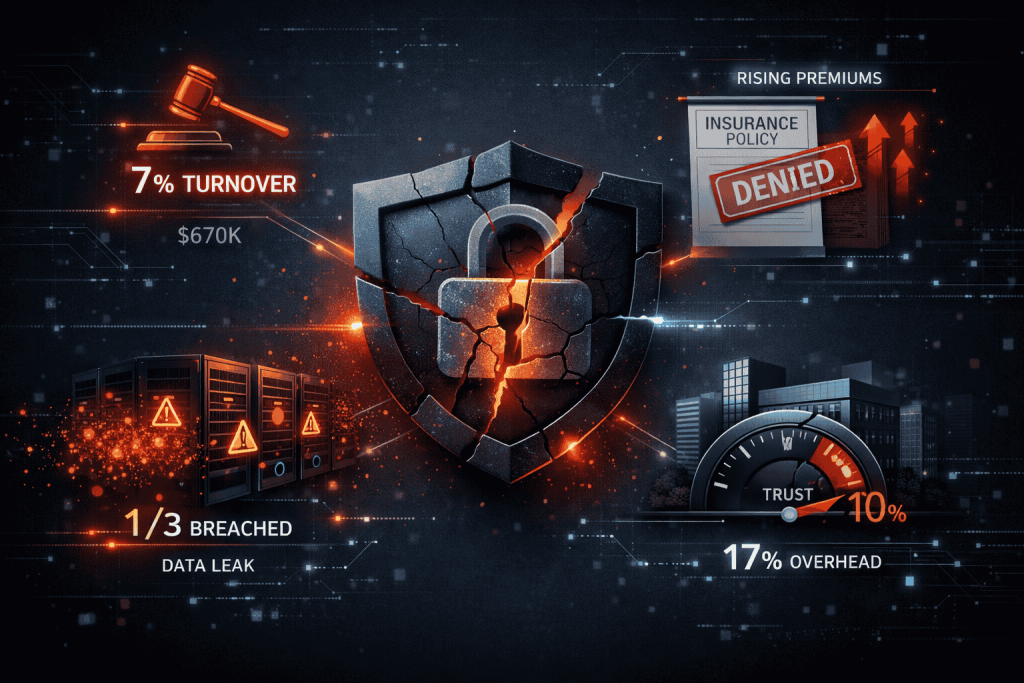
Regulatory. EU AI Act penalties reach 7% of global turnover. SEC examinations are actively looking at AI governance. State-level enforcement is accelerating. The compliance cost of catching up reactively is significantly higher than building governance proactively.
Insurance. Carriers are conditioning coverage on AI-specific controls. Organizations without documented AI risk management may find themselves uninsurable for AI-related incidents, or paying substantially higher premiums.
Operational. One-third of organizations already experienced AI-related cloud breaches in 2025. Shadow AI is creating invisible attack surface. The longer AI systems operate without governance, the more technical debt accumulates in the form of unaudited models, ungoverned data flows, and unmonitored integrations.
Reputational. When (not if) an AI-related incident occurs, the first question regulators, insurers, and customers will ask is what governance was in place. “We didn’t realize AI needed its own security controls” is not an answer that ages well.
The Bottom Line
AI cybersecurity risk isn’t a subset of your existing cybersecurity program. It’s a fundamentally different risk category that requires dedicated governance, specific technical controls, and board-level visibility.
The good news: the frameworks exist. NIST’s Cyber AI Profile, the AI RMF, the OWASP Top 10 for LLM Applications, and ISO 42001 provide actionable guidance. The regulatory expectations are clear and getting clearer. The technical controls (AI asset inventory, supply chain governance, access management for AI agents, shadow AI monitoring) are implementable with existing security infrastructure.
The bad news: the window to get ahead of this proactively is closing. The SEC is already examining. The EU AI Act is already enforcing. Insurers are already conditioning coverage. And attackers are already exploiting the gaps.
Start with the AI inventory. Extend your risk assessments to cover AI-specific threats. Get AI cybersecurity risk into your board reporting. Build from there.
The organizations that treat AI governance as a cybersecurity imperative (not just a compliance checkbox) will be the ones that capture AI’s benefits without absorbing its full risk. Everyone else will learn the hard way that ungoverned AI is the most expensive kind.
FAQ
What is AI cybersecurity risk and why should executives care?
AI cybersecurity risk refers to the security threats introduced by AI systems your organization uses, builds, or is exposed to. This includes attacks against your AI systems (data poisoning, prompt injection, model theft), risks from AI-enhanced attacker capabilities (AI-generated phishing, deepfakes, automated exploitation), and governance gaps created by unsanctioned AI usage. Executives should care because the SEC has made AI governance a 2026 examination priority, cyber insurers are conditioning coverage on AI security controls, and the average shadow AI breach costs $670,000 more than traditional incidents. It’s no longer an IT issue. It’s a board-level risk.
What frameworks exist for managing AI cybersecurity risk?
The primary frameworks are NIST’s Cybersecurity Framework Profile for AI (NIST IR 8596, released December 2025), the NIST AI Risk Management Framework (AI RMF, with a Generative AI Profile), the OWASP Top 10 for LLM Applications 2025, and ISO 42001 for AI management systems. The EU AI Act provides legally binding requirements phasing in through 2027. In the U.S., state laws in California (SB 53), New York (RAISE Act), Colorado (AI Act), and Texas (RAIGA) establish specific governance obligations. NIST’s Cyber AI Profile is particularly useful because it maps AI risks directly to the widely adopted CSF 2.0, making it actionable for organizations already using that framework.
Where should an organization start with AI governance for cybersecurity?
Start with an AI asset inventory: catalog every AI model, agent, API key, dataset, and integration your organization uses, including shadow AI. Then extend your existing risk assessment process to cover AI-specific threat categories (prompt injection, data poisoning, supply chain compromise, shadow AI). Apply least-privilege access controls to AI agents. Establish clear policies on approved AI tools. Get AI cybersecurity risk metrics into board-level reporting. The NIST Cyber AI Profile’s priority ratings (High, Moderate, Foundational) can help sequence your efforts. Most organizations find that just completing the inventory reveals governance gaps they didn’t know existed.
Follow Us on XHack LinkedIn and XHack Twitter